Give me shelter


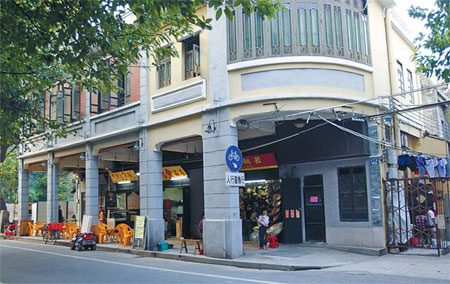
| Qilou is a straddling building with its ground floor opening for public access and upper floors reserved for residence (top). Walking along stores and restaurants inside a qilou offers a unique experience (above). Photos Provided to China Daily |
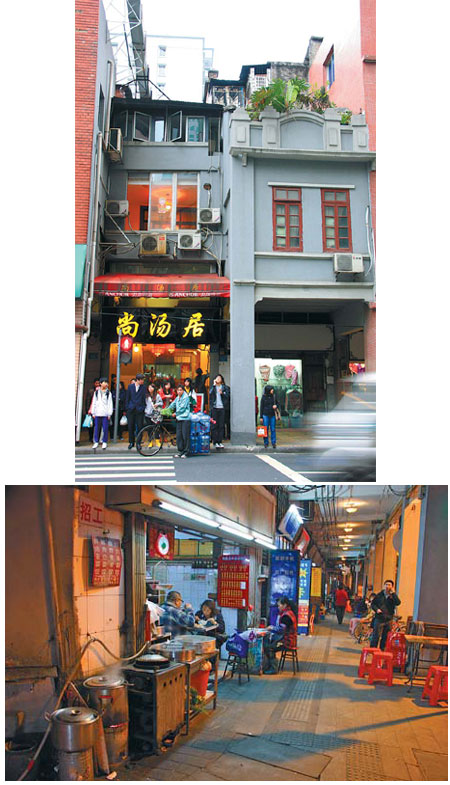
| Qilou on the commercial Shangxiajiu Street is a must-go when sightseeing in Guangzhou. Zou Zhongpin / China Daily |
Guangzhou's qilou structures started as a pragmatic solution to dodge bad weather but have ended up becoming an architectural fingerprint that makes locals proud, Raymond Zhou finds.
I didn't realize the beauty of Guangzhou's qilou until a recent rainy day when I was caught in a rainstorm in Beijing and had to find temporary shelter at the entrance of a residential hotel. It has a covered patio that serves as a doorway. Usually, it is the place where people pause for a second before proceeding into the premise or onto the street. That day, a bunch of pedestrians huddled there, not knowing how long we would need to stay put to stay dry.
Seeing no sign of the rain abating, the concierge asked us to leave, saying this is a private property and we were blocking the way of their patrons. So, without umbrellas or raincoats, we had to step into the precipitation. If this were Beijing Road in Guangzhou, I thought to myself, nobody would have driven me away.
When I first lived in Guangdong's provincial capital as a graduate student in the 1980s, Beijing Road was the retail center that drew huge crowds every day.
As is typical of the local weather, rainstorms would lash the city without warning, except perhaps a crash of thunder minutes before the downpour. Pedestrians would vanish into the buildings that flank the street, but they could still do their window-shopping and go from one end of the street to the other.
Literally, qilou is a straddling building. You can see it as the ground floor opening for public access, or a sidewalk which is topped with higher floors.
Not the whole ground floor, mind you, just the width of a small store or that of a walkway. I never figured out whether that is public or private property, but whoever the owner is, he or she does not mind you lingering.
Qilou feels like a roofed corridor. You are shielded from the elements, yet you retain the sense you're part of the hustle and bustle of the street.
As shops place some of their merchandise outside the door and onto the qilou, you also feel you are walking along aisles of a store, of course not as neatly stacked as in a supermarket, but no less diverse in assortment. There are also small vendors who set up shop exclusively inside the qilou, offering knickknacks and knockoffs for impulse purchase.
Qilou is supported with thick columns, onto which are posted the ubiquitous flyers and leaflets.
Nowadays, these have become the target for cleanup, and the columns are restored the majesty of their old days. If you bother to step out of the qilou and look at the whole building, you'll find it usually has a somewhat Western style.
That is because the architectural form was a product of urbanization in the early 20th century.
When Guangzhou removed its city walls in 1918 and built its first modern streets, it introduced qilou buildings along them. Its popularity after first appearing on Yide Road led to it being replicated throughout the city.
Despite its relatively short history, there are many theories about the origin of qilou. The most convenient cites the inflow of overseas Chinese who returned from Southeast Asia, and qilou was one of the exotic styles they brought back.
Others point to Mediterranean architecture, with its verandah, as the ultimate origin of qilou.
Many architectural styles feature a roofed deck that surrounds the main building, but the Mediterranean one is used for functions similar to those in Guangzhou, which has hot and humid weather.
However, it is in Guangzhou that it turned into a customer-friendly attraction that characterizes its retail businesses. Not only do three or four-story structures have built-in qilou, but also high-rises like the 64-meter Aiqun Mansion - a hotel that opened in 1937 - incorporate the open walkway on the ground floor.
If you've visited the hinterlands of Southeast China, you know that people who live in similar weather often come up with similar designs for their living quarters.
In some ethnic villages, the first floor is often left vacant. Some use it for storage or to shelter animals, but they always remove much of the wall for better ventilation.
Like these ancient village huts, qilou's upper floors are reserved for residence.
No matter how noisy or grubby below, those living above seem to be detached from the din of the world.
Actually, in the old days, the stores usually had workshops right at the back, so a whole family could live on the second floor, produce merchandise at the back of the ground floor and sell them at the qilou-front shop.
For similar reasons, qilou can be found in Hong Kong, and Hainan and Fujian provinces.
But many of the buildings have given way to relentless waves of modernization.
Even in Guangzhou, residents were shocked that qilou were disappearing at an alarming rate that the call rose to preserve it as an architectural heritage.
Nowadays, you can spend a whole day in a shopping mall, unaware of the vicissitudes of Mother Nature and shrouded by amenities like air-conditioning.
That makes qilou seem like the tentative first step toward modernization - somewhat like the architectural equivalent of the bicycle.
Sure, we have buildings that allow us to control every minutia. But, strangely, we long for the days when we found an ad-hoc sanctuary from nature's wrath.
In a qilou passageway, you won't get drenched, but you can still feel the wind, and even droplets of the torrents outside would waft in.
You get an impression you're taunting nature as nature taunts you.
In other words, you feel you're still in Guangzhou instead of some nondescript bomb shelter-like venue totally out of touch with the environment.
Contact the writer at raymondzhou@chinadaily.com.cn.
(China Daily 10/11/2012 page19)