History under a new light


A trilogy of historical drama presents situations seemingly remote from our daily lives but with haunting resonance.
There is a gallery of assassins in Records of the Grand Historian, China's best-known history book, which is over 2,000 years old. Playwright Xu Ying did not pick Jing Ke, the most often retold of them all, but "the most extreme one" in his eyes.
Yu Rang, a member of Minister Zhi Bo's coterie in the Kingdom of Jin, sets as his mission to kill Zhao Xiangzi because Zhao has killed Zhi during a military campaign. Yu is repeatedly thwarted in his plot against Zhao but set free by Zhao who appreciates his loyalty to his slain employer. Loyalty drives revenge, but what is the fundamental cause for Yu's loyalty?
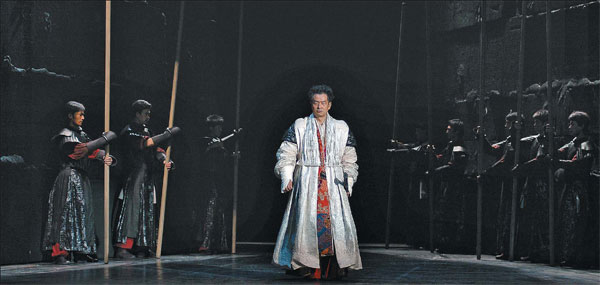
| Pu Cunxin, arguably the reigning king of Chinese stage, plays Zhao Xiangzi. Provided to China Daily |
| Gao Yalin plays Yu Rang, a member of Minister Zhi Bo's coterie in the Kingdom of Jin. |
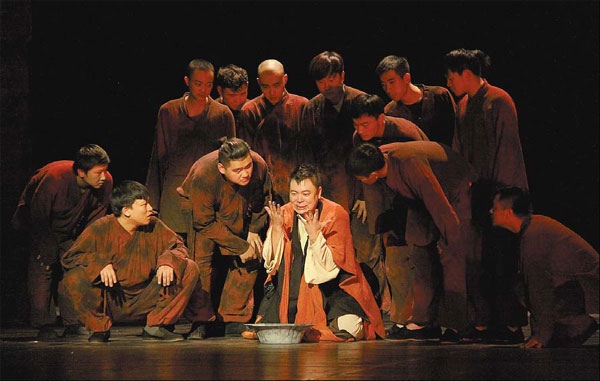
Yu offers the ultimate rationale, which has now become a familiar refrain of the Chinese lexicon: "One dies for someone who understands him." Yu's employer, or patron, not only understood him, but treated him with respect. In a rigid hierarchy where equality is non-existent, it is something of a marvel indeed.
What complicates the matter is the target of Yu's revenge. Whether in history or in this dramatic retelling, Zhao is not a tyrant. As embodied by Pu Cunxin, arguably the reigning king of Chinese stage, Zhao, despite his streak of arrogance, is prone to bouts of forgiveness. Even when he commits an act of violence, he tends to be soul-searching, concerned with his image as a king in the public eye.
Questions both Zhao and the audience want to ask of Yu: Zhi was not Yu's first patron, but replaced him in a similar twist that killed him. Why was Yu willing to be Zhi's protege, but not Zhao's? Doesn't Zhao treat him with enough respect as well?
The fascination of Xu's play lies in the ambiguity. The main character of Yu Rang can be read in many ways, as a symbol of loyalty or one of blind loyalty, or someone who is obsessed with the notion of loyalty.

"What I want to show is the paradox in Yu Rang," explains Xu Ying the playwright. "Yu is fully aware that he is defending the honor of a bad politician and attempting to assassinate a good one. But he uses a standard higher than what we know in the mundane world. Specifically, it is 'yi', which is not exactly the same as 'zhong (loyalty)'. Politicians of that era work from court to court, kingdom to kingdom, without a sense of betrayal. 'Yi' is more like faith, but not in a religious connotation. It could be faith in a person and it requires the ultimate sacrifice if necessary."
Xu believes that director Lin Zhaohua deliberately blended the two concepts to drive home a point that is poignant in modern China, and a personality defect at the heart of the tragedy. But the real tragedy, he insists, is at a spiritual level.
The Assassin (Cike) is one in a trilogy of Xu's historical dramas based on the legends of the Spring and Autumn Period (770-476 BC). The other two tales are better known and therefore display more vividly Xu's brilliance in distilling historical episodes for the stage. The Counsel (Menke), a.k.a. The Orphan of Zhao, has a sharp focus on the orphan as a grownup who casts in doubt the notion that he is obligated to carry on the task of avenging his family, killed when he was but an infant. It is almost the flip side of The Assassin when tackling the subject of retribution. While most adaptations, including Chen Kaige's 2010 film version, elaborate on the gesture of sacrifice whether it is an honorable thing or an act of anti-humanitarianism to give up one's own child for the survival of a royal descendant Xu chose a less examined but more challenging angle: The royal orphan grew up with the nemesis of his blood relations, but they have been living like father and son.
Can he switch his loyalty as soon as he learns the truth? What if he refuses to? Either way, he is a traitor - to his ancestral roots or to the only father he knows and probably loves.
The Emissary (Shuike) portrays Confucius as a traveling interventionist who intends to do good but often ends up with a wreckage of diplomatic failures. Unlike the ubiquitous depiction of Confucius as a saint who can do no wrong, the Master in this dramatization is downright human with no superpowers. He is more like a member of the contemporary intelligentsia who offers profound words on world affairs but lacks basic training in pragmatism.
There is a comic-tragic feel to the character that director Lin Zhaohua brought out into the treatment. Lin, a titan of stage direction, is responsible for two of Xu's plays, including The Assassin, while Yi Liming did The Counsel and another staging of The Emissary. The two productions of The Emissary were presented back to back, illustrating the two artists' different approaches yet at the same time establishing a link between them as the duo are often perceived as mentor and protege.
Xu Ying's lines are stylized, sometimes highly so, attaining an operatic grandeur. The stage direction is appropriately abstract, stripped of all superfluous details. Where both Lin and Yi depart from convention, they forfeit not only the familiar realism of Beijing People's Art Theater, where they once worked and are still associated with, but also the Peking Opera-style exaggeration often employed for period plays. There is a modernity in the staging that subtly corresponds to the complexity and relevancy in the texts.
Unlike traditional opera stories that cater mostly to the fan base, this trilogy is for the sophisticated of taste by asking tough questions and withholding easy answers. In that sense, it is Shakespearean in ambition if not in scale. The plays are taut, but they target the bull's eye and never pander to conventional wisdom in interpreting historical characters or events. They are quietly revolutionary.
The Assassin just finished a run at the National Center for the Performing Arts and will tour Tianjin on Nov 2 and 3. Both this one and The Emissary have toured Germany, and the whole trilogy is regularly revived, but often separately.
Contact the writer at raymondzhou@chinadaily.com.cn.
(China Daily USA 11/01/2013 page7)