Packing a punch


China's amateur boxers are top-class, and promoters are eager to develop the infrastructure that can make them champions at the professional level, Matt Hodges reports in Shanghai.
When Inner Mongolia's unheralded Wang Yingang brought Shanghai Fight Night to a chilling climax with a bloody fifth-round knockout earlier this month, he sent a statement of intent to the mostly expat crowd and sponsors like the Macao-based Cotai Ring Club.
These made-on-the-mainland fists of fury, Wang seemed to say, prove we Chinese can pack a killer punch. Combined with a decent defensive repertoire, they're game-changers. They can go all the way. Zou Shiming is not as good as it gets. What he symbolizes is a work in progress.
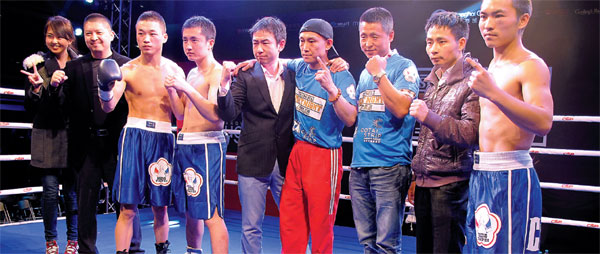
| Three pro boxers from China (blue shorts) pose with their coaches and friends in the ring during Shanghai Fight Night at Shanghai Center earlier this month. Photos by Matt Hodges / China Daily |
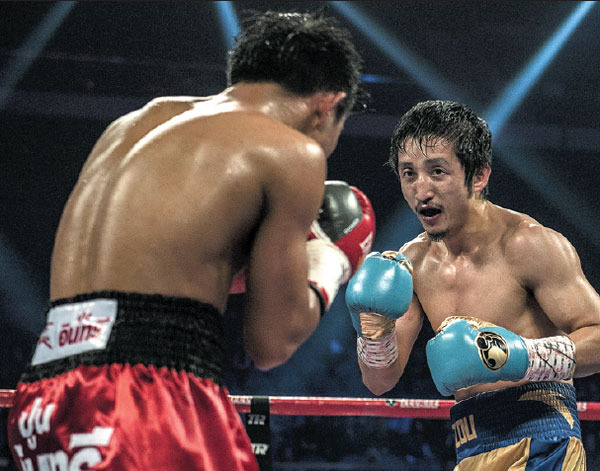
| Zou Shiming (right) fights with Yokthong Kokietgym of Thailand in their flyweight bout in Macao on Feb 22. Alex Ogle / Agence France-Presse |
Wang's tour-de-force professional win over odds-on favorite Ou Yuzhou suggested that Chinese can bring to Western boxing what Hong Kong action star Zhen Zidan (Donnie Yen) brings to the martial art of wushu: devastating, game-ending strikes.
"My goal is to become another Manny Pacquiao, and I'll fight any chance I get," the 24-year-old lightweight says from his training camp in Dalian, Liaoning province. He turned pro about a year ago.
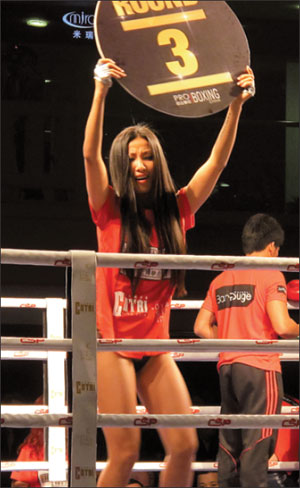
| A ring girl keeps the punters fastened to their seats midway through one of the bouts. |
If Zou doesn't prove to be the Yao Ming or Li Na of Western boxing in China, Wang hinted at the legions of understudies who are ready to pick up the mantle and take the sport's popularity to the next level.
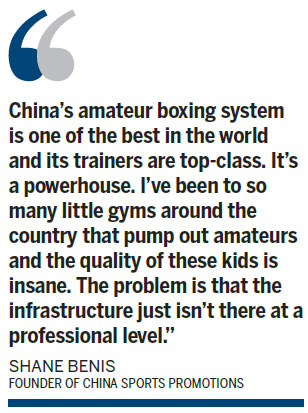
"China's amateur boxing system is one of the best in the world and its trainers are top-class," says Shane Benis, founder of China Sports Promotions, which organized the event. He also runs Shanghai-based Golden Gloves Gym.
"It's a powerhouse. I've been to so many little gyms around the country that pump out amateurs and the quality of these kids is insane," he adds. "The problem is that the infrastructure just isn't there at a professional level."
You've probably heard of Zou, the three-time world amateur champion with the lightning-fast feet and fists who debuted as a professional for Top Rank in 2013. He is scheduled to get a world title shot in Macao in November.
Meanwhile, the names of Wang and Yunnan's Yang Xinxin are unlikely to ring any bells just yet. Ditto for hundreds of other unpolished Chinese amateur and pro boxers who may have as much, if not more, potential than Zou but are hamstrung by a lack of professional coaching and bouts.
"It's still hard for these guys to get fights, and there aren't enough qualified professional trainers," Benis says. "The situation for them in China is still pretty dire."
Change in the wind
Things are moving, but perhaps not quickly enough. China officially joined the World Boxing Council recently, which was hailed as a milestone event. Another world governing body is reportedly now setting up a number of Chinese titles.
To drum up potentially lucrative interest in the sport in China, Benis organizes biannual "fight nights" in Beijing and Shanghai as well as white-collar-boxing events. He is expanding his reach to Taipei this October.
The third and most recent fight night took place on April 4 at Shanghai Center above Nanjing West Street, home to more foreign-brand "showrooms" than almost anywhere in the country. Nine pro boxers from China and Ryan Willis from the Philippines made up the five-bout card.
In a country where Western boxing was not considered kosher for decades, the event gave the boxers a pro fight, international exposure and an enthusiastic foreign crowd.
Several fighters in the blue corner, including Wang Yingang, had only spent a year training full time as pros at a camp in Dalian, they said.
At Friday's event, there were bloody noses, knockdowns, knockouts, upsets, controversial decisions, Eastern European ring girls and even a fairly convincing Las Vegas-style announcer - from Huddersfield, England.
It was less glamorous than the black-tie, white-collar events, and in a different league altogether from the kind of pay-per-view bouts staged at the Venetian Resort in Macao or the MGM Grand in Las Vegas.
There were no titles on the line or famous names on the card. Most tickets were standing-only. Beer and rum were served in plastic beakers. And the sole food concession was a kebab stand.
Moreover, due to the diminutive stature of some of the pugilists, and the flat response to Kung Fu Comedy star Butch Bradley's warm-up routine, it felt closer to "midget boxing" in Manila at times.
But there were hints of world-class potential. Wang proved the star of the show, but he wasn't the only one to cause a stoppage.
He bloodied Ou's face in round 3, then recovered from a ferocious pounding that saw him resort to clinching to buy time as he found his legs. A brutal right hook dropped Ou for the second time in the fifth - the saliva and sweat spraying out of Ou's mouth in almost 24-frame-a-minute slow-motion - before the ref stepped in to stop the fight.
"Ou is a really good fighter, exciting to watch and a real crowd-pleaser. He was the clear favorite," Benis says. "And Wang totally tore him apart."
Wang Yiming, 22, also registered a second-round knockout win, while Liu Yongcai, boasting movie-star good looks, hardly deserved to lose a unanimous decision to Ryan Willis of the Philippines. All three Chinese are teammates. Liu's corner later contested the result.
"I expose my team to high-intensity sparring every day to make them overcome their fears, feel the pressure of being in a real fight and hone their defensive skills," says Cui Di, who coached the two Wangs and several other blue-corner fighters on the April 4 card.
"Defense is normally the Achilles' heel of Chinese boxers."
Although Wang Yingang credits his early reliance on his defensive skills for setting up the win, it wasn't the Inner Mongolian's ducking, weaving and bunched fists that electrified the arena.
"I worked hard on building up those power punches," says the fighter, who extended his career record to 7-5-1 (6 KOs) by beating 27-year-old Ou. "I train harder than my teammates, usually for an extra two hours a day. Once a week I'll do a 10-hour overnight training sessions and force myself not to sleep."
According to Xiong Xin, a four-time Shanghai champion at 63.5 kg from 1996 and 1999, "the dream of becoming a world champion for fighters like Wang is now quite possible".
"The Chinese market is starting to grow as more professional fighting events are gradually being attracted from overseas," he says. "Chinese boxing needs someone like Yao Ming to fight in the world stage sooner or later."
The right stuff
China already has a professional world champion in the form of Xiong Chaozhong, but he's little-known outside the mainland.
Xiong beat Thailand's Lookrak Kiatmungmee last December in his home province of Yunnan to defend his WBO minimum weight title for the second time.
Other prominent names culled from the ranks of leading Chinese boxers include super heavyweight southpaw Zhang Zhilei, who won bronze at the world amateur championships in 2007, and silver at the Beijing Olympics one year later.
Zhang is now working with promoter Dino Duva, who wants to relocate him to the United States, so he can pair the fighter with a professional trainer there.
"I really, really believe there's much better professional prospects in China (than Zou) that are going to go much further, and cause much more impact as boxers in the professional ranks," Duva says.
"There's some really good boxers who are going to become champions from China over time, and I think I got the first stable of them."
According to Xiong, Chinese boxers are naturally fast but suffer due to their diet and training.
"More healthy eating habits and efficient training methods should be introduced from abroad so Chinese fighters can apply these to their speed and quick responses," he says.
The next generation
This was the situation that confronted Freddie Roach, who also coaches eight-division world champ Manny Pacquiao, when he began working with Zou at Top Rank.
Roach was able to iron out some of the Guizhou native's bad habits, including persuading the two-time Olympic gold medalist to stop curling his fists every time he threw a punch, according to media reports.
Such tweaking paid off in February, when Zou recorded his first career stoppage - in his fourth fight as a pro - by sending Thailand's Yokthong Kokietgym to the canvas three times in the decisive round.
But while Zou has improved considerably under Roach, at 32 even he admits he has a lot to learn in the pro game. Singing from a different hymn sheet, Top Rank CEO Bob Arum says he hopes Zou can win a world title and defend it once or twice.
Benis says such coaches could work wonders with younger Chinese.
"I've been watching this one fighter, Yang Xinxin, in Kunming. This kid is electric. You watch him slide around the ring and hit from all angles. He's good-looking. He's humble. He could totally be a poster boy for the sport," he says.
"If he had Freddie Roach coaching him, he'd be a superstar in five years. He's got potential. But he doesn't have Freddie Roach."
Benis says he hopes to one day manage a stable of boxers, but that is still a long way off.
Right now he is more interested in courting big-spenders as an event organizer and acting as a local partner on the mainland for Cotai Strip Resorts Macao, which has the Venetian as part of its portfolio.
"Zou is getting a title shot within a year of turning pro, which is almost unheard of, and that's totally down to the Venetian's support," Benis says. "The Venetian is also the main reason why Top Rank signed him."
More Chinese are coming to watch his events in top-tier cities, which bodes well for the future of boxing. About 20 percent of those at the latest Fight Night were Chinese.
"If I can get that to 30 percent for the next event I'll know I'm on the right track," he adds.
Contact the writer at matthewhodges@chinadaily.com.cn.
(China Daily USA 04/23/2014 page11)