Voices of Tuva


An ethnic Siberian band, whose members produce music in their throats, is coming to China yet again to charm audiences with their exotic craft, Chen Nan reports.
Sayan Bapa, 52, grew up listening to an old, beautiful folk song called Camel Caravan Drivers, popular for generations in his home state of Tuva Republic, which is a Russian Federation subject in southern Siberia, bordering Mongolia.
The song is about a horseback rider's travels to Beijing from Tuva along the Silk Road.
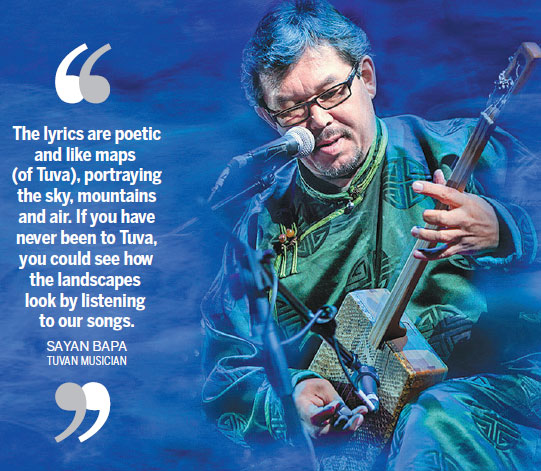
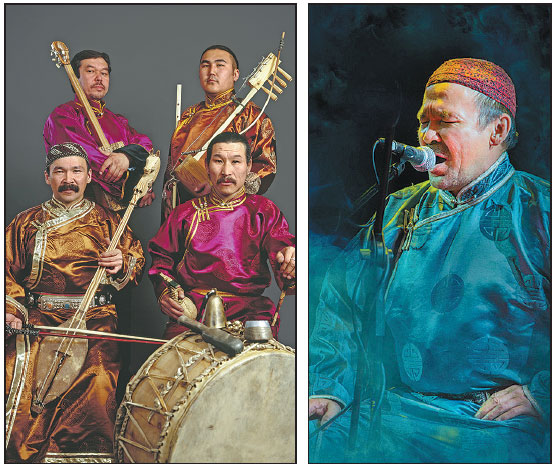
| Tuvan musician Sayan Bapa (above) founded his band in 1992 with his friend Kaigal-ool Khovalyg (below right). The quartet (below left) Huun-Huur-Tu tours China this month. Photos Provided to China Daily |
The lyrics revolve around the man's beloved horse and how he misses his family during the long trip. The ancient central Asian singing technique of khoomei, also known as "throat singing", is used. Vocalists in this strain tend to produce the sounds of multiple notes simultaneously in their throat.
The song haunted Bapa for years and inspired him to create his own music.
Along with his quartet, Huun-Huur-Tu, based in the capital, Kyzyl, the veteran throat-singer will perform the song during his band's first major tour of China, beginning later this month. The tour will include Beijing, Shanghai, Chengdu and two other cities.
The ensemble will adapt the song with the members' traditional Tuvan instruments, including Bapa's three-stringed doshpuluur (Tuvan lute), Radik Tulush's four-stringed byzaanchi and his flute-like instrument shoor, Kaigal-ool Khovalyg's two-stringed bowed igil and Alexei Saryglar's shaman drum.
"The lyrics are poetic and like maps (of Tuva), portraying the sky, mountains and air. If you have never been to Tuva, you could see how the landscapes look by listening to our songs," Bapa tells China Daily.
Ever since the band first performed at the Shanghai World Music Festival in 2008, it visited China almost every year, greeted by warm receptions from Chinese audiences.
According to Liu Zhao, Huun-Huur-Tu's China tour promoter, the throat-singing art has been embraced by more young people in China. Liu's company, Stellion Era Cultural Communication, also works for two popular folk bands from the Inner Mongolia autonomous region, Hanggai and Yik-Ccn.
Most shows that such bands put up are usually sold out, no matter which venue such events are held at, Liu says.
"The audiences are attracted by the melodies and the exotic language (Tuvan and Mongolian). After the concerts, people want to go and see what kind of places could produce such songs," Liu says.
Huun-Huur-Tu's four musicians are all masters of different styles of khoomei, for which Tuva is famous. Tulush will perform the solo-style sygyt, which is characterized by high-pitched whistle melodies. Khovalyg and Bapa will sing in the kargyraa style, which means low and deep tones.
"We learn traditional Tuvan songs and khoomei from our families and friends, who are not professional singers but sing very well. We are grateful that our ancestors gave this powerful gift to us," says Bapa.
Born to a Tuvan father and Russian mother in the industrial town of Ak-Dovurakthe in Tuva, Bapa founded his band in 1992 along with his friend Kaigal-ool Khovalyg. They named it Huun-Huur-Tu, which means "sunshine" in Tuvinian.
Before Bapa formed the band, he was trained as a bass guitar player in a Russian jazz-rock band. But in the early 1990s, he returned to Tuva to study traditional Tuvan musical instruments and khoomei.
Huun-Huur-Tu released its first album, 60 Horses in My Herd, in 1993, and the same year, the band made its American debut that enabled the musicians to become musical ambassadors of Tuva.
Nobel Prize winner in physics Richard Feynman dreamed about going to Tuva, Bapa says. Feynman also gave ethnomusicologist Ted Levin recordings of Tuvan khoomei. Overwhelmed by the mysterious sound, Levin then went to Tuva in 1987, when he met the four musicians who would become Huun-Huur-Tu.
Since then, the band has toured parts of the world and worked with musicians across genres, such as collaborations with American string quartet Kronos Quartet in 1997, and a DJ remix, Spirits From Tuva, in 2003. In 2004, the group was nominated for the BBC World Music Award, considered the most prestigious in the world of ethnic music.

"For me, some of the collaborations have been interesting. We were trying to find where we all have common ground in music. We don't just try to mix for the sake of mixing. We are trying to find where all the sounds work well together," Bapa says.
Radik Tyulyush, 40, soloist of the ensemble, says: "Tuvan music is organic and natural. It mixes well with all traditional musical cultures as well as with contemporary music, such as electronic and rock. I believe that Tuvan music has no limits."
Tyulyush studied folk Tuvan music since childhood and learned khoomei from his grandfather. Before he joined the band in 2005, like many young people in Tuva, he listened to the music of Huun-Huur-Tu and attended all its concerts, and "absorbed the art".
"Listeners should come to a concert with an open heart. Both the listener and the performer will then be connected emotionally," he says.
Contact the writer at chennan@chinadaily.com.cn
(China Daily USA 12/15/2014 page8)