Finding a family in the fog of war


Thousands of former 'war orphans', Chinese-born Japanese children left behind when their parents returned to Japan in 1945, have spent their lives attempting to find their true antecedents. For one woman, that journey took more than 40 years and involved three changes of name, as Cai Hong and Shan Yi report from Tokyo.
One day in 1953, a policeman arrived at the home of Sumie Ikeda in Mudanjiang city in the northeastern province of Heilongjiang. He asekd yo speak with her mother, and requested that the 8-year-old girl leave the room so the adults could speak freely.
Ikeda complied, but hid behind a door to eavesdrop. The conversation stunned her.
"Your daughter is Japanese, isn't she?" the officer asked.
Even though her mother refuted the accusation, for Ikeda - who was known as Xu Ming at the time - the exchange corroborated the strange stories her neighbors and classmates had told her. Some said she had been adopted. Others simply called her "the Japanese".
She demanded to know the truth, and was distraught to discover that the policeman had been correct. At the time, just eight years after the War of Resistance Against Japanese Aggresion (1937-45), recollections of the Japanese army's bruality during the occupation of China were still raw.
"Not all Japanese people commit evil deeds. The Japanese soldiers are bad men, but the Japanese people are not," her mother said, in attempt to calm her.
Despite making many efforts, the only thing Ikeda was able to learn about her biological parents was that they had left her behind when they evacuated Mudanjiang after Japan's surrender on Aug 15, 1945.
Initially, Ikeda had a happy life with her adoptive family, but everything changed when her foster father fled after his business failed. Ikeda began to take care of her mother, who had bound feet and could hardly walk, let alone earn a living.
They lived on the breadline. Late one night, Ikeda awoke to discover her foster mother attempting to hang herself. Dissuaded by the sight of Ikeda's tears, she she pledged to stay alive for the sake of her adopted daughter.
The dire circumstances led Ikeda to try to find her biological parents and ask for help. "Although I knew absolutely nothing about them, I always prayed toward the east, which, as I knew, is where Japan is," she said.
In 1953. China began repatriating "war orphans" - children left behind by Japanese soldiers and civilians - but Ikeda refused to go because she didn't want to leave her foster family and, equally important, she had no one to turn to in her home country.
After graduating from a teaching college in 1962, Ikeda was sent to a school in a remote woodland district far from home, where she married a woodcutter, settled down and had three children.
High hopes
When China and Japan restored diplomatic relations in 1972, the Chinese Public Security Bureau asked Ikeda to register as a Japanese citizen, and she was invited to meet a group of Japanese visitors in Mudanjiang.
Once again, she tried to trace her biological parents. One day she received a letter from a veteran in Hokkaido, Japan, who was trying to find a daughter he'd left in China. Facially, Ikeda bore a striking resemblance to the girl, and her date of birth and blood group were the same. Eventually, the veteran invited Ikeda and her children to visit him.
In July 1981, Ikeda, then 37, made an emotionally charged journey to Hokkaido, where she applied for Japanese citizenship and underwent DNA tests. She also took the veteran's family name as her own, but the situation deteriorated when the results of the test showed that she wasn't his daughter. The old man was so angry he threw Ikeda and her children out of his house, but his wife provided a lifeline by secretly giving the young mother 100,000 yen ($820 today).
Ikeda went to a local ward office to apply for Japanese citizenship before her Chinese passport expired. However, the authorities refused to accept a certificate issued by the Chinese government that confirmed Ikeda was a war orphan, and demanded proof that she had Japanese family members. Unable to provide the required evidence, Ikeda was told that the family would be forcibly repatriated.
"Under the circumstances, I would have be seen as a fake Japanese if I'd returned to China," she said.
Ashamed and desperate, she decided to take an overdose of sleeping pills, but had a change of heart when she went to take a last look at her sleeping children. She knew she had to stay alive to care for them. "It was the small hours of the morning, and reminiscent of the scene when my Chinese mother wanted to die," she said.
In December 1981, Ikeda, now penniless, took her children to live in Tokyo, and caused a sensatin when the Asahi Shimbun ran a story about her plight.
A law firm volunteered to help Ikeda obtain Japanese citizenship. To do so, she would need a Japanese name, so she chose Akiko Imamura, which she used for 13 years. Akiko was the equivalent of her Chinese name, Ming, and Imamura was the surname of the lawyer who helped her and gave her a job as a clerk. The family was reunited when her husband moved to Japan to join Ikeda and the children
A providential meeting
In December 1994, Ikeda was drinking tea in a Tokyo cafe, when a 60-something woman asked if she could share the table. The woman became curious when she heard Ikeda's fluent Chinese, so Ikeda explained about her life as a Japanese war orphan in China. The woman responded with the story of her younger sister who had been left in Mudanjiang when her mother, herself and a sister returned to Japan.
The similarities in the stories excited the two women, and they both had DNA tests. The results, released in 1996, confirmed that they were indeed biological sisters.
It was then that Ikeda finally learned her own history.
Her father, a Japanese officer, had been stationed in China, but was captured and held as a prisoner of war in Siberia. Ikeda was born in May 1944, and the Japanese evacuation began when she was just 10 months old. Because the child was sickly, her mother felt she wouldn't survive the trip and begged a Chinese family take her. They agreed, but later sold the girl to another family, and she became Xu Ming.
Once Ikeda learned the truth, she changed her name for the third and final time, and her sisters took her to visit her parents' tomb in Ibaraki prefecture. Once there, her excitement began to give way to bitterness. "When I stood in front of the grave of my biological parents I couldn't help asking why I had been left behind," she said.
She realized that her apartment in Tokyo was only an hour's drive from her parents' final resting place, but it had taken her 15 years to cover the short distance between them.
"I guess it fate," she said.
As of March 2005, 6,286 "war orphans" had been permanently repattiated, according to the Japanese Ministry of Health, Labor and Welfare. Many found the transition traumatic. Some committed suicide because they were unable to speak Japanese and found it too difficult to settle down.
In 1982, Ikeda formed a support group to aid and advise war orphans - she is still active as its director-general - and a petition signed by 1.13 million people was presented to the Japanese parliament calling for better treatment of war orphans.
Although her life has been a prisoner of fortune, Ikeda remaions upbeat and positive. She is still grateful to her Chinese foster parents and China, and she donates funds to social projects, such as the construction of a school in Wenchuan, Sichuan province, after the area was devastated by an earthquake in 2008.
In just a few weeks, she will return to China as a guest of the Chinese government and will attend the celebrations being held to mark 70th anniversary of the China's victory over Japan. Maybe then, her quest for closure will finally be over.
Contact the writers at caihong@chinadaily.com.cn and shanyi@chinadaily.com.cn
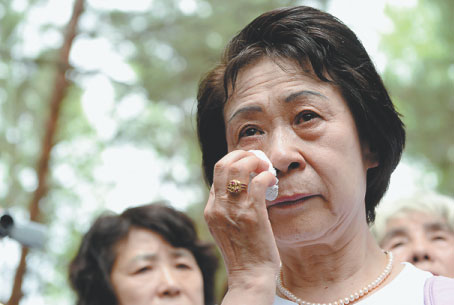
| Sumie Ikeda sheds tears as she leads a group of Japanese citizens on a visit to the graves of their adoptive Chinese parents in Fangzheng, Heilongjiang province, in July. Wang Kai / Xinhua |
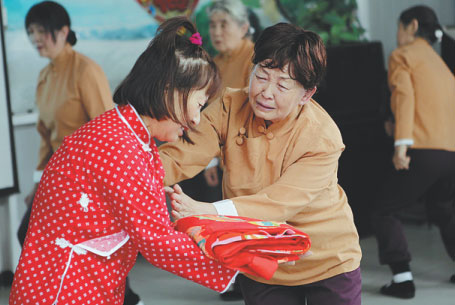
| More than 50 Japanese citizens left in China by their parents after Japan's surrender in 1945 stage a self-penned play, Chinese Mother, at a nursing home in Beijing in July. Zou Hong / China Daily |
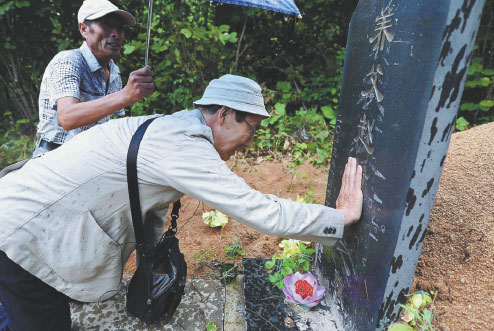
| Chen Qinghe, a 73-year-old Japanese man abandoned by his parents during the hasty retreat at the end of World War II, kneels and weeps at the grave of his adoptive Chinese parents in Mudanjiang, Heilongjiang province, on Aug 11. Wang Kai / Xinhua |
(China Daily USA 08/24/2015 page7)