The golden creatures of Shennongjia


Twelve researchers give their all to save an endangered species
Home is where the heart is, which raises a burning question for Huang Yuanpeng: Who pulls his heartstrings hardest - his wife and 3-year-old son or those strange creatures in the forest he has decided to devote his life to?
The group of animals that Huang, 34, has spent the past 10 years doing research on at Shennongjia Golden Monkeys Protection and Research Center high in the mountains of Shennongjia National Nature Reserve in Hubei province are as rare as pandas: golden snub-nosed monkeys that are found nowhere other than China.
| Top: Huang Yuanpeng's fellow researchers from Shennongjia Golden Monkeys Protection and Research Center check on the monkeys. Below: Shennongjia Nature Reserve has been one of themost important habitats for golden snub-nosed monkeys, a rare primate living exclusively in China. Photos Provided to China Daily |
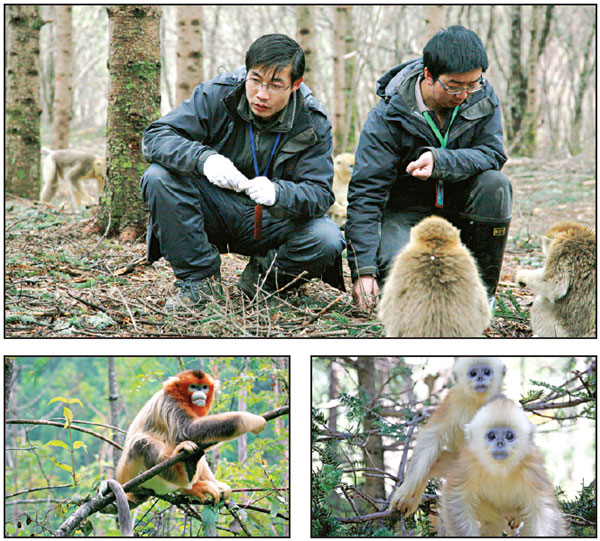
Huang visits his home in a nearby town, where his wife takes care of their son, almost every month, but the transport logistics make it hard for some of the other 11 researchers aged from 20 to 60 from distant regions to go back home regularly.
They take turns to have four days off each month and even spend the traditional Chinese New Year looking after the monkeys.
And that self-sacrificing care seems to be paying off, for the group of snub-nosed monkeys he has been looking after has grown from about 50 to more than 90 over 10 years.
"I'm really happy to see that," Huang beams. "Our work has paid off."
Golden snub-nosed monkeys are distinguished by their bright fur, graceful movements, and gentle nature. They were once widely distributed throughout China but have retreated to high mountains because of changes in the environment.
They are critically endangered because of habitat destruction and human hunting, and the International Union for the Conservation of Nature has listed them as a rare animal species. China has classified them as a first-grade State-protected animal.
Years of close interaction with the monkeys has given Huang and his colleagues an intimate knowledge of their charges' habits and traits. Each of the monkeys even has a name.
When Huang talks about the monkeys' lives he comes across as a proud parent talking about his offspring. That includes lovingly describing how one of the monkeys was born and recounting how a new male adult challenged and defeated an older male for supremacy in the group.
"I'm with the monkeys almost every day," Huang says. "We are very close now, and if I had to take a leave I would miss them so much."
Shennongjia, with mountains, thick forests and abundant rainfall that nurture diverse foods for animals, is an important habitat for the golden snub-nosed monkeys. Wild snub-nosed monkeys were first spotted there in the 1980s.
In 2005, the research center Huang works in was founded in Dalongtan, which is 2,300 meters above sea level and one of the natural habitats for the species.
The researchers selected a typical group of the monkeys that lived in a surrounding area of 8 square kilometers for long-term tracking and research.
The researchers track and observe the snub-nosed monkey population, and collect their feces and fur for research.
Huang says that at first life with the monkeys was dull, but he slowly acclimatized to the point where he could feel at one with them.
"The most important quality for working here is being able to withstand hardships."
These include severely cold weather and snow-blanketed roads in winter and mosquitoes and snakes in summer. In summer, the researchers often wake up at 4 am to track monkeys in the wild and do not return to their base until 8 pm.
In the early years, before the advent of electronic tagging, they would pack camping equipment and food, and sometimes remain in the wild for weeks on end doing tracking work.
"Often as the monkeys were jumping from tree branch to tree branch we would be scrambling along on the ground trying to keep up," Huang says. "No matter what the weather was we would be out there looking for them, and the monkeys have scratched almost all of us at some time or other."
One of the greatest challenges for the monkeys is the harsh climate, winter lasting as long as six months and temperatures dropping to -20 C. Some young, weak individuals have died of starvation and the cold.
In 2005, researchers began to provide food to the monkeys, starting with usnea, a kind of parasitic plant growing on pine trees. However, it was too difficult to collect enough of this in winter, and so they started to feed the monkeys apples wrapped in usnea instead.
The monkeys were very cautious at first and they took three months to try the apples and adapt to the new diet, Huang says.
"It was a breakthrough. It allowed us to closely observe the monkeys and laid the foundation for further research on them."
Nowadays, the researchers get up at daybreak to track the monkeys, and feed them three or four meals a day, with usnea, apples, pine cones and other foods.
Over the years, the number of the snub-nosed monkey population in the reserve has risen from about 500 in the mid-80s to more than 1,300 now.
Yang Jingyuan, head of the reserve's scientific research institute, says the achievement is the result of several major national campaigns such as the country's natural forest protection project started at the beginning of the century.
"These projects have reduced human activity and damage to their habitats, and gradually increased their range of activity. The maturing protection network and supply of food in winter has also played a crucial role."
In 2011, the State Forestry Administration of China turned the Dalongtan base into a national research center for golden snub-nosed monkeys. Its activities include artificial breeding, disease research, habitat protection and supplying food in winter.
It collaborates in research with many universities and often receives international scientific research groups.
With greater support from the national government in recent years, the center has carried out more key protection projects related to the species, such as restoring fragmented or degraded habitats and finding potential new habitats in the region.
At its Dalongtan base, the center has set up a 4G monitoring platform that includes technologies such as wireless sensoring, satellite navigation and positioning and cloud services.
"The projects not only benefit the habitat protection and management of the snub-nosed monkeys but may provide an example for protecting other endangered animals," Yang says.
liuxiangrui@chinadaily.com.cn
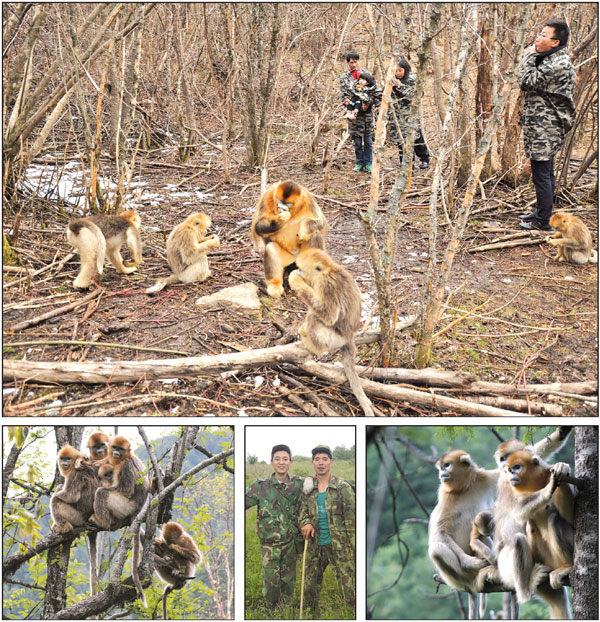
| The golden snub-nosed monkeys in Shennongjia, once elusive animals, are now comfortable with intimate contacts with researchers after years of food offering programs in winter. Above: Huang Yuanpeng (left) with a colleague. Top photo by Liu Xiangrui / China Daily; below photos provided to China Daily |
(China Daily USA 06/13/2016 page8)