An uncertain history


Mahjong, also spelled majiang and mahjongg, is a board game played by four people with 136 domino-like tiles - although 144 are used in international competitions - in which players try to collect groups of tiles. Its nearest Western equivalent is the card game bridge.
China's most popular game originated during the Ming Dynasty (1368-1644) and became a celebrated pastime during the Qing Dynasty (1644-1911), although the precise date varies according to different accounts.
One theory suggests the game was invented in Taicang county, in the eastern province of Jiangsu, where it was called maque, meaning "sparrow", a name that is still popular in South China and Japan.
Taicang was famous for its 110,000-square-meter granary for more than 100 years, overlapping the Yuan Dynasty (1271-1368) and the Ming. Carvings on the faces of mahjong tiles depict a famous incident in the county, when local residents and soldiers were encouraged to kill sparrows because the birds ate seeds and caused a decline in rice harvests.
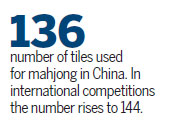
Regional variations mean some tiles may be omitted or added and there are minor modifications to the rules.
Under standard rules, each player begins by collecting 13 tiles, and then draws and discards them until the 14th tile drawn produces a winning hand, consisting of four sets of three tiles and a pair of tiles.
The rules for drawing tiles are generally standardized, as are those related to how tiles are taken from another player, the use of simples (numbered tiles) and honors (winds and dragons), the kinds of melds (groups of three or more tiles) allowed, dealing and the order of play.
Following the founding of the People's Republic of China in 1949, playing for money was regarded as illegal gambling, but a non-monetary version was popular home entertainment until 1998, when the game was recognized by the General Administration of Sport of China. In the same year, the administration published a set of international rules as the unified regulations for international competitions.
There is no clear account of how mahjong spread to other countries from China.
In 1895, the British sinologist William Henry Wilkinson (1858-1930) recorded the game in his diaries. In the 1920s, Chinese immigrants took the game to the United States.
The earliest reference to mahjong in Japan came in the early 1900s, during the Russo-Japanese war, when Japanese soldiers saw people playing the game. In the 1970s, Japan began hosting mahjong masters' tournaments.
The European Mahjong Association, established in 2005, has 19 member countries and an established ranking system for players based on tournament results.
In October 2005, the World Mahjong Organization was established in Beijing, with joint initiatives with mahjong clubs in China, Japan, America, Germany, France, Denmark, the Netherlands and Hungary.
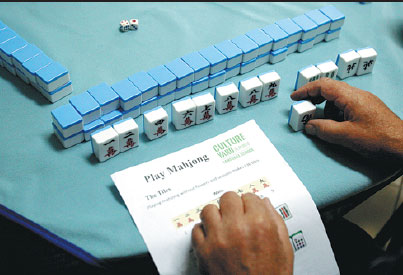
| An expat learns how to play mahjong at an enthusiasts'workshop in Beijing. Wang Zhuangfei / China Daily |
(China Daily USA 10/12/2016 page6)