No meeting of minds


Some single women and men in China stay away from family dinners this Spring Festival to avoid marriage talk, Xu Lin reports.
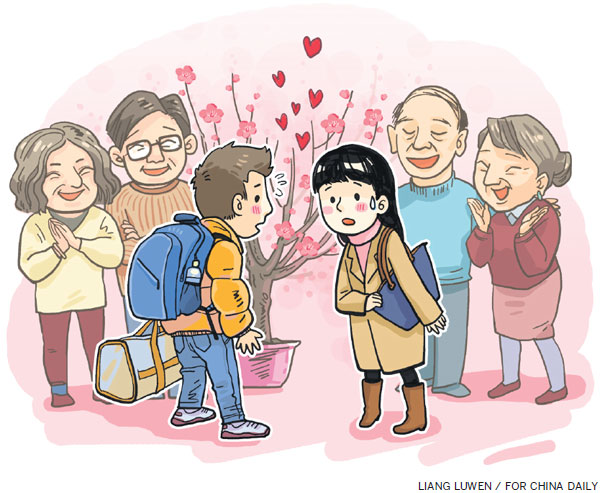
While most people look forward to family reunions during Spring Festival in China, some young Chinese prefer to give the gatherings a miss in order to avoid any talk of marriage.
With the Chinese society undergoing rapid changes, late marriages and late parenthood are no longer uncommon, especially among residents of big cities.
Many single Chinese are also willing to wait for the right partner.
In 2010, the last national population census by the State Council and the National Bureau of Statistics, showed 36 percent of men and 21 percent of women in the 25-29 age group as unmarried. For those between ages 30 and 34, it was 12 percent and 5 percent respectively.
"I had promised my parents that I would get married last year," says Ma, 30, who runs a small company in Beijing. "But marriage relies on destiny, and you can't find it that easily."
Ma, who only gives her surname, says although she feels bad to have broken her promise, she is fed up with her parents' constant nagging. She didn't return to her hometown, a small city in Central China's Hunan province, for the festival this year, because in the past all her relatives would gather for meals during Spring Festival and discuss her unmarried status at every opportunity.
"They (her relatives) would tell me that my old childhood friend's kid is growing up. And, my mom complained that she would die discontent if I didn't get married. I wanted to flee such situations," Ma says.
In addition, there's peer pressure: Ma has two younger female cousins back home; one just gave birth to a second child, and the other was visiting with her boyfriend this year.
As an independent woman, Ma wants to marry someone who has a successful career and shares her values. She has been on unsuccessful blind dates with many men.
"Sometimes we are dazed by the many choices," Ma says of such dates. "And when you're still considering whether to be with a man, he may have found a girlfriend already."
But overall, she is cautious about marriage.
"You have to be really careful and think if he is the one with whom you can spend your life."
Jin Songmin, 36, invited her parents to Beijing instead of going back home to Hebei province for the usually weeklong festival holiday this year. Her parents not only understand that she is busy and under a great deal of work pressure, but they also rarely bring up the topic of marriage before her.
It's a different matter for her extended family.
"It's better to avoid meeting my relatives. Or else, I have to politely tell them that I don't have a boyfriend. If I say I have one in order to end such talk, they will then ask, 'When are you getting married?'" Jin says.
She studied fine arts in London and started her own company in Beijing in June.
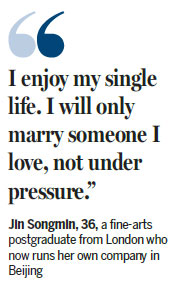
"I enjoy my single life. I will only marry someone I love, not under pressure," she says. "It's OK to meet the one I love when I'm in my 40s or even 50s."
If she spends time on work and her friends, she will have both financial rewards and lasting relationships. Besides, it's risky to invest in marriage as the outcome is uncertain.
Zhang Xuan, who works in her hometown, Chengdu, Sichuan province, feels such pressure not just during the festival season, because she often meets her parents and relatives.
"They are anxious that I don't have a boyfriend yet and I may get married as late as 30. It's not my concern at all. I just haven't found the right person. I'm surprised that a friend joked I was one of the 'leftover women'," says Zhang, who is vice-president of a gameplay company at age 26.
While Chinese women feel most of the social pressure, there are plenty of similar examples among Chinese men.
Tong Kang, 30, who refuses to reveal his real name, prepared himself mentally much in advance of the festival and wrote down notes in order to argue with his parents.
"I want to exchange views calmly, especially on such occasions, ... but sometimes we quarrel with each other over this issue," he says.
The Beijing-based office worker also has a side occupation, and his total annual income is about 200,000 yuan ($29,121).
"I will get married but the time is not ripe yet. Maybe two or three years from now," he adds.
His parents aren't backing off though. Each week they mention the subject once over the phone. They also arranged a date for him during this Spring Festival, but Tong says he is too busy to follow up after such dates.
"In Beijing, housing and educational expenses of children are steep. A house may cost several million yuan," he says. He views his current financial condition as being below such standards.
His parents, he says, are willing to support him financially and they think he and his wife could earn more together if he got married.
"They told me that they resolved money problems together earlier, but they have no idea about the economic pressure on our generation. It's much bigger," Tong says.
Ming Li, chief counselor for Shanghai-based Weiqing International Marriage Hospital, a marriage consultancy, says: "Parents are under great social pressure but they don't have to force kids into marriages if the kids don't want to. Those who are eager to get married will actively find a partner on their own. If you don't have a suitable partner, you can't marry hastily."
Young people should think independently of their parents and learn how to be responsible couples when they find someone, she says.
Contact the writer at xulin@chinadaily.com.cn
Chinese dating report 2016
The 2016 Dating and Marriage Report, released by Shijijiayuan in January, said more than 60 percent of 8,745 single males and half of 7,755 single females on the dating website were being urged by their parents to get married.
According to the more than 16,500 respondents of the report, the average age for "leftover men" was 35 and for "leftover women" 32. Of the respondents, 29 percent of men and 38 percent of women said they would not marry until they found true love.
While well-educated women with good judgment were most favored by men, family-oriented and considerate men were the most favored among women.
"Being money-minded, narrow-minded and causing problems out of nothing" were the top three unacceptable traits in women, male respondents said.
"Being stingy, sissy, quibbling over details and narrow-minded" were the top four characteristics in men disliked most by women.
Men were curious to know if women would be willing to have children and how they felt about living with parents-in-law. Women were keen to know about the economic prospects of their potential partners and their sexual ability. Women were also interested in knowing their thoughts on living with their parents and parents-in-law. Both genders wanted to know about each other's medical history.
(China Daily USA 02/08/2017 page8)