



Both sides of Strait mark Mazu birthday









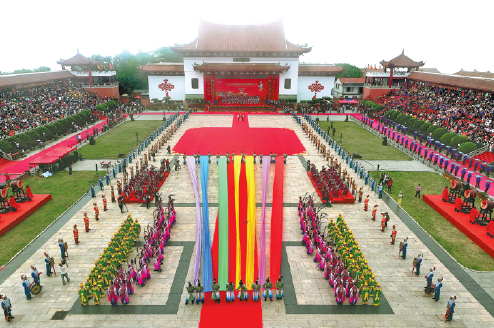
A shared belief in Mazu, the revered goddess of the sea, drew thousands of people, including many from Taiwan, on Sunday to celebrate her birth in Fujian province, despite heightened cross-Strait tensions.
Mazu, originally named Lin Mo, was born on Meizhou Island in Putian, Fujian, during the Song Dynasty (960-1279). Revered for her miraculous ability to calm storms and rescue ships in distress, she became a symbol of protection for seafarers, leading to the construction of temples in her honor around the world.
Ma Jui-chun, a board member of the Xingang Fengtian Temple in Chiayi, Taiwan, said that more than 300 years ago, early settlers brought incense fire from the Meizhou temple across the Strait to Taiwan.
"They brought with them the spirit of pioneering and overcoming challenges, but also a cultural bond that now unites both sides of the Strait with shared hometown and family affection," he said. "In Taiwan, every Mazu temple represents the roots of our ancestors."
When the Ming Dynasty (1368-1644) ended, residents of Fujian crossed the Strait to settle in Taiwan. Facing a treacherous sea journey, they carried small statues of Mazu aboard their boats for protection, eventually establishing temples across the island.
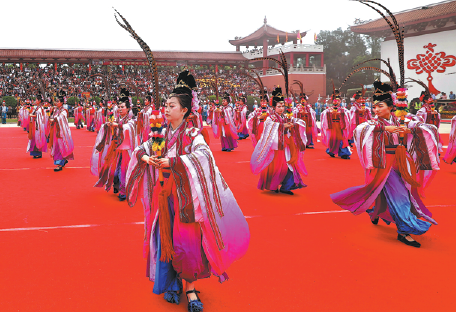
Today, there are about 500 Mazu temples across Taiwan, and an estimated two-thirds of the island's population are believed to be devotees.
"Mazu is the source of people's inner peace and faith in Taiwan. She is not only a spiritual support but also very close to each believer, like a family member," said Chiu Yi, a political commentator from Taiwan.
"All Mazu temples originate from Meizhou Island," he said, adding that even though the current Taiwan authorities are promoting the removal of Chinese cultural elements, the connection between the two sides "cannot be separated".
Mazu's presence in Taiwan has been a cultural phenomenon. In 1997 and 2017, her statue from Meizhou caused a sensation when it traveled to the island for ritual patrols. Last month, two Mazu statues made headlines again when they were flown from Xiamen, Fujian, to Taiwan in designated seats on a plane to join this year's celebrations.
Even though the Taiwan authorities introduced "17 strategies" last month aimed at countering "perceived threats" from the mainland, including curbs on religious exchanges, many temples in Taiwan, including those in Changhua, Taichung and Hualien, joined the 1,065th birthday celebration for Mazu in Fujian through online platforms.
More than 130 Mazu temples and cultural organizations from about 25 countries across five continents took part in the ceremony.
On Saturday, well-known actress Liu Tao, 46, was named global ambassador for Mazu culture. She appeared at the Meizhou temple to present longevity peaches to the Mazu statue during the birthday countdown.
Dressed in classical attire, Liu also attended the celebration the next day. Her appearance sparked a wave of online discussion, as many netizens recalled her portrayal of the goddess in a hit 2013 TV series. When filming that role in Meizhou, she visited the temple to pray for blessings.
Contact the writers at zhangyi1@chinadaily.com.cn


- New county established in Xinjiang
- 8,406 suggestions from national lawmakers forwarded for review
- China launches national long-term care insurance program
- Chinese researchers develop high-efficiency thin-film photovoltaic for space energy
- China to open 10 major scientific facilities to international academia in 2026
- Data product IPs drive value creation in Shanghai





