Politics
US urged not to sell arms to Taiwan
Updated: 2011-07-29 07:28
By Tan Yingzi, Wu Jiao, and Cheng Guangjin (China Daily)


 Twitter
 Facebook
 Myspace
 Yahoo!
 Linkedin
 Mixx
MixxWASHINGTON / BEIJING - With a decision looming on an arms deal between the US and Taiwan, Beijing is publicly nudging Washington to "take the appropriate course of action".
Wang Yi, minister of the State Council's Taiwan Affairs Office, said that the goal of his annual trip to Washington was to discuss cross-Straits relations and the situation in Taiwan with US officials.
Wang said that his visit was also aimed at promoting understanding and explaining China's concerns on issues of common interest.
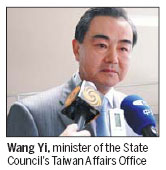
Wang also urged the US to "send positive signals on Taiwan-related issues".
The Taiwan issue is China's internal affair and should be resolved through consultation by Chinese across the Straits, Wang said during a meeting with a group of Taiwan people living in the US.
Wang also said that the understanding and support of the international community was important for the improvement and development of cross-Straits relations.
Wang met Kurt Campbell, assistant secretary of state for East Asian and Pacific Affairs, on Wednesday. Details of the talks were not made available to the media but China News Service reported that US arms sales to Taiwan were discussed.
Wang is scheduled to meet with White House officials and congressmen before returning on Saturday.
Wang's visit came amid reports that an amendment to a budget bill urging the US to sell F-16 fighters and diesel-electric submarines to Taiwan was approved by a voice vote in the House of Representatives Foreign Affairs Committee. Beijing considers both the fighters and submarines to be offensive in nature.
US Secretary of State Hillary Clinton recently announced that President Barack Obama would make a decision by Oct 1. US arms sales to Taiwan have long been a cause of turbulence in mainland-Taiwan ties and China-US relations.
Military-to-military ties, which Beijing broke off in January 2010 after the US announced plans to sell more than $6 billion worth of arms to Taiwan, only began to thaw toward the end of last year.
Analysts predicted that arms sales to Taiwan could jeopardize Sino-American relations.
It certainly would put relations, which have just stabilized, at high risk, Ni Feng, deputy director of the Institute of American Studies at the Chinese Academy of Social Sciences, said.
However, both China and the US understand that military ties are becoming more and more important, Ni said.
The Ministry of National Defense, in a news briefing on Wednesday, urged the US to abide by the three Sino-US joint communiques and end arms sales to Taiwan to avoid harming military ties.
In the China-US Aug 17 Joint Communique in 1982, the US declared that it will not seek long-term arms sales to Taiwan and that they will be reduced over time.
According to media reports, F-16 fighters and diesel-electric submarines were not included in the 2010 sales package.
Because of recent strains in the relationship "the two sides now are clear of each other's bottom line on the Taiwan issue", said Zhang Shengjun, deputy dean of the School of Political Science and International Studies at Beijing Normal University.
"Due to the complexity of Sino-US relations, the relationship is unlikely to be either extremely good or extremely bad," he said.
The US will try to take advantage of our internal conflicts but if we have good cross-Straits ties, the "US will have less room to play", Zhang said.
Taiwan people in favor of reunification have also protested against US arms sales, condemning them for trying to damage cross-Straits peace and stability, Hong Kong-based China Review News reported in February 2010. According to the Taiwan Affairs Office, the economic, cultural and people-to-people exchanges between the mainland and Taiwan have reached their highest levels in 60 years.
Last June, the mainland and Taiwan signed a landmark free trade deal, the Economic Cooperation Framework Agreement, which cut tariffs on the island's exports and allowed banks on both sides to invest across the Straits.
Ma Liyao contributed to this story.

Specials
Wen pledges 'open' probe
Design flaws in the signal equipment led to Saturday's fatal high-speed train collision, authorities say.

Turning up the heat
Traditional Chinese medicine using moxa, or mugwort herb, is once again becoming fashionable

Ciao, Yao
Yao Ming announced his retirement from basketball, staging an emotional end to a glorious career.