Art
An illustrator's macabre whimsy enjoys an afterlife
Updated: 2011-03-13 07:58
By Mark Dery (New York Times)


 Twitter
 Facebook
 Myspace
 Yahoo!
 Linkedin
 Mixx
Mixx
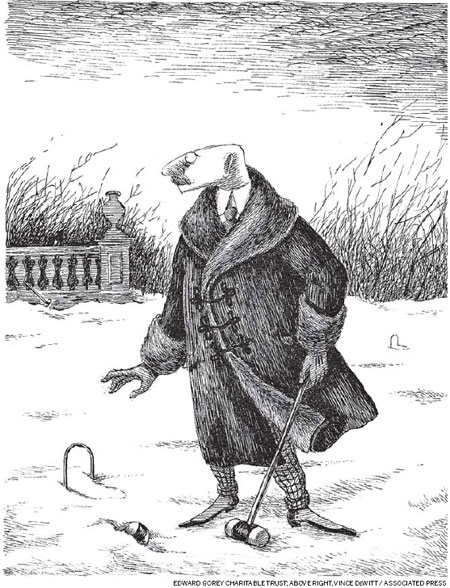
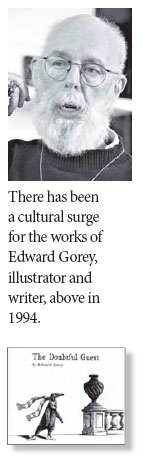
News bulletin from the spirit world: The specter of Edward Gorey, who died in 2000 at the age of 75, is haunting our collective unconscious.
In a sense that's as it should be; Gorey was born to be posthumous. His poisonously funny little picture books established him as the master of high-camp macabre.
Told in verse and illustrated in a style that crosses Surrealism with the Victorian true-crime gazette, Gorey stories are set in some unmistakably British place, in a time that is vaguely Victorian, Edwardian and Jazz Age all at once.
Though Gorey was a 20th-century American, he conjured a world of gramophones and cars that start with cranks. His titles: "The Fatal Lozenge," "The Deadly Blotter," "The Hapless Child."
Gorey's set for the 1977 Broadway production of "Dracula" spread his fame far beyond theatergoers.
But until the last few years true Gorey devotees were a secret society. Now, however, their numbers have swelled.
The writer Daniel Handler, better known as Lemony Snicket, said, "When I was first writing 'A Series of Unfortunate Events,' I was wandering around everywhere saying, 'I am a complete rip-off of Edward Gorey,' and everyone said, 'Who's that?' Now, everyone says, 'That's right, you are a complete rip-off of Edward Gorey."
Tim Burton owes an obvious debt to Gorey. Gorey illustrations are even becoming voguish as tattoos. The market for Gorey books and merchandise buoys indie publishers like Pomegranate and Fantagraphics.
Attendance has been climbing steadily at the Edward Gorey House in Yarmouth Port, Massachusetts, and curators of the first major traveling exhibition of Gorey's original art, "Elegant Enigmas" - now on view at the Boston Athenaeum - have been stunned by the enthusiastic response.
"I knew Gorey had a wide following, but I had no idea of the mania," said David Dearinger, an Athenaeum curator.
Opinions differ about why Gorey is casting a longer shadow these days.
Mr. Handler attributes it to the sophisticated understatement of Gorey's hand-cranked world.
"That worldview - that a well-timed scathing remark might shame an uncouth person into acting better - seems worthy to me," Mr. Handler said.
Many see in Gorey's work an invitation "to return to a time of gentility," to quote the promoters of the annual Edwardian Ball, a celebration of Gorey.
In contrast, some fashion designers see Gorey's anachronistic use of historical references as perfect for our age of mash-ups and remixes. The neo-Victorian couturier Kambriel said that in her designs, as in Gorey's tales, "the propriety of the past" is infused with the "playful mischief and irreverence" of the present.
The British "dark cabaret" act the Tiger Lillies had a Grammy-nominated collaboration with the Kronos Quartet, "The Gorey End" (2003), which set unpublished Gorey tales to music.
Many of Gorey's images "look like theater sets, so there's that dramatic appeal to it," Mr. Dearinger said. "They're very well composed, easy to read, yet there's enough detail in them that every time you look at them you'll see something you hadn't seen before."
The images also reveal an encyclopedic knowledge of period architecture, wallpaper, fashion and interior design. They rejoice in repeated patterns, giving them a decorative quality.
Gorey-philes may be amazed to learn that Gorey's dizzily crosshatched or stippled illustrations were originally no larger than their reproductions in books. "You can picture him with his nose right on the paper, practically, and the pen just making tiny, tiny little strokes, each one where it's supposed to be," Mr. Dearinger said.
Whatever Gorey's work appears to be about, it's forever insinuating that it's really, truly about something else.
For his part, Gorey would doubtless have groaned (theatrically) at any attempt to make intellectual sense of his posthumous popularity.
As he liked to say, "When people are finding meaning in things - beware."
The New York Times
(China Daily 03/13/2011 page12)
Specials
Earthquake Hits Japan
A massive 8.8 magnitude quake hit the northeast coast of Japan on March 11,2011.

NPC & CPPCC sessions
Lawmakers and political advisers gather in Beijing to discuss major issues.

Labor crunch
Worker scarcity is no longer confined to eastern areas, minister says.