China
Service sector: China's emerging powerhouse
Updated: 2011-03-02 07:41
By Liu Jie (China Daily)


 Twitter
 Facebook
 Myspace
 Yahoo!
 Linkedin
 Mixx
Mixx
|
|
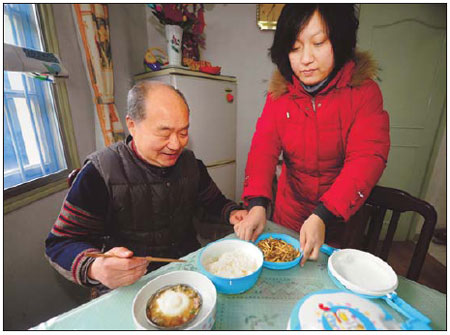
BEIJING - Masayuki Fujita, chief executive officer of Japan Frontier Age, a major non-profit organization that specializes in care for the elderly, was leading a group of Japanese enterprises in studying the Chinese market late last year.
These companies plan to bring their products and services to China, a nation that has 110 million people older than age 65 and is expected to have more than 400 million by 2050.
Tokyo-based Comfort-Life has decided it will cooperate with Japanese investors to set up a nursing home in Dalian, Liaoning province, in October 2012. And Japanese Longlife will launch its service facilities for the elderly in Qingdao, Shandong province, in October and open 50 outlets around China by 2020.
Japanese entrepreneurs' enthusiasm for China's elderly care sector is just one example of foreign interest in China's service industry, for which the central government has set ambitious developmental goals.
Ambitious plan
According to the draft of China's 12th Five-Year Plan (2011-2015), which will be discussed at the fourth session of the 11th National People's Congress starting on Saturday, the sector's proportion of gross domestic product (GDP) should increase by 4.2 percentage points by 2015 to around 48 percent. The number of people employed in the sector is expected to grow by 5 percentage points to 41 percent.
The figures are higher than the goals set in the previous five-year plan - 3 percentage points for GDP and 4 for employment. Those targets, however, were not reached last year.
Economists attributed the failure to the unexpectedly fast growth of China's GDP. The annual increase of the GDP hit 9.1 percent in 2009 and 10.3 percent in 2010, compared with the planned average year-on-year growth of 7.5 percent from 2006 to 2010.
According to Chen Naixing, director of the Small- and Medium-Sized Enterprises Research Center under the Chinese Academy of Social Sciences, it is also partly because of the current statistical model, which refers some service industry businesses to the agriculture and raw material sector, such as service units of large industrial enterprises.
Although the nation's service sector has seen rapid growth in the past five years, it still lags behind the demand generated by the nation's fast economic growth and that of developed economies, Zhang Ping, minister of the National Development and Reform Commission, said in a report. China's service industry accounted for 43 percent of the nation's GDP, just slightly under the planned 43.2 percent last year, but much lower than the 75 percent in the United States and some 60 percent in Europe.
"The gap implies there are both challenges and opportunities in China. We have to deal with problems that hinder the rapid growth of the service industry, while there's huge room for development in the sector," said Feng Fei, industrial economy studies department director at the Development Research Center of the State Council. Feng suggested that further opening-up will help industrial upgrading, given multinational companies' long history and rich market operating experience in the industry.
Diversified services
In the aviation service market, emerging low-cost carriers are testing the waters in China.
In November, the Singapore-based budget airline Jetstar Asia added a twice-weekly, third direct flight to China - between Guilin and Singapore - and it is looking for further penetration in the nation's booming travel sector. The airline established flights to Haikou, Hainan province, and to Shantou, Guangdong province, in 2009.
Air Asia, a low-cost airline based in Kuala Lumpur, operates flights from seven mainland cities, including Tianjin, Hangzhou, Chengdu, Guangzhou and Guilin.
According to a survey conducted by global payments technology company Visa and released in September, Chinese tourists are planning on average at least seven trips over the next two years. Of these, four would be international trips. "Global carriers are competing to satisfy the ever-increasing and more diversified demands of Chinese travelers with tailored services. It's a trend to a market turning complicated," Li Lei, an aviation analyst at China Securities Co Ltd, said.
Xia Jiechang, a researcher at the Institute of Finance and Trade Economics, affiliated with the Chinese Academy of Social Sciences, said that the opening up of China's service sector should be cautious and based on various conditions of different segments.
The service sector has become China's key source of foreign direct investment (FDI). According to the Ministry of Commerce, FDI chalked up $4.69 billion in January, a year-on-year increase of 31.8 percent. Meanwhile, the sector accounted for 46.8 percent of the nation's FDI as a whole, up 3 percentage points from the previous year.
Yao Jian, spokesman for the ministry, said that FDI in the service industry will continue to surge and more will turn to businesses that meet domestic consumption demands.
Supporting policies
"In addition to luring foreign investment, the service industry's fast growth will depend on the development of domestic small- and medium-sized enterprises, something that needs government support in terms of tax and fund raising channels," said Xia Jiechang.
The Chinese high-end restaurant chain South Beauty is striving for listing this year to fuel its expansion at home and acquisitions abroad, according to Chairwoman Zhang Lan. Many other eateries, including the tea restaurant Chamate and hotpot chain XiabuXiabu, are also favorites of venture capitalists and private equity operators. XiabuXiabu has provided more than 20,000 job opportunities, most of them for workers who had been laid off and migrants in key cities.
"These kinds of businesses can add not only fiscal revenue for local governments but also help create job opportunities for citizens and migrant workers and improve people's standard of living, so they deserve favorable tax," said Pang Wei, an analyst from Guotai Junan Securities.
The government is planning to include the sector in the value-added tax group to reduce the tax burden on services and further advance economic rebalancing, said Liu Zuo, director of the taxation science research institute affiliated with the State Administration of Taxation.
"Value-added tax is levied only on manufacturing, while services are subject to a business tax that raises a much smaller amount. Given the heavy dependence of local governments on value-added tax revenue, they have a strong incentive to promote manufacturing rather than services," said the Asian Development Bank in a report.
Zhang Ping vowed to implement more favorable tax policies, support the efforts of qualified services enterprises to list on the markets and issue bonds, and ensure that the sector can obtain electricity, water, gas and heat at the same prices as other industries during the next five years.
"The employment-intensive domestic sector can be the turning point in the government's efforts to solve the dilemma of restructuring the economy and ensuring rapid growth to maintain employment levels," said Li Wei, economist at Standard Chartered Bank.
Hu Yuanyuan, Wang Xiaotian, Wang Zhuoqiong and Cai Xiao contributed to this story.
China Daily
Specials

Self-made aircraft
An automobile mechanic in Northeast China made a test flight of his self-made aircraft which cost about US$395.

Venetian Carnival
Masked revellers celebrate in Saint Mark's Square in Venice.

Olympic mascots
Organizers made the unusual decision to have three mascots for the 2014 Olympic Winter Games.