Business
Lessons learnt from being open to all
Updated: 2011-03-04 10:40
By Lin Jing (China Daily)


 Twitter
 Facebook
 Myspace
 Yahoo!
 Linkedin
 Mixx
MixxBEIJING - Nine years ago, David Wang resigned as China CEO of a Fortune 500 company. He then sold his house in the United States and moved to China, the country where he was born, to become the vice-president of the Boeing Company and president of Boeing China.
"I was 58 years old then and I just wanted to do something challenging when I still could," Wang said.
To Wang, change itself is the thing that never changes.
Wang was born in East China's Fujian province in 1944. And he spent his early years in different regions: kindergarten in Shanghai, primary school in Hong Kong, middle school in Indonesia and university in the US. He has worked in many countries, including the US, Mexico, Malaysia, Indonesia and China.
He said his multinational experience has had a positive influence on his career, as his diverse cultural experience has made it easier for him to stand in other people's shoes and better understand different opinions.
|
|
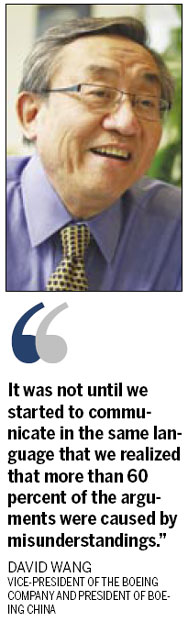
"In the business world, lack of understanding can often cause unnecessary frictions," he said.
Wang gave as an example the time he came to China for negotiations over a joint venture with two other parties who spoke different languages. The negotiations had been going for months and they had different opinions on almost 24 clauses.
He then decided that they should speak in one language without interpreters and after a couple of days they reached an agreement.
"It was not until we started to communicate in the same language that we realized that more than 60 percent of the arguments were caused by misunderstandings," he said.
Besides English and Mandarin, Wang also speaks good Cantonese, and the Shanghai and Zhejiang dialects.
In 1967, after obtaining a bachelor's degree in electrical engineering at St.LouisUniversity, Wang joined the family business in Jakarta. Wang said that his experience managing the family business was invaluable.
"It taught me the value of each worker and that they should be treated as part of the family," he said.
After working in Jakarta, Wang went back to the US and studied for his master's degree in electrical engineeringat the UniversityofMissouri-Rolla, which is now known as Missouri University of Science and Technology.
In 1980, Wang joined General Electric Co, as an engineer. One day three company trainees came to interview him about management practices. At the end of that interview they asked whether they could offer some advice to him.
Though a little bit surprised, Wang agreed. The trainees said that Wang had already reached the top of his career ladder and would stay in the same department all his life doing the same thing.
They gave him three reasons: First, Wang was good at managing the department and got along very well with his colleagues; second, he was satisfied with his current job and performance; third, he had no plan of trying anything new.
Their words, though straightforward and bold, prompted Wang to reflect on his career.
After that, Wang began to pay more attention to other departments such as marketing and financing. And his position gradually changed from design engineering to production, and finally to long-term strategies.
In 1997, he became CEO of GE China. And in 2002, Wang joined Boeing.
Wang said that one has to be "deep and broad" to succeed.
"First you should extend your abilities in a wide range of fields, so you will be able to seize the opportunity when it comes," he said.
Recalling the unexpected advice from young trainees, he smiled and said that one should be humble and learn from everyone around.
"Be open to other people's advice," he said. "You will benefit a lot."
In 2009, Boeing co-founded the US-China Energy Cooperation Program (ECP), a US commercial sector initiated, managed and financed non-government organization, and Wang also became co-chair of Clean Transportation Working Group, in charge of sustainable aviation biofuels development as well as other clean transportation technologies.
Wang said that Boeing is optimistic about biofuel development and is working toward being carbon neutral by 2050. Boeing has been working with many different research institutes worldwide and its current annual investment on research and development is $3 billion to $4 billion, while 75 percent of its research projects are related to reducing energy consumption.
In September last year, Boeing and the Qingdao Institute of Bioenergy and Bioprocess Technology opened a joint laboratory to accelerate aviation biofuels research.And in May or June this year, Boeing and Air China will launch an inaugural domestic flight using sustainable aviation biofuels.
Wang said that the inaugural flight is to prove commercial viability of biofuels in China.
As a co-chair of ECP, Wang said the most challenging part was to persuade companies, which were market competitors, to share resources and cooperate with each other in research and market development.
"Normally companies have their own way of doing business and it is really difficult for them to work with others," he said. "So a perfect market opportunity is essential for their collaboration.
"It is like herding cats, which is much harder than herding sheep."
In Wang's opinion, in the clean energy field, China and the US are not competitors.
"In terms of energy cooperation, every project is a win-win one," Wang said.
"But each country is competing with itself," he added. "It is like playing golf. In order to win, you have to conquer yourself first."
China Daily
Specials
NPC & CPPCC sessions
Lawmakers and political advisers gather in Beijing to discuss major issues.
Self-made aircraft
An automobile mechanic in Northeast China made a test flight of his self-made aircraft which cost about US$395.

Venetian Carnival
Masked revellers celebrate in Saint Mark's Square in Venice.