View
Chronicle of a region needs to be retold
Updated: 2011-03-28 08:01
By Tom Mcgregor (China Daily)


 Twitter
 Facebook
 Myspace
 Yahoo!
 Linkedin
 Mixx
Mixx
|
|
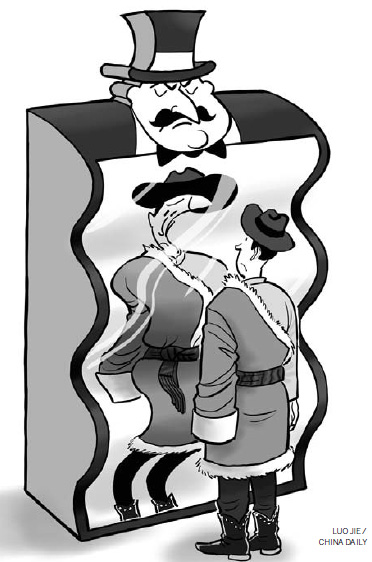
The story is not new. When you meet Westerners who have never visited Asia or are unfamiliar with China and ask them about Tibet, many say it is a place of horrors where the Chinese government ruthlessly cracks down on Tibetans.
Such Westerners assume Tibetans do not have any freedom to practice their religion, they are forced to live in poverty and the Chinese government has created a "concentration camp" atmosphere under the control of the People's Liberation Army (PLA).
But these Western assumptions are based more on fantasy than facts.
Nevertheless, Beijing has not done a good enough job to dispel the myth and prove that in reality the social, economic and cultural life of the Tibetans is a lot better in the Tibet autonomous region today. You only have to say the word "Tibet", and many Westerners conjure up negative images about the Chinese government's role in the region.
To overcome misconceptions, the central government has to play a more effective role in leading a renewed public relations campaign to explain how it is enhancing, not harming, the quality of life in the Tibet autonomous region.
But this is not going to be an easy task, because the Dalai Lama holds sway over the Western mind and has been very successful in his public relations blitz. The Dalai Lama has been so effective at playing the game that to imagine this separatist leader living in India's hill town of Dharamsala as anything but an angelic figure would be deemed as "heresy" by most Westerners. The Dalai Lama is a genius at public relations.
He is a man who loves the cameras and always appears either entranced in spiritual ecstasy or smiling. How can you criticize a man who travels the globe, and tells the world he loves "peace, harmony and compassion" and glosses over the fact that Tibet was never the utopian paradise before 1951, when China liberated the region?
The truth is that the Tibetans were subjected to egregious human rights abuses before 1951, because Tibetan rulers imposed a harsh theocracy on the people where only Buddhism was the permissible religion.
Heinrich Harrer, author of Seven Years in Tibet, described his time in Tibet (1944-51) as deeply disturbing in regard to human rights. He has said democracy, human rights and universal education were non-existent. The Tibet government was ruled by lamas selected because of their religious piety, with the Dalai Lama at the head of this theocracy.
He has written that Tibet had no impartial system of law, while religious leaders and the noble ranks prevailed over justice. Only the Dalai Lama could grant mercy or pardon a sentence.
Whipping was not only legal, but also a common practice. Judicial mutilation, the gouging out of eyes, and cutting off of hands or feet, was not outlawed until 1913. In fact, Harrer saw many limbless Tibetans on the streets, who had been brutalized earlier.
Tashi Tsering, a critic of traditional Tibetan society, wrote an account of how he was whipped severely as a 13-year-old boy for failing to participate in a dance for the Dalai Lama in 1942. Harrer has said monks were especially cruel during the annual Losar Festival, which falls on March 4, when government officials granted permission to Buddhist monks to flog Tibetans, which frequently led to fatalities.
If the West insists on launching campaigns to improve human rights in Tibet, it must also more thoroughly examine the history of Tibet to determine if the Dalai Lama is as innocent as he appears to be. Does the Dalai Lama want the return of a theocratic Tibet?
Yet casting aspersions at the Dalai Lama will not garner the support of the West.
Instead, China must talk about its achievements in Tibet in terms of the progress that the region's economy and society has made. Beijing has to show that the new Tibet is better than the old, feudal Tibet.
It has to emphasize its plans for Tibet's future, too.
Changing the West's misconceptions about the central government's role in Tibet will be difficult. But it something that Beijing has to do if it wants to promote tourism and trade in the autonomous region.
Currently, China is dealing with the Tibet autonomous region in a constructive way, but the Dalai Lama and his fellow activists have a vested interest in keeping the West misinformed. Nowhere does this seem more pervasive than in the articles that Jamyan Norbu, a Tibetan writer, wrote in the Huffington Post on Jan 4, 2011. Norbu has said that for Tibetans "to engage China more constructively" is "to live within this lie".
But, it's Norbu who is being dishonest when he engages in a public relations campaign that calls for extremism and independence, rather than a system of collaboration and moderation with Beijing.
The author is a journalist with China Radio International and before that was based in the United States and later in South Korea.
Specials

Tea-ing up
More turning to Chinese tea for investment opportunities like vintage wine
A cut above
The ancient city of Luoyang is home to a treasure trove of cultural wonders.

Rise and shine
The Chinese solar energy industry is heating up following recent setbacks in the nuclear sector