View
Debate: Dog meat
Updated: 2011-04-25 07:59
(China Daily)


 Twitter
 Facebook
 Myspace
 Yahoo!
 Linkedin
 Mixx
Mixx
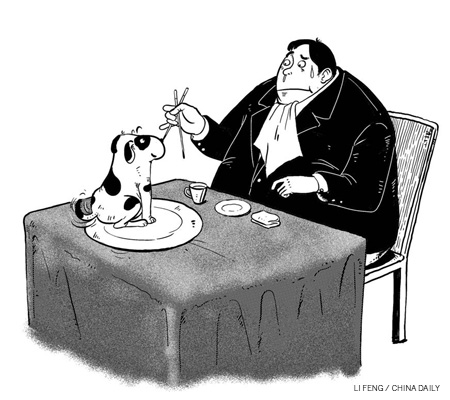
Should the slaughtering and eating of dogs be banned? A teacher and dog lover says an emphatic "yes", but a journalist differs.
Eric Sommer
Dogs not meant to be eaten, but loved
Mahatma Gandhi, the apostle of peace who led the movement to free India from British rule, once said: "The greatness of a nation and its moral progress can be judged by the way its animals are treated."
There is no doubt that contemporary China is a country with high moral values. It has never attacked another country, has no military base outside its borders, has one of the lowest rates of violent crimes and is deeply concerned with the social and economic welfare of its people.
But when it comes to animal rights, China may well fail the Gandhi test. Recently, animal rights activists stopped a truck carrying about 500 dogs on the Beijing-Harbin Highway and prevented them from being butchered and sold as dog-meat in Changchun, Jilin province. The incident has ignited a nationwide debate on the treatment of dogs, and the majority seems to support the sale and consumption of dog meat.
Though illegal in many other countries, there are no laws against the slaughter and consumption of dogs in China. In fact, the serving of dog meat in Chinese restaurants has increased in recent years.
People who eat dog meat have put forward several arguments in their favor. They say dogs have been eaten in China for thousands of years. They argue that there are no extra health hazards from eating dog meat, and instead claim that it has "health benefits" because it contains "certain medicinal properties". In general, they contend that eating dogs is no different from eating any other animal, and accuse people opposing it of practicing a kind of cultural imperialism based on the practices in their countries.
There is, however, a strong argument against eating dogs: they are more intelligent and higher up in the development chain than the other animals we commonly consume as food. Research studies show that a typical dog can count up to four or five, understand more than 150 words, solve spatial problems by modeling on the behavior of humans or other dogs, and generally its mental ability is similar to a two or two-and-half-year-old child.
"(Dogs) may not be Einsteins but are sure closer to humans than we thought," says Stanley Coren, professor of psychology and dog expert at the University of British Columbia, Canada.
A second reason for banning dog meat is the changing sensibilities of Chinese people, who are increasingly adopting dogs as pets. Once introduced as a pet, a family typically comes to consider a dog as another family member - a "baby of the family" or a companion that must be cared for and respected like any of the others.
Even learning about, let alone seeing, others eating dogs can be repulsive and upsetting for such people. For them, eating dog meat is similar to cannibalism. This newfound sympathy for pets has been reflected in a movement against consumption of dog and cat meat in the country in recent years.
To begin with, the Chinese animal protection network has more than 40 member societies and has organized well-publicized protests in Guangzhou, Guangdong province, and many other cities since 2006.
Besides, online signature campaigns against eating dog and cat meat have been joined or started by more than 10 groups, attracting tens of thousands of signatories. More importantly, an online poll that attracted about 100,000 respondents shows that more than 52 percent support a ban on eating dog meat, with only 33 percent opposing such a move.
Finally, the appeal to ban dog meat has reached the highest levels in the country. A draft to ban dog meat was introduced in the National People's Congress last year, though no legislation has been passed. The draft proposes banning the consumption of dog and cat meat, and fining those violating the proposed rule up to 5,000 yuan ($768) and sentencing them to 15 days in jail. Organizations found selling dog or cat meat, the draft says, should be fined between 10,000 and 500,000 yuan.
With an increasing number of Chinese adopting dogs as pets and treating them like family members and the rising opposition to selling and eating of dog meat, it's time China banned the consumption of dogs and cats as food.
The author, a Canadian, is a Beijing-based teacher.
Ku Ma
Poison for one can be meat for others
Some animal rights activists blocked the Beijing-Harbin Highway recently and saved about 500 dogs from being slaughtered and served as food in restaurants in Changchun, Jilin Province, after paying 115,000 yuan ($17,600) for their "rescue". The 15-hour standoff on the highway has sparked a heated online debate on whether eating dog meat should be banned.
I have never tasted dog meat nor do I intend doing so, but I think a regulation to ban dog meat should not be implemented hurriedly.
People in China have been eating dog meat for a long time, even though it's a relatively expensive affair. During the Spring and Autumn Period (770-476 BC), King Goujian of the Yue Kingdom, before going to war against the Wu Kingdom, awarded dogs to women who gave birth to boys and pigs to those who gave birth to girls. Dog meat cost more than pork even then.
According to Shiji (or Records of the Grand Historian), Fan Kuai, a senior military general who helped found the Western Han Dynasty (206 BC-AD 24), made a living as a dog butcher when he was young.
Many consider dog meat not only a delicacy, but also to have medicinal properties. Bencao Gangmu (or Compendium of Materia Medica), the seminal work of medical and pharmaceutical expert Li Shizhen of the Ming Dynasty (1368-1644), describes dog meat as warm, yang-nourishing and especially beneficial for the kidneys and stomach.
But many foreigners and an increasing number of Chinese dog lovers consider the practice of eating dog meat cruel. Howerver, some dietary habits - and even delicacies - in other countries may appear equally cruel or weird to Chinese.
When I was in Australia last year, I was shocked to be served kangaroo meat. The hosts explained that Australians have to eat kangaroos to arrest their ever-growing population and protect the environment. But I felt guilty as if we Chinese were eating panda meat.
Insects are popular snacks in Thailand, but many tourists are appalled at the sight of vendors selling them openly on streets.
Foie gras, a paste made from goose liver, pork fat, onions and mushrooms (and truffles), is a delicacy in France that only the rich can afford. But to get the right kind of liver for the paste, geese are force-fed extra fat, which is against nature and offends animal rights and BirdLife International activists but perfectly in accordance with French laws.
Conservation and animal rights groups are against whaling, which in fact is throwing marine ecology out of balance, but Japanese fishermen continue to hunt whales for food.
Instead of finger-pointing at each, people grown up in different cultures should be more open-minded.
In Northeast China, members of the Man ethnic group don't even touch dog meat, because a folk tale has it that a dog sacrificed its life to save Nurhaci, the Man hero who laid the ground for the Qing Dynasty (1644-1911), from his enemies. But in neighboring South Korea, dog meat is a savored dish, and yet neither side criticizes the other signifying exemplary inclusiveness and leniency.
Dietary habits differ from country to country and region to region, and there cannot be a rule of thumb for all. Some dog lovers distinguish dogs from other animals because of their intelligence and special relationship with humans.
But there are similar many stories about cows, horses, sheep and pigs, too.
Once King Xuan of the Qi Kingdom (reigned 319-301 BC) saw a bull dragged to be sacrificed at a ritual for the installation of a new bell. Seeing its pathetic condition, the king ordered it to be replaced with a sheep. Mencius (c. 372-289 BC), philosopher and great Confucian scholar, praised the king's benevolence but said he ordered the sheep to be sacrificed because he didn't see it.
The Chinese saying, "gentlemen should keep away from kitchens", originated from the story. In fact, critics have always doubted such a hypocritical sense of mercy.
How can it be morally and culturally acceptable to eat pork, chicken, mutton, beef, fish and other animals but not dog meat? Aren't we behaving like King Xuan?
But that does not mean we should turn a blind eye to animal rights abuse. Animals are part of nature and should be protected and treated properly. Many animals are under the protection of wildlife laws, and people treating animals cruelly should be punished. But implementing a law to ban dog meat is not advisable rather our attempt should be to persuade people to change their eating habits. Indeed, some dishes like cooking or eating live fish are disappearing gradually from Chinese dinner tables, because of people's changing mindset.
The sale of dog meat was banned in Seoul, capital of South Korea, in 1984, but the local government didn't enforce the regulations rigorously because of people's culinary preference - not even during a big international event like the 2002 FIFA World Cup.
This should reflect the difficulty of enforcing such a ban in China. People in this country, too, have been eating dog meat for thousands of years. But then one man's meat is another man's poison. Stopping people from eating dog meat in China will be a long-drawn process of social and cultural development and change in culinary habits.
The author is an editor with Op-Ed department of China Daily.
Specials

Urban breathing space
City park at heart of industrial hub positions itself as top tourism attraction

On a roll
Auto hub Changchun also sets its sight on taking lead in railway sector

The stage is set
The Edinburgh International Festival will have a Chinese flavor this year.