Life
Then & now
Updated: 2011-05-29 07:55
By Rebecca Lo (China Daily)


 Twitter
 Facebook
 Myspace
 Yahoo!
 Linkedin
 Mixx
Mixx
|
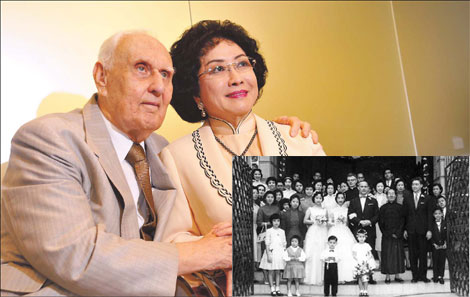
Dan and Vera Waters have weathered 50 years together, and their marriage is testimony to the effort they both committed to making a cross-cultural union work. KWok Ching / For China Daily |
Two Hong Kong authors talk to Rebecca Lo about their personal experiences with cross-cultural marriage.
Dan Waters has been married for more than 50 years, and he is still as devoted to his Chinese bride as the day they walked down the aisle at Pokfulam's St. Anthony's Church in 1960. Their wedding day was on Queen Elizabeth's birthday, a public holiday in Hong Kong at the time. A few Europeans were scandalized and refused to attend the wedding, though all the invited Chinese guests came to witness the celebration. Originally from England, Waters saw action in North Africa and Italy during World War II before sailing for Hong Kong in 1954. He joined the Government Education Department and taught at the precursor to the Hong Kong Polytechnic University before going on to become principal at Morrison Hill Technical Institute.
While he was a lecturer, he met Vera Chan, a young commerce student - though he quickly points out that he never taught her. The year was 1955. At the time, cross cultural relationships were scarce and a Suzie Wong prejudice was the norm. Though Waters himself did not experience any discrimination, he was warned against marrying into the Chinese culture by his boss, S J G Burt: "Only two kinds of people marry Chinese women: policemen and cranks."
"I was always interested in Chinese culture and customs," Waters remembers. "I was attracted to Vera partly because she was Chinese. She had an 18-inch waist - I could circle it with my two hands when we were married.
"Vera's father didn't want her to marry a foreigner. He didn't have any sons, and he wanted to have a Chinese son-in-law to 'buy water' at his funeral. But he died in 1959. I got along very well with my mother- and sisters-in-law, though they didn't speak English. I learned household Cantonese and we managed. I just accepted that there would be problems, and found the difficulties intriguing."

He says he has been researching material for his book throughout his entire marriage, collecting a file of information whenever he came across an interesting item in newspapers or through word of mouth. By 2003, he had a lot of potential candidates for his book. He found the rest through referrals.
One Couple Two Cultures is a study of 81 Western and Chinese couples and how they coped with a cross-cultural marriage.
"Some people didn't want to be interviewed," he admits. "About 30 couples turned me down - and some of them were people who I thought would have a lot to say on the subject." Waters notes that often if the marriage was unhappy, the couple would rather not air their dirty laundry.
Kirsteen Zimmern has no qualms about presenting facts as she sees them. She witnessed firsthand her parents' cultural differences. The 32-year-old Hong Kong mother, barrister, amateur photographer and author of The Eurasian Face was born to a Scottish mother and an Indonesian-Chinese father. She grew up on a large property in Yuen Long surrounded by her father's extended family. Cantonese was her first language.
"I was aware that I looked different on the outside," says Zimmern, combing out her dark blonde hair in her Pokfulam apartment after swimming lessons with her 3-year-old son James.
"I wanted my grandmother to dye my hair black when I was little. I felt Chinese. I didn't really put it together at the time that I looked like my mom."
Zimmern's parents first met when her mother's father came to Hong Kong to work with the Mass Transit Railway (MTR) Corporation. He brought along his wife and 22-year-old daughter and asked a friend of a friend to show them around.
It was love at first sight: Zimmern's mother never went home. Her parents are now separated, though both live in Hong Kong and remain close friends. She sees her parents' cultural differences as being tough on the relationship.
"They couldn't understand that each thought he or she was doing the right thing," she surmises. "Mom would prepare a nice meal and wait patiently for dad to come home. Dad was selling insurance, and that meant a lot of wining and dining. He felt that he had to provide for his family.
"After an evening with clients, he would come home, put his key in the lock, and remember that our school tuitions were due next week. And he would go right back out again to earn more money as mom waited inside.
"Though his English was good, it was his second language. Communication between them was frustrating at times. But both are very accepting people and there was a sense of duty to each other. After all, they managed to stay together for 20 years! That's epic."
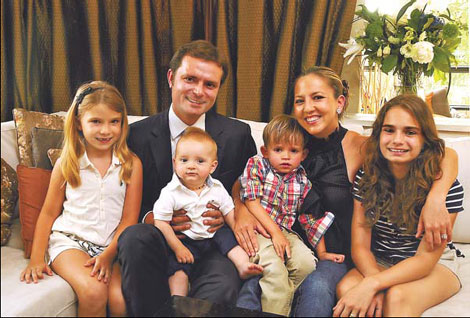
A mother with two sons and two step-daughters, Zimmern is married to Richard, a fourth generation Hong Kong Eurasian. She credits their "somewhat Chinese" backgrounds for the mutual understanding about what takes priority in their household.
"We are on the same page when it comes to raising our kids," she says. "They go to bed at 7:30 pm, not when we go to bed - which is very western. But in other respects, we have an old school Chinese way of doing things. We understand the nuances of face. And we both grew up deferring to our elders. We have lunch every Saturday with my mother-in-law. We know when to keep our mouths shut and our heads down. We don't feel that we have to discuss everything in depth."
She came up with the idea for a photo essay on the thoughts and experiences of other Eurasians through a dream. The next day, she tracked down a publisher willing to accept her.
"I had no idea how rare it is to get a first book published this way," she laughs. She gave each of her subjects free reign to say what they felt in the first person, and found many of them through Facebook or referrals.
She argues that Eurasians are good sales people because they are attractive and appeal to a wider demographic. Flipping through Zimmern's book, most of the faces have an exotic quality about them that invites a closer look. She recalls that when she was in high school, all her friends wanted a hot Eurasian boyfriend.
Zimmern routinely has strangers trying to guess her ancestral origins. She tried to capture that moment in her book when people have no qualms about figuring out her family tree.
"People are amazed that Chinese can come out of my mouth," she says with a shrug. "If it's a shop clerk, their jaws drop and they sometimes forget to do their jobs. If I go to a Chinese movie, people assume that I am in the wrong theater. I find it displacing to be in my home city but don't belong. When I was studying in London, no one looked at me twice."
Dan Waters feels it is much easier today being in a cross-cultural marriage, and that the younger people who he interviewed didn't feel there was anything remarkable about it.
"Opposites attract," he believes. "And it is important to keep a sense of humor and have your own goals and interests."
Zimmern feels Hong Kong is very accepting of cross-cultural marriages in comparison to other parts of the world.
"It is about being in the minority," she says. "In small towns in the US, many Eurasians were unhappy because they encounter racism. In Hong Kong, the younger people I interviewed had nothing to say about the subject - because it is so normal to be Eurasian here."
|
Both Kirsteen Zimmern and husband Richard are products of two cultures in a marriage. Kenny Ho / For China Daily |
Specials

Room at the inn
The Chinese hotel industry experiences a building boom, prompting fears of oversupply.

Pearls of wisdom
Chinese pearl farmers dominate the world market but now want to work smarter, not harder
Truly a super woman
Li Yuchun first came to prominence in 2005 as the Super Girl winner, and since then has become an international star.