View
The pros and cons of studying overseas
Updated: 2011-06-09 07:42
By Chung-yue Chang (China Daily)


 Twitter
 Facebook
 Myspace
 Yahoo!
 Linkedin
 Mixx
Mixx
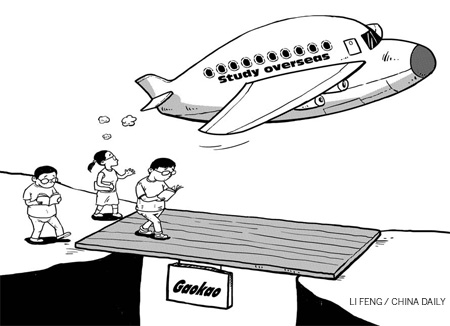
High school students across China are taking gaokao, the annual national college entrance examination, which normally lasts three days. This time every year, students and their parents face intense pressure, while teachers, neighbors - in fact, the entire nation - lend them support. The intense competition has a critical outcome.
This year the number of students taking gaokao is about 9.33 million. It was 9.46 million last year and 10.2 million in 2009. The reasons for the decline are the decreasing birth rate and the rising popularity of overseas undergraduate studies.
The decreasing birth rate is a cold demographic fact, given China's strict family planning policy. Overseas studies, however, is a hotly debated phenomenon. In 2010, about 200,000 high school graduates skipped gaokao in favor of studying overseas. The meaning of this youthful migration is not yet clear.
There exists a debate among experts, families and schools on whether high school graduates should study overseas. The answer of many experts is a clear "no". Studying overseas is deemed risky for youngsters' normal development, and may not contribute significantly to their future career success. Also, it will most certainly put an inordinate financial burden on them and their families.
Sending youngsters to study overseas is not new in China. Between 1872 and 1875 the Qing Dynasty (1644-1911) rulers created the Chinese educational mission (CEM), which sent 120 carefully selected boys, some as young as 14, to study in the United States. With newfound Western knowledge, they returned to serve China. They became diplomats, business leaders, navy commanders who fought in the Sino-French War (1883-1885), engineers like Zhan Tianyou who built China's first railway without foreign help, and diplomats such as Tang Guoan who founded the world-famous Tsinghua University, which is celebrating its 100th anniversary this year.
The CEM experiment was successful for the following reasons. CEM's mission was clear and execution focused. Student quality was uniformly high. It was well funded by the Qing government. It was supported by the US government and by institutions such as Yale University, too. Students were chaperoned and lived with caring American host families. Last but not least, students' cultural exposure was balanced, for during their stay in the US, they also received traditional Confucian instructions from CEM tutors.
Even after 140 years, there is a lesson to be learned from the CEM experience. Overseas education for Chinese students, especially for high school students, can be beneficial only if proper arrangements are made. Studying abroad for high school graduates is a risky proposition today. For many students and their parents, the arrangements could be too ill-conceived, inadequate or inflexible to accommodate circumstantial changes. Other students may fare better, because of proper planning and arrangements made to counter academic, emotional, social, financial and cultural inadequacies they could face. Ultimately, parents are primarily responsible for making proper arrangements for their children.
Today, many of those who skipped gaokao are top students, while others are not. The top students may receive multiple undergraduate acceptance letters from top foreign universities. And average students may be lured to attend lower-tier institutions that are eager to accept foreign students but not capable to accommodate their special academic and personal needs.
Many 18-year-olds are not mature enough to take proper care of themselves. In April, a Chinese youth from a rich family was kidnapped and robbed of his Porsche after attending a university in Boston for only a few months. This happened largely because he was flashing a lot of cash and paying big bar tabs for friends around campus. Luckily, he was later rescued by police.
Then there are students with financial worries. In the same month, a student returning from a college in Japan stabbed his mother at Shanghai airport after he got into an argument with her over tuition.
Money can be a burden. If having too much money but not knowing how to spend is a burden, not having enough and not knowing how to make the requisite adjustments is also a burden.
To take the gaokao, attend a university in China, work a few years, and then go overseas for advance study would be a sounder approach for a more mature individual. The proper arrangements, still required, would be less complicated than the case for undergraduate overseas studies.
To take gaokao or opt to study abroad either can be a good choice. The question is "when" and for "whom". To answer this one needs self-knowledge. As an expert has summed up the requisite self-knowledge, "yin ren er yi, liang li er xing", which roughly translates into: "Use different measures to fit different needs. Do what is only within one's ability to do."
The author teaches Western and Chinese philosophy at Montclair State University, Upper Montclair, New Jersey, US.
(China Daily 06/09/2011 page9)
Specials

Birthday a new 'starting point'
China's national English language newspaper aims for a top-notch international all-media group.

Room at the inn
The Chinese hotel industry experiences a building boom, prompting fears of oversupply.

Pearls of wisdom
Chinese pearl farmers dominate the world market but now want to work smarter, not harder