Influential at the start
Updated: 2011-10-07 08:45
By Wang Yan, Zhang Yuchen and Wu Wencong (China Daily)
|
|||||||||


|
From left: Lin Shu, the translator; Yan Xiu, the educator; Zhu Erdian (John Newell Jordan), a UK diplomat; and Zhang Zhujun, the medic. They are only four of hundreds of people who influenced civilization in New China. China Daily Illustration by Zhang Ye, using artwork Provided by Beijing News |
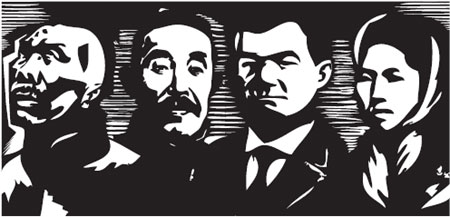
The 1911 Revolution brought about more than political reform. Some key people led change in everyday lives, Wang Yan, Zhang Yuchen and Wu Wencong report.
This month will see not only a large celebration for the 62nd National Day of New China, but also the 100th anniversary of the 1911 Revolution, which brought an end to the country's last imperial dynasty. The revolution, which is also known as the Xinhai Revolution, brought the curtain down on the Qing Dynasty (1644-1911) and gave birth to a republican form of government. Zhu Xiehan, history professor at the Chinese Academy of Governance, deemed it a great turning point in Chinese civilization.
On Oct 9, 1911, a bomb made and put in a hidden place by revolutionaries was exploded by accident in Wuhan, Central China's Hubei province, leading those who were hostile to the imperial power to begin to carry out their long-held plans before they had expected to. The ensuing conflict between Qing loyalists and the revolutionary forces of the Chinese Revolutionary Alliance ended with the abdication of Emperor Puyi on Feb 12, 1912.
The Republic of China was then established and Sun Yat-sen was appointed to be the provisional president. He later agreed to make Yuan Shikai, previously the prime minister of the Qing Dynasty's imperial cabinet, the president. Within a few years, Yuan was trying to reinstate the Chinese monarchy.
"China was politically fragmented during the time, and abundant new ideas were flowing in," Zhu said. "People were faced with a slew of choices about the future of China. It was a time of wisdom, when lots of personages left their names on history. It was a liberal and free period that embraced deep observations and thoughts about the nation and the world.
"New ideas drove reforms throughout society. People were fighting for their own goals. The changes were obvious."
To mark the eve of the revolution's 100th anniversary and to gauge its consequences for the country both then and now, China Daily reporters looked at the stories of some who lived through the events.
Lin Shu (1852-1924) the translator
Lin Shu, who is best known for introducing Western literature to a whole generation of Chinese readers despite his ignorance of any foreign language, is representative of a group of intellectuals whose enthusiasm for the revolution waxed and waned over time.
During his life, he translated more than 170 novels and other works that were originally in English or French, including Alexandre Dumas' La Dame aux Camlias and Harriet Beecher Stowe's Uncle Tom's Cabin. Since he could not read those works himself, he had to rely on help from assistants, whose initial renderings he later put into literary Chinese.
Before the translations, Lin took China's imperial examinations seven times, failing every single one. Until he was faced with the shock of the revolution, he never considered becoming an adherent of the ruling dynasty.
After fighting broke out in the city of Wuchang in October 1911, Lin fled with his family from Beijing to Tianjin and took up residence in the British concession. Jubilation over the victory against the Qing soon filled the city, making Lin recognize he had to choose which side to stand on.
After the new government decided to let Lin's elder son remain a county leader in Hebei province, he threw his support behind the revolutionaries.
"There is no reason to go back to the monarchy since a republican period in history is coming," he said. "I hadn't received an official title in the Qing Dynasty and cannot be counted as an adherent of the old regime."
A year later, Lin and his family returned to Beijing. He wrote essays that he hoped would be seen as guides to the government. Still, he felt puzzled by the unstable state of society and politics he was witnessing.
When Yuan Shikai, in his short-lived attempt to revive the Chinese monarchy invited Lin Shu to work in a position, Lin refused.
From then on, Lin became increasingly fond, as many intellectuals then did, of the fallen imperial dynasty. In 1917, as Lin persisted in writing classical Chinese, he was severely criticized by the young as being stubborn and reactionary.
He became disillusioned about the revolution. His support further shifted toward the former rulers of China after he unexpectedly received a favor from the last emperor. At a royal wedding in 1922, Puyi gave him a slab engraved with Chinese characters implying that he had been a loyal adherent to the Qing Dynasty.
Yan Xiu (1860-1929) the educator
Being one of the best-known educators in Chinese history, Yan Xiu used to hold a high post in the National Academy (Hanlinyuan) of the Qing government.
In 1902, he started the first home school for girls in Tianjin, at first enrolling his female relatives who were between the ages of 10 and 20. The institution later became one of the first formal primary schools for girls in the country.
Among the classes taught there were Chinese, English, Japanese, math, physics and history.
In 1905, Yan established one of the first private kindergartens in China, basing it on institutions he had seen in Japan when he took two tours of that country between 1902 and 1904.
Before the 1911 Revolution broke out, Yan had quit his job. He later refused posts offered to him by the Qing government but accepted an invitation to tutor Yuan Shikai's children.
After Yuan was elected the provisional president of the Republic of China in 1912, he tried to persuade Yan to come out of retirement and take a high post in the new government. Yan, though, stuck to his principles and declined Yuan's offer several times.
He made his reasons for doing so clear: He had not agreed to participate in state affairs, only to be a teacher for Yuan's family.
Since 1902, Yan had put most of his exertions into opening and running schools. In the years leading up to 1905, Yan joined some friends and businessmen to help set up more than 20 primary schools, girls schools and technological academies.
He visited the United States in early 1918 to learn about higher education and returned to China intent on raising money to build a top-class university. The next year, Nankai University, where late premier Zhou Enlai later studied, was established in Tianjin.
The next five years saw Yan donate a lot of money, land and books to the university. In 1928, a series of "Nankai schools" was formed: a primary school, middle school, girls school and university.
Yan was opposed to the imperial examination system and called for it to be abolished. He thought the old ways of teaching had placed too much emphasis on poems and literature, things that he saw as being completely useless in real life. As a result, students in his schools and universities learned history and English and about Western science and technology.
John Newell Jordan/Zhu Erdian (1852-1925), a UK diplomat
When the first gunshot of the 1911 Revolution rang out at night, John Newell Jordan, who was known in Chinese as Zhu Erdian, was 59 years old and had spent more than half of his life in China.
By the end of the 1870s, a campaign to make China more Western had prevailed. Western money began pouring into the country to meet government officials' demand for Western science and technology. Those events brought Zhu, a UK diplomat, to China in 1876, when he was 24.
When the revolution broke out, both the Qing government and the revolutionary alliance were trying to win his support. At first, he chose to stand with the government, a policy picked to best serve UK interests.
Seventy percent of China's imports at that time came from the United Kingdom. The UK government also held shares in 60 percent of the foreign companies in China and was also the biggest creditor of the Qing.
Jordan soon found that actual events in China were deviating widely from his expectations. Within a month after the revolution started, 11 provinces and cities across the country had declared independence.
Qing government officials were so desperate to hold the country together that they began to consider appointing Yuan Shikai to the important post of prime minister. Just two years before, he had been told to retire after his military power had become great enough to pose a threat to the government.
Zhu had long admired Yuan, considering him to be the official most capable of protecting the UK's interests in China from the Qing government. So he made use of his influence and played an important role in Yuan's appointment as prime minister.
When the events of October 1911 came, though, Zhu was realistic enough to see that even Yuan was not powerful enough to stop the revolution. He then put his efforts into bringing about a peaceful reconciliation between the revolutionaries and the loyalists, using Yuan as an intermediary.
Zhang Zhujun (1876-1964), the medic
A native of Panyu county in Guangzhou, Zhang Zhujun graduated from a local medical school at the age of 23 and founded two Western-style hospitals the same year. She also became the first female hospital director in China.
She accomplished all of these things in 1899, a time when Western hospitals were still rare in China. Her deeds were thus seen by many as being irregular.
Then again, she was never one who allowed herself to be confined by tradition.
During her life, she could be seen at many times wearing a man's suit with a formal hat, sitting on a shabby sedan chair held by four people and reading books while shuttling back and forth in the streets.
Aside from wearing odd clothes, Zhang set up a lecture association that she used to give speeches to the public on weekends, spread new ideas and criticize old notions about ethics.
Her audiences became larger and larger. Many celebrities paid her deep respect. Some called her the female version of Liang Qichao, a famous politician, educator and enlightenment thinker.
In 1904, she went to Shanghai to establish hospitals and girls schools, moving her career into social welfare.
After the 1911 Revolution broke out, she started a non-governmental organization called China Crimson Cross, which worked with the State-owned Qing Dynasty Red Cross.
Only five days after the organization was established, Zhang took her team to the front lines of the revolutionary battlefields in Wuhan, Hubei province. She stayed there for a month and three days, curing the wounded and performing surgeries. One day, she accidentally cut herself during a procedure. The wound was infected, her two hands swelled and she ran a high fever.
Returning to Shanghai for a rest, she was greeted with a warm welcome, and has since been recognized as "the Chinese version of Florence Nightingale".
Not just a piece of history
"People from different walks of life were calling for reforms in politics, education, literature, medicine and so on," Zhu said. "New things were coming in and many 'firsts' occurred."
Listing the accomplishments of the 1911 Revolution, Zhang Haipeng, research professor with the Chinese Academy of Social Science's institute of modern history, cited "freeing the country" from imperial rule and "establishing the constitutional system".
"After the revolution, rights could be talked about, and it opened the door to managing the State according to a constitution," Zhang said. "Sun Yat-sen, for the first time, introduced the principle of government stipulating that officials at all levels should serve the people as 'public servants'."
The revolution is not just an event in history, according to professor Zhu, but rather the product of a spirit that should live on.
"History is never a story by itself, but an interpretation made in the light of current facts and thoughts," Zhu said. "With changing times, the same story will result in different inspirations."