Michael Chow: A Life fit for a Hollywood script
Updated: 2015-03-06 11:41
By Li Jing(China Daily USA)
|
||||||||


Michael Chow is better known in the West than in his native China.
As the owner of Mr. Chow, one of America's most glamorous and most expensive Chinese restaurants, Chow conquers the palates of Hollywood A-listers while he juggles roles as restaurateur, art collector, architect and designer.
Chow, however, has a very different identity in his native China, where he is known as Zhou Yinghua, the son of revered Beijing Opera grandmaster Zhou Xinfang.
Born in Shanghai in 1939, Chow is the youngest son of Zhou Xinfang (1895-1975), one of China's greatest 20th Century Peking Opera performers, on par with Mei Lanfang at the time. His mother Qiu Lilin came from a wealthy family whose fortune had been made in tea.
"My Chinese name was made by my father and he expected me to be yinghua, translating a Chinese hero in English," Chow said. Influenced by his father's dedication to Peking Opera, Chow was immersed in the highest forms of Chinese culture from an early age.
Wanting to follow his famous father's footsteps into theater, he was instead packed off by boat to Great Britain at the age of 13 and started his Hollywood script-like life to be a "Chinese hero" by bringing the East to the West.
After a 60-year absence from China, he returned with his re-established persona as an artist, bringing the West to the East. He had landed his first exhibition in his homeland, "Michael Chow: Voice for My Father".
"It is important in the sense that the time is incomparable," said 76-year-old Chow at the exhibition opening ceremony, in a short-sleeved t-shirt mixed with jeans spotted with paint. The show is being held as part of major official celebrations commemorating the 120th anniversary of Zhou Xinfang's birth this year. It will move to the Power Station of Art in Shanghai in April.
On imposing large-scale canvases, paint, milk and melted metal are mashed with egg yolks, stuck on sponges and other materials, something reminiscent of classic Jackson Pollock. Chinese esthetics is rooted in expansive stretches of white punctuated with at times dense collections of material, creating a vision of Chinese ink-and-brush painting.
These works are a collage, a technique of modern art that Georges Braque and Pablo Picasso created in the beginning of the 20th Century, which Chow studied at Saint Martin's School of Art, a beneficiary of the great postwar boom in British art education, when the schools opened art-making to the working class.
In 2012, Chow returned to his artistic roots after a 50-year hiatus, a "radical sabbatical" as he dubs it.
Jeffrey Deitch, the former director of the Museum of Contemporary Art, Los Angeles (MOCA), encouraged the reluctant painter to pick up his brushes again, after visiting Chow at his home and happened to notice a small painting of his from 1962 leaning against the wall in the kitchen.
"Chow's work fuses Asian, American, and European aesthetic approaches, drawing on his extraordinary international background. His paintings embody his experience in theater, painting, and even cuisine," said Deitch. "His 60 years of creativity have now been distilled into the most concentrated and perhaps the most challenging art form: abstract painting."
Around the founding of the People's Republic of China, Chow's mother sent Chow and his siblings abroad, in advance of a cascade of social movements that would lay waste to his family's fortune and legacy.
Chow said his mother had many talents dealing with life and skills to live in the world. "My career life is based half on my father and half on my mother," Chow added.
In 1951, Chow went on his own to boarding school in England in the bleak, war-ravaged and food-rationed country, leaving a life of pampered opulence.
Different from the new rich second generation 60 years later, Chow's overseas life started with a rude shock.
"I lost everything I loved or familiar. I found myself an alien in an unfamiliar place. I felt like Oliver Twist," Chow recalled with a sense of sadness. "I never saw my father again." He saw his mother only once more when she visited him earlier at school.
"Chinese was seen as the lowest of the low. I had a bad health and I felt I was on the edge of death every day," Chow recalled. "But if I could survive, I could rejuvenate to do everything. I needed to fight the battle."
An interest in photography led to a year at Saint Martin's School of Art, and from 1956 to 1958 he studied architecture at the Hammersmith School of Art and Building.
He painted for 10 years and showed in a range of exhibitions in the London art scene of the 1960s, with titles like "Three Contemporary Chinese Artists" and "Artists of Fame and Promise".
"But the conditions weren't quite right, there was no support system for me to be an artist, certainly not in London and America and history proves that. I think the only successful artist was Zao Wou-Ki and he lived in Paris," Chow said in an interview with ARTINFO Hong Kong.
"Previously, it was very cynical. There were only two jobs for Chinese, laundry or restaurant."
Having flair of networking and a knack for being in the right place at the right time, he went on to open the iconic Mr. Chow restaurants, first in London, then New York and Los Angeles, where he lives today.
The restaurants are as famous for the people who dine in them as they are for their Beijing duck -- The Beatles and The Rolling Stones have all hung out at Mr. Chow's and John Lennon ate his last meal out at Mr. Chow New York.
From an early age he became an obsessive collector of furniture and contemporary art, notably his, famous collection of portraits (of himself) by world-renowned artists.
In the long gallery of the exhibition space, Chow's paintings are joined by his iconic portrait collection, which includes works by artists such as Andy Warhol and Jean-Michel Basquiat. Many of these portraits were acquired directly from these artists or given as gifts in recognition of friendship and collaboration with Chow over the years.
"My works are collages and basically my life is a collage, too," Chow said. "Collage allows putting different things together, so I want to encompass as wide as I can. In order to survive in the West alone, I have to have life skills by using techniques of collage."
In Chow's works, gold leaf and silver, household trash, acrylic paint, blow-torched metal and broken eggs are mixed on the canvases.
"In some ways, my father has been very lucky," says his eldest daughter, China Chow, as quoted by W Magazine. "He is incredibly hardworking, has a great eye, and has mastered the art of running a restaurant down to the tiniest detail. But he also has a knack for popping up in the right places at the right time -- London in the 1960s and 1970s, when that city was the cultural center of the world; New York and L.A. during the art and showbiz booms there. It's uncanny."
Finally though, the timing was right to return to China.
"Fifty years ago, for a Chinese painter in the West, there was no support system and I had no encouragement. But now, I feel that the conditions are correct, especially with China being so prosperous and creating many great recent artists," Chow said.
"China went through almost 500 years of decline, and in particular in the 20th Century, suffering from two World Wars, civil war and natural disasters. The good thing is that the reversal, from my point of view, started in 1949, boosted by 2008 Beijing Olympics. China reverses itself and 21st century belongs to China.
"Like liangxiang (striking a pose when staging on the stage) in Peking opera or the opening scenes from movies, I hope my paintings to grasp the audience at the first sight," said Chow. "Simplistic and powerful, like a hook."
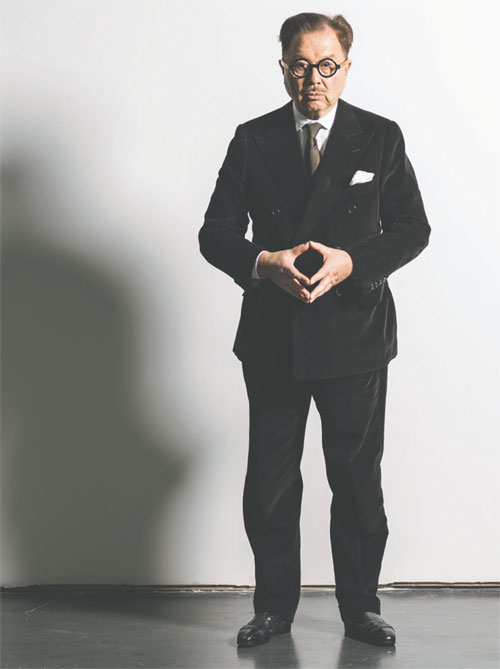
Amicable and jovial, he imitates a Peking Opera performer's action on stage to explain the point. Behind his trademark, black-rimmed bespoke glasses, the energetic septuagenarian doesn't resemble a person of his age and the glasses give him an almost startled look.
"I had bad fortune and good fortune mixed all in one. I left for London at 13 and lost everything I was familiar with, but got my objective mindset to view the world," Chow said.
Lijing2009@chinadaily.com.cn


|
MichaelChow (the youngest) and his siblings with father Zhou Xinfang. Provided to China Daily |

|
Michael Chow, the owner of famous chained Mr Chow restaurants, reestablishes his old and new identity as an artist in China. Provided to China Daily |
(China Daily USA 03/06/2015 page10)
 Culture Insider: 6 things you may not know about Awakening of Insects
 Top 10 favorite gift brands of rich Chinese men
 Buddha statue with mummified monk is museum draw
 Snowstorm rages in eastern US
 Across Canada March 4
 Seven things you may not know about Lantern Festival
 Top 10 destinations for Chinese tourists
 Floods displace over 2,000 in Brazil
Most Viewed
Editor's Picks
|
|

|
|

|
|
Today's Top News
US fails to grasp China's terror laws: legislature
Militaries' cooperation 'key' in ties
China, California address climate, energy issues
US companies bullish on China
China faces 'formidable challenges', says Li
Diplomats talk about 'two sessions'
GDP target drops to 7%
US ambassador to S.Korea attacked
US Weekly
|
|