 |
|
 |
Large Medium Small |
|
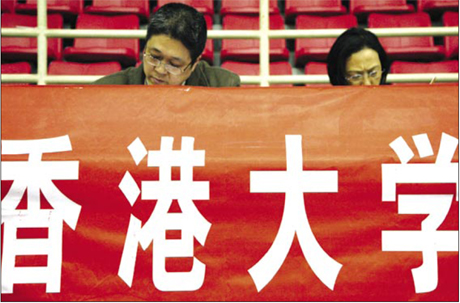 Parents of high school students study documents behind the banner of Hong Kong University at an enrolment fair held by Hong Kong colleges in Nanjing, East China's Jiangsu province, last year. Provided to China Daily |
BEIJING - Hong Kong universities are losing ground to their mainland and foreign peers, with a couple failing to attract even one applicant from the Chinese capital.
Over the past two years, fewer students from all over the mainland have applied to study at Hong Kong universities, which were once magnets for mainland students.
This year, two lesser-known universities, Lingnan University and Chu Hai College, failed to recruit any student from Beijing, a long-standing pool for Hong Kong colleges, data released by Beijing's Education and Examination Authority showed.
Lingnan University's spokesperson Priscilla Chan said one key reason for the decrease has been that mainland students now have more study options.
"We did notice a decrease in the application number," she said.
Top institutions such as the University of Hong Kong (HKU) saw about 8,000 applicants last year and 9,000 this year, down from its peak in 2008 of 12,000.
HKU would not comment on the decline.
Hong Kong Polytechnic University (PolyU), a top science university in Hong Kong, is also seeing fewer mainland applicants.
Eddie Ho, assistant manager of its mainland affairs office, said PolyU used to receive up to 9,000 applications from the mainland in 2006 and 2007.
"Due to the impact of the financial crisis, only around 3,600 mainland students applied last year. And the number is about 4,200 this year," Ho said.
To make matters worse, fewer top scorers are opting for Hong Kong universities.
Ho said the number of students from the mainland who received its top scholarships dropped from 95 in 2007 to 48 this year.
Since 2008, no top student from South China's Guangdong province - which shares its dialect with Hong Kong - applied to study in Hong Kong. From 2005 to 2007, there were nine.
Guangdong's eight top scorers in the National College Entrance Examination from 2008 and 2010 all went to Peking and Tsinghua universities, both in Beijing.
Education experts said this points to Hong Kong's diminishing role as a bridge to the mainland and the rest of the world as the mainland continues its move to be a global economic power.
"The competition that Hong Kong universities have to face is apparently fiercer," said Li Jixing, researcher at China Central Education Science Research Center in Beijing.
Internationalism used to be the triumph card of Hong Kong universities, but their mainland counterparts are catching up.
"Mainland universities are becoming more and more international these years, after cooperating with and learning from foreign counterparts," Li said.
Generous scholarships used to be another lure for mainland applicants.
Hong Kong universities offer HK$120,000 ($15,400) a year in scholarships to top mainland students, an amount equivalent to the starting salaries of fresh graduates in Hong Kong.
Years ago, mainland students would choose Hong Kong as a springboard to apply for further studies in countries such as the United States and Britain.
But with easier access to study at Western universities, more mainland students, especially the top ones, are going directly to colleges in countries abroad.
US universities, for example, admitted 16,000 mainland students last year, up from 9,000 in 2007, a recent report in the Washington Post said.
In addition, a decrease of students taking China's national entrance examination also contributed to the woes of Hong Kong universities.
About 9.5 million students took the exam this year, down from 10.2 million last year and 10.5 million in 2008.
At the same time, an increasing number of high school students are skipping the national exams and applying to overseas universities directly.
"The national exam is too competitive, and I don't want to take my chances," said 18-year-old Zhang Xinyue, a high school student in Chongqing, a municipality in southwest China. She has already been offered places and scholarships from three US universities.
"It is a new and growing trend for students to skip the national exam and apply for overseas universities directly," said Yu Ying, deputy director of Bashu High School in Chongqing. "Excellent students deserve to be recognized by good universities abroad instead of being buried in the crammed national exam."
Hong Kong universities, however, appear not to be concerned about the decline in the number of applicants.
Candy Chouk, senior liaison officer of the mainland and external affairs office of the City University of Hong Kong, said fewer applicants will not affect recruitment plans for the mainland.
"The number of applicants is decreasing, but it is still a big number," Chouk said. "The talent pool is big enough."
After all, Hong Kong universities recruit less than 2,000 students from the mainland every year, Chouk said.
For China Daily


