|
|
 |
Large Medium Small |
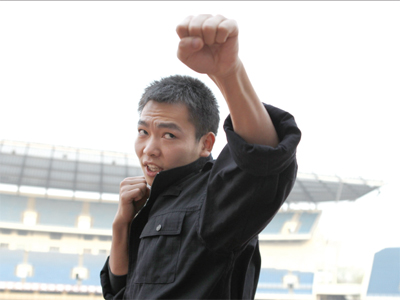
Striding authoritatively through the halls of the Olympic Sports Center Stadium, where his employer, Lightning Bodyguard Co. Ltd., is based, the slim 180cm Wuhan native told of his journey from soldier in the People’s Liberation Army to bodyguard for prominent citizens and visiting celebrities.
“After two years of the military, I would return home and my mother would tell me I looked awful,” said Xu, attired in his company’s black fatigues.
“She would say I looked exhausted and worn out, not as energetic as I used to be.”
Turning the corner into his office, he pivoted his perfectly polished black boots at a 90-degree angle, flashing a patch sewn onto his sleeve. The patch displays his company’s coat of arms — a lightning bolt stitched into a map of the world hovering above a thick-legged white pigeon — symbolizing peace — flying over the Great Wall.
“She thought being a soldier was too dangerous and too exhausting,” Xu said, with a broad smile spreading across his boyish face. “But I knew it was just hard work.”
When a group of rich businessmen approached his commanders looking to hire personal bodyguards in early 2008, Xu thought of what his mother had said. Lured by more money, he jumped at the opportunity, to leave the military at age 20 after two years of enlistment.
“When my mother first found out I took a job as a bodyguard, she was still unhappy with me,” he said. “She didn’t want me to put myself in harm’s way.”
Working as a private bodyguard has not proven to be as dangerous as the military, but the job still has its downsides.
After just three months of working privately for the businessman, Xu became bored. He was still earning relatively little money.
“It wasn’t very stable, they didn’t always require my help and didn’t want to pay me just to sit around,” he said of that job.
As a private bodyguard, he could not carry the official title of bodyguard, which would command a more respectable paycheck. Instead he was categorized as a driver.
In addition to unstable working conditions and low pay, he was at times asked to do things that were not necessarily illegal, but made him question the ethics of the request, he said.
In one extreme case, while working for another businessman, he said he was asked to physically assault someone who had insulted his employer.
“My employer at the time wanted me to take revenge on this person, despite it being against the law,” he said. He noted that former military personnel caught breaking laws face doubled punishment. He refused and left the position immediately.
Shortly after that, in late 2008, he started work with Lightning Bodyguard.
He said the meaning of his job as a bodyguard has changed significantly since moving into the profession. Now Xu has had the opportunity to guard some of China’s highest-profile actors, actresses and athletes, including Jackie Chan, Yao Ming, and Fan Bingbing.
Two years into the job, his mother has accepted and even him.
“She also told me I look much better when I come home to visit now,” he said.
In 2008, during the Beijing Olympic games, Xu was responsible for helping apprehend someone suspected of planning to attack Yao during a visit with fans.
Dressed in plainclothes while watching over Yao, Xu spotted a strange-looking man among a crowd of fawning fans.
The police quickly apprehended the man and discovered he had been holding a plastic bag full of liquid, later determined to be ink, behind his back.
“He didn’t want to hurt Yao Ming but he wanted to disrupt things by throwing ink at him. He was just a troublemaker up to no good,” said Xu.