 |
|
 |
Large Medium Small |
Impoverished county in Gansu now has roads, potable water and better ecology
|
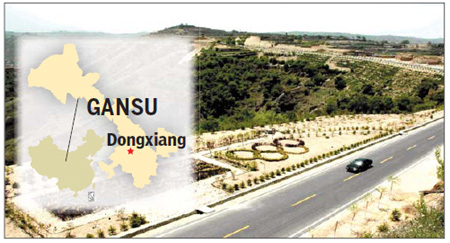 Dongxiang now has 1,078 km of roads that link almost every village in the county. Photos Provided to China Daily |
Arid and land-locked Dongxiang county in central Gansu province is among the poorest in China.
In 2009, per capita net income for the county's rural residents was 1,602 yuan - only 406 yuan above China's poverty line of 1,196 yuan - and at the equivalent of 65 cents a day, a figure far below the World Bank minimum of $1.25 daily.
Rural residents account for 97 percent of the county's 279,600 people.
With a natural environment unsuitable for widespread farming, and lacking water and roads, the ethnic Dongxiang people - whose ancestral roots can traced back 700 years to Central Asia - have been locked in a centuries-long struggle against poverty.
But in recent years their own efforts and increasing assistance from home and abroad have opened a route out of poverty.
The effort started with water supply projects.
Bringing in water
Water is so precious that a local saying notes the usually generous Dongxiang people would "give you a free meal, but hesitate to give you a cup of water".
But that is changing. After nine years of construction, the 556 million yuan Nanyang Canal became operational in July 2004. The county's first large-scale water supply and irrigation project, it was funded by the local and central governments along with donations from businesses outside the county.
A project to bring drinking water to the countryside began three years later, and in June last year rural residents for the first time used clean tap water.
Another effort to fight poverty is construction of roads. Renovation of the Suonan-Daban highway - the county's main transportation artery - began in April 2007.
When completed 20 months later, the road's width was almost doubled from the previous 7.5 m and its length was extended to 41 km to connect the 11 townships in Dongxiang.
Now linked to the 213 National Highway in the north and the 212 National Highway in the south, it is also an important passageway to the neighboring regions of Lanzhou and Dingxi.
Over the same period, a number of local roads have also been built to connect the townships and villages in the county, bringing the total road length in Dongxiang to 1,078 km including 203 km that are surfaced with asphalt.
Ecological shield
Improving the natural environment and building an ecological shield for the residents has also been a top concern of local authorities over the past decade.
Located on the west of the Loess Plateau, Dongxiang's annual average precipitation is just 350 mm, far surpassed by the evaporation rate of 1,387 mm.
As well, soil erosion from when it does rain, usually in summer, has continued to weaken the already fragile ecology.
Excessive farming over the centuries and pressure on farmers for greater grain yields has helped turn mountain slopes barren.
The local government's efforts to improve the ecological system started in the late 1970s. On steep slopes now unsuitable for farming, grasslands and forests have been developed. As highways were improved, the land along them has also been reforested.
By last year, 7 percent of the county's land, some 18,000 hectares, was covered by forests, compared with 4 percent in 1978.
Farmlands on gentler slopes have been retained, but upgraded into terraced fields to fight soil erosion.
A total of 2 billion yuan has been invested in Dongxiang's improvements over the past decade - ranging from water and power supplies to farmland reclamation, other ecological improvements to education and healthcare facilities.


