Power of faith
Updated: 2011-11-11 13:18
By Xu Lin (China Daily)
|
|||||||||


 |
|
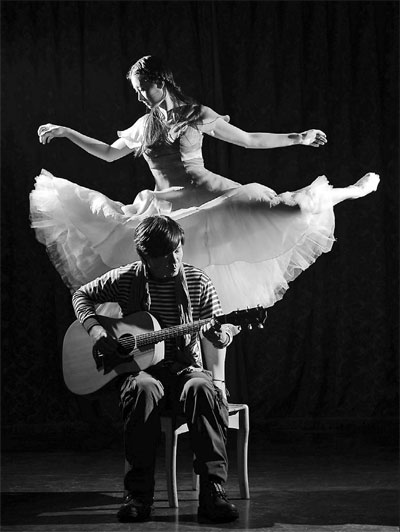
The third installment of Yabin and Her Friends series meshes Eastern and Western styles and features Chinese-American Zhou Long, a Pulitzer Prize winner for Music. Wang Ning / For China Daily |
An experimental dance examines the expectations of contemporary life, Xu Lin reports.
Six men and six women line up to each toss a cup in a wastebasket as they walk by.
They circle back, each take another cup and drop those into the can until it overflows.
While this representation seems to come straight out of a piece of behavioral art, it's instead from the three-part modern dance Yabin and Her Friends Three: Expecting with Faith that will premiere in Beijing next week.
"Everyone has their own expectations about faith, whether we're talking about love or career," the show's director and lead dancer Wang Yabin says.
"This show is more about love and contemporary life. For me, it's about the expectations I have for my own faith in pure art."
This dance is the third installment of the Yabin and Her Friends series she started after founding Yabin Studio in 2009. The franchise is meant to create a platform for young dancers to demonstrate their talents.
Last year's installment sold out both times it was shown in Beijing.
"We've made great progress over the past two years," she says.
Because the show will be staged three times this year, rather than twice as in previous years, it will be seen by 1,000 new audience members, including some from other cities.
"And media are starting to pay attention," Wang says.
She began planning the series' third show in February and began rehearsals in June, with 20 dancers - all born after 1980 - practicing five to six hours a day.
This will be the first time foreigners will be brought into the fold.
"So, this show will mesh Eastern and Western styles," Wang says.
She has teamed up with Chinese-American Zhou Long, who won a Pulitzer Prize for Music, in April, and American Dance Festival instructor and choreographer Mark Haim.
Chinese choreographers born in the 1950s, '60s and '70s choreographed the first and second parts.
"They present different generations' understandings of modern dance," Wang says.
"Seeing these dances in the same show is akin to time traveling."
She says Haim is more flexible and focused on inspiring students than his Chinese counterparts, some of whom seem trapped in formulaic conventions.
The 25-minute third section Haim created tackles several dimensions, including consumerism, environmental protection and gender. Its scenes are borrowed from daily life, such as one in which people are texting while walking.
"It's a slice of contemporary life," Haim says.
"The dancers don't do many formal dance steps but walk most of the time."
He takes inspiration from the ways different people walk, he says.
"I try to show the feminine side of males and masculine part of females, in different walks," he says.
"It's a challenge for the dancers, as they have to be actors. Life is changing through time. Through the repetition of various walks, we grow old and Earth becomes more damaged."
The blend of cultures can be seen in the alternations between Chinese music - Wang's idea - and country music - Haim's idea - in the last section.
"Popular songs make us feel it's about the real life," Haim says.
"As for me, it's interesting to listen to (the Chinese songs) but have no idea what they are singing about."
Rather than switch back and forth between Chinese and American songs, Zhou, the Chinese-American composer, fuses them.
Zhou composed a guqin (seven-stringed zither) and flute duet in 1984, which accompanies Wang's solo dance in this installment.
"It's special in that it goes beyond the five-tone scale and the combination of the guqin and flute makes it possible to fully display the music's beauty in terms of scales and harmony, and the rapid finger slides that represent thunder," Zhou says.
Expecting with Faith is his first time cooperating with Chinese dancers since 1985.
"Wang and her group are young, lively and promising," Zhou says. "My music and her dance go together very well. She displays feelings of loneliness, aloofness and grace in her dancing."
Wang says she borrows elements from traditional Chinese operas, such as orchid finger gestures and yuanchang (walking in circles).
"But I present them in a modern way," Wang says.
She was careful to not overuse multimedia for fear it would overshadow the dancing. So projections are used only a third of the time, she says.
There's good reason, she hopes, to preserve the dance as the centerpiece of her production, as it has remained the lynchpin of her life.
The 27-year-old gained acclaim in dance circles from an early age. She has snapped up top spots in four national championships and has performed five times as the annual CCTV Spring Festival Gala's principle dancer.
For her, this show about expectations of faith is a test of her own expectations of faith.
"We hope to draw more young audience members and tour Europe next year," she says.