Navy ensures ships can navigate a sea of danger
Updated: 2011-12-26 08:00
By Li Xiaokun (China Daily)
|
|||||||||


|
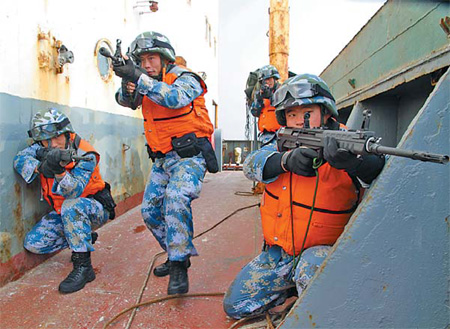
Soldiers are put through their paces on a merchant vessel before an escort mission in the Gulf of Aden earlier this year. Chen Zhiyuan / for China Daily |
|
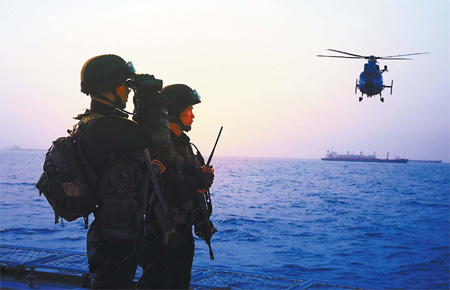
In three years, Chinese warships have escorted more than 4,300 commercial vessels from China and other countries through the pirate-plagued waters of the Gulf of Aden. Yan Dong / for China Daily |
Escort fleet keeps the menace of pirates at bay, Li Xiaokun reports from Beijing.
After spending months escorting vessels in the Gulf of Aden, Wang Hongmin found it no surprise that China plays a leading role ensuring ships from around the globe safely navigate pirate-plagued waters.
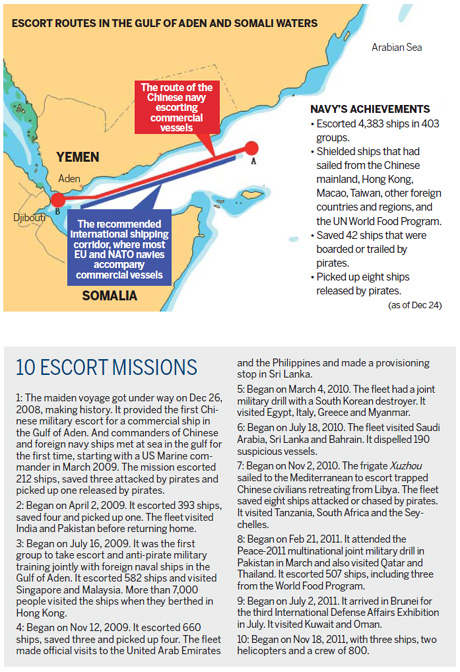
"The Chinese escort fleet is very reliable in terms of escort missions," he said. "I mean, since many navies choose to patrol certain waters, the Chinese are accompanying the vessels exactly from site A to B, and then back from B to A, like a nanny who doesn't go a step away."
Wang spoke to China Daily on the eve of Monday's third anniversary of China sending escort fleets to the Gulf of Aden.
According to the Ministry of Defense, Chinese forces have escorted more than 4,300 Chinese and foreign ships in the gulf, and all missions were completed successfully.
A former captain of the missile frigate Xuzhou, one of China's most advanced vessels of its type, Wang led his crew as part of the third and seventh escort fleets that Beijing sent to waters off Somalia in 2009 and 2010-2011.
In the latter mission, his crew "fortunately" - as Wang put it - became the first group of Chinese servicemen to militarily engage with confirmed pirates.
They were also given the honor of being the first ship to escort a large number of Chinese citizens forced to leave Libya during the recent political turbulence that led to the downfall of the Muammar Gadhafi regime.
Theirs also was the first Chinese navy ship to escort a large number of overseas Chinese citizens on the start of their journey home from Libya when Muammar Gaddafi's government started to collapse.
A bold attack
Their fight with the pirates "came at noon on Nov 13 last year, when we were escorting the 275th group of ships that China took charge of," Wang said. Suddenly, they received signals for help from a vessel in the convoy, which was stretched across at least 10 km.
Soon, a pirate boat was detected advancing at high speed toward the vessel team and firing at one ship. Pirates threw a rope ladder onto it.
"We all found it unbelievable at that time," Wang said. "The pirates have become so fierce. How dare they rob a ship under the eyes of a warship?"
The Xuzhou and Chinese helicopters fired intensively at the pirate vessel until the pirates, unhurt, surrendered. Then the Chinese forces returned to the escort mission.
"But we did not stop at that," Wang said. "Later we had a meeting to discuss why the incident happened."
They agreed on two reasons: First, the Chinese navy was restrained to the pirates and would not attack them as some navies do as long as the pirates do not disturb the commercial vessels.
Second, "There are too many foreign ships applying for Chinese escort, even when they have to wait for another few days or leave the waters suggested by international escort forces as a secure area."
As long as China maintains its policy of not attacking pirates if their identities are not confirmed, Wang and his colleagues needed another countermeasure. They decided they would not allow unaffiliated ships to pass through those under their protection, and they moved the naval ships to both wings of the vessel team instead of ahead and behind.
The toughest time, he said, was when they waited for 39 days for diplomatic efforts to unfold to secure and escort a ship that had been hijacked by pirates. "We were just waiting there, with no resupply. In the end we almost ran out of food." The ship and its crew were released safely.
Better, but not over
In that manner, the Chinese navy has escorted more than 4,300 vessels from China and other countries through the unpeaceful waters in the past three years, Chinese military spokesman Geng Yansheng said recently. They also escorted vessels of the United Nations World Food Program four times and took care of 50 vessels that had been attacked or released by pirates.
For such a heavy mission, Beijing has sent 10 groups with a total of 25 warships, more than 8,000 military men and women, and 700 special operators.
"China will continue to dispatch naval escort squads to the Gulf of Aden and Somali waters" in accordance with UN Security Council spirit, Geng said.
After 36 months of joint efforts by international navies, Wang Hongmin said, there are few cases of robbery in the Gulf of Aden.
"But the pirates did not disappear. Sea conditions in the area will get better soon, so the risk of pirate attacks will be on the rise in the near future. International navies have to stay there for a long term."
China's gains
The arduous efforts not only helped safeguard a key international commercial route, but also helped China.
"The biggest harvest in escort missions is that we guaranteed security of our lifeline at sea effectively," said Yin Zhuo, a military expert and retired navy rear admiral. "It costs a lot to keep escorting there, but we have to bear in mind that more than half of China's energy imports are carried via that route, as well as trade deals of about $3 trillion."
Besides, if the Chinese warships had not been there, the Xuzhou could not have escorted more than 2,000 Chinese who fled Libya, Wang said.
Zhang Qi, a People's Liberation Army officer who took part in early escort missions, wrote recently that China has found a "Chinese way" to be involved and contribute to international peacekeeping. In the Gulf of Aden, he said, the Chinese navy showed its efficiency - and will - to contribute to world peace through all kinds of joint missions, exchanges and exercises with foreign troops.
He made his comments in an article posted on the Defense Ministry's website on Dec 16.
Wang Hongmin feels the same way. "For instance, we had very good cooperation in escorts with Japanese helicopters. The Japanese pilots often exchanged information with us when they were still far away in the air, telling us what they found and asking for our situation."
The captain said he also met many foreign captains during the trip. "A foreign commanding officer told me he was impressed when he arrived at the Xuzhou frigate on a helicopter. The appearance and spirit of the Chinese navy have changed. Visitors can feel the confidence deep in minds of our soldiers."
Gary Li, who analyzes Chinese military affairs at the London-based International Institute for Strategic Studies, told China Daily earlier that the country's involvement showed that "China is a major responsible power willing to cooperate multilaterally".
"The mere fact that China has a multiyear naval presence in the Gulf of Aden has great symbolic and diplomatic significance," Frans-Paul van der Putten, senior research fellow at the Netherlands Institute of International Relations Clingendael, told Agence France-Presse last week.
Deep-water lure
On another track, the mission is a real test for the Chinese navy, which is accustomed to training off its own coast, said Yin, the retired rear admiral.
"China has stuck to a defensive national defense policy, so it cannot forge its troops in real combat as some countries do. Hence the long-distance sailing and escorts present a precious chance."
It has been a dream of generations of the Chinese navy to transit from a near-sea navy to a blue-water one, Zhang said in his website article. "The tasks at the Gulf of Aden have served as enlightenment, both spiritually and physically, for a military that has stayed long in a peaceful age."
An article in the PLA Daily, the army's official newspaper, on Dec 5 said a stride from the offshore to the far seas has become the navy's central task.
The maturing of the Chinese navy does not mean it will pose a threat to the world, Yin said. "On the contrary, it will serve as a balancing power to maritime hegemony and forces hampering international security.
"People can tell from the facts by themselves," Yin said. "What the Chinese escort fleets have done at the Gulf of Aden is a testimony to that."
Zhao Shengnan contributed. Write to the reporter at lixiaokun@chinadaily.com.cn.
|
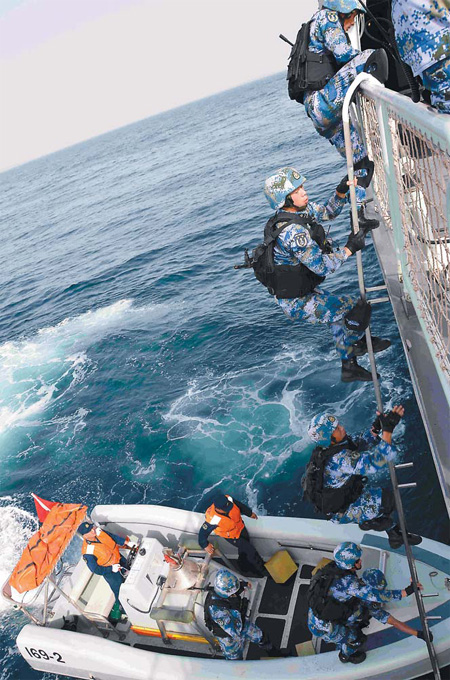
Drilling to keep sharp, sailors on the ninth deployment practice how to climb aboard a commercial ship. Li Gencheng / for China Daily |
|
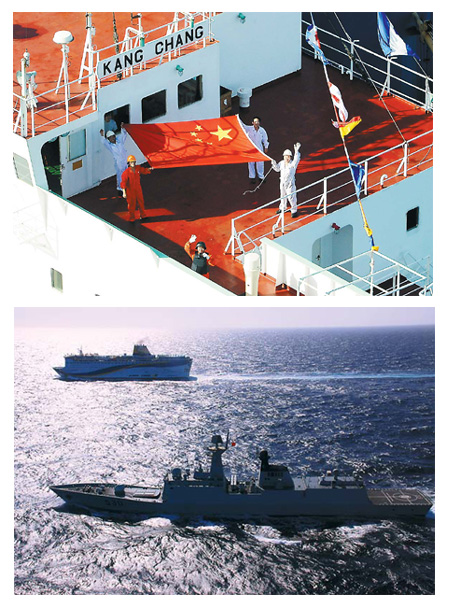
Crew members on a Chinese commercial ship spread a national flag to show their gratitude for the navy's escort. Yu Jingjun / for China Daily Below: The frigate Xuzhou was able to divert from the Gulf of Aden to help escort Chinese fleeing Libya when the Gaddafi regime began to fall. Li Gaojian / for China Daily |
(China Daily 12/26/2011 page1)