Art
Amazing Chinese eaves tiles
Updated: 2008-05-06 09:10
By Liu Rong (Chinaculture.org)


 Twitter
 Facebook
 Myspace
 Yahoo!
 Linkedin
 Mixx
Mixx
 |
Eaves tiles are small accessories from classical Chinese architecture fixed at the end of rafters for decoration and for shielding the eaves from wind and rain. 4000 years after their debut on the rough-built palace of Zhou (c. 11th century 771 B.C.), these tiles ended up lying on tables of researchers of ancient politics, economics, art, handicraft, calligraphy and text-interpretation, as well as those of enthusiastic collectors.
Eaves tiles emerged as a culture in their own light during the Zhou and reached their zenith during the Qin and Han (221B.C-220 A.D.). In the intervening years they underwent a transition from a half-round design to a cylindrical design, and from plain surface to decorative patterns, from intaglio to bas-relief carvings, from lifelike imagery to abstraction, and from patterns to inscriptions, until they became an art that involves language, literature, aesthetics, calligraphy, carving, decoration and architecture, with themes that ran the gamut from nature and ecology to mythology, totems, history, palaces, yamens, mausoleums, place names, auspicious phrases, folklore, and family names. Together the eaves tiles form a history book that reflects vividly the natural scenery, humanities and political science and economics. The Beijing Museum of Ancient Ceramic Civilization is billed as the nation's first exhibition centre of ancient eaves tiles: its collection of more than 400 eaves tiles has no lack of rare and valuable pieces of art.
 |
Primal eaves tiles are half-round terracotta ornaments. Upon their invention the only material used was clay. Calcined clayish cylinders were divided in two and laid over rafters, plain or with simple decorate designs at top. Later when the country was separated into 7 regional regimes and entered the age of Warring States (475 – 221 BC), a boom in handicrafts and civil construction brought about the technical innovation of eaves tiles. Round ones came out, and a higher heating gave birth to ceramics which were stiffer and quick-molding than rough clay wares. Complicated decorations also developed in this time, most of them animal or totem.
More patterns of eaves tiles appeared after the Qin Dynasty (221- 207 BC) took over the whole country. This was also when round tiles dominated the construction. In No.2 site of the First Emperor’s Tomb of Qin Dynasty has been found a round eaves tile, 18.9 inches high and 24 inches broad, with a large twin carving of propitious monster Kui on top. It is regarded “the king of eaves tiles” in archeology academe.
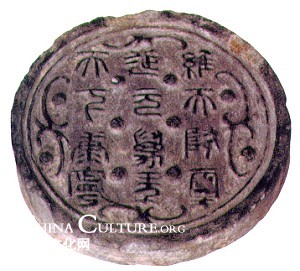
The centrosymmetry of round eaves tiles might have inspired Qin’s craftsmen. They began carving fine phrases onto these tiles. In archaism, fine phrases often have four characters. They marked the discal tiletop with a cross, and engraved in each part with one carefully-designed character. The phrase can be read from right to left, top to bottom. Sometimes they let a phrase circled with flower patterns around the fringe, as what we do to coins. This usually happens to an overlong phrase, which could have as many as 12 characters. Inscriptive designs reached their zenith during the Han Dynasty (206 BC- AD 220), which went further in manufacture and design. Eaves tiles of Qin and Han are always considered most valued among researchers and collectors.
 |
A few improvements were added to techniques afterwards, including the colored glaze tiles invented after the Tang Dynasty (618-907) and metal tiles after the Song Dynasty (960-1279). But they didn’t enter mass production due to rarity of their raw materials. At the same time, Buddhism deepened its influence in China and along with it came the design of honeysuckle and water lily, which in India means lustration and sanctity. During the Tang Dynasty, lotus design became common. Animal designs were revived during the song dynasty.
Unearthed in Xi’an City, Shaanxi, 1953, this tile was made in the Qin Dynasty. The phrase reads: Heaven grant the emperor sanctity and beatitude; his eternal ruling appease the world.
 |
Also made in Qin, this kind of twin-monster-designed eaves tile was generally used.
Characters on this Han tile noted one of the most striking occurrences at the age that a Han princess was married to Hunnish King. The marriage ensured the peace of Han’s northern frontier.
This set, The Eaves Tiles of Four Deities, was excavated from the site of Han’s great wall in 1956. Ancient people looked up at stars studded in the sky and visualized them as four types of images, namely the bird, dragon, tiger, tortoise. At the end of the Western Han Dynasty (206 BC- AD 24) and the beginning of the Eastern Han Dynasty (25-220), the green dragon, white tiger, rosefinch, and black tortoise were worshiped as supernatural beings, usually called the four deities or the four gods, to guard all sides and drive out evil spirits.
Specials

President Hu visits the US
President Hu Jintao is on a state visit to the US from Jan 18 to 21.
Ancient life
The discovery of the fossile of a female pterosaur nicknamed as Mrs T and her un-laid egg are shedding new light on ancient mysteries.

Economic Figures
China's GDP growth jumped 10.3 percent year-on-year in 2010, boosted by a faster-than-expected 9.8 percent expansion in the fourth quarter.