Business
Nutrition tips the pregnant need to know
By Xiao Lu (China Daily)
Updated: 2010-08-06 14:38
 |
Large Medium Small |
BEIJING - From the moment of conceiving a baby to the date the baby is born, young mothers-to-be always have hundreds, if not thousands, of questions to ask.
How should she choose her lingerie and other maternity clothes? What kind of pregnancy milk powder is most popular?
But before getting the right answers for these questions and spending a lot of money on these items, pregnant women should first go to a pregnancy nutrition guidance center to design a balanced diet for herself, said Lu Minfang, general manager of Dumex Baby Food Co Ltd.
Lu made the remarks on the sidelines of a conference about developmental origins of health and disease (DOHaD) theory in Beijing.
The DOHaD concept is bringing new insights into the pathogenesis of disease. Poor fetal growth and small size at birth are followed by increased risk of coronary heart disease, stroke, hypertension, Type 2 diabetes and osteoporosis. This has led to the hypothesis that these disorders originate through unbalanced nutrition before birth and during infancy.
With the help of the UK-based International Society for Developmental Origins of Health and Disease, Dumex brought the DOHaD concept into China in 2005. Last year Dumex and the international DOHaD society established more than 100 pregnancy nutrition guidance centers in partnership with leading hospitals in more than 70 Chinese cities.
China is now facing an increasing number of babies born large for gestational age. Over all, more than 7 percent of newly born babies in China are considered over-sized, while in large cities, such as Beijing and Shanghai, the rate has reached 10 percent, said Duan Tao, head of Shanghai First Maternity and Infant Hospital at Tongji University.
A baby born small or large for gestational age - either of the two extremes - is thought to have an increased risk of obesity in later life.
With many of the post-80s generation now married and having families of their own, the second "single-child generation" has arrived. With improving living conditions, many of them grow up with too much food.
With excessive weight gain and even obesity rates rising in pre-schoolers and toddlers, DOHaD experts said action should instead be focused on childern's earliest years, or perhaps even before they are born.
Excessive weight gain during pregnancy is not safe for the mothers-to-be as it can lead to gestational diabetes. Moreover, mothers who are put on too much weight during pregnancy have a greater likelihood of having a baby who ends up obese later in childhood.
Every year about 16 to 18 million babies are born in China (Australia's total population is about 21 million) according to the World Bank.
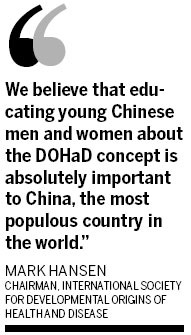
"We believe that educating young Chinese men and women about the DOHaD concept is absolutely important to China, the most populous country in the world," Mark Hansen, chairman of the International Society for DOHaD.
Dumex, a wholly-owned subsidiary of Danone Group, controlled the largest market share of baby milk powder in China between 2006 and 2008, according to ACNielsen. With an annual growth rate of 12 percent, China has become Dumex's largest market in the world.
China Daily