US
US visit to maximize bilateral relations
(China Daily)
Updated: 2010-09-09 08:03
 |
Large Medium Small |
|
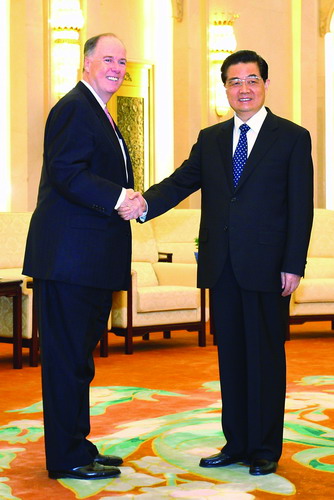 President Hu Jintao (right) shakes hands with US Deputy National Security Adviser Thomas Donilon at the Great Hall of the People in Beijing Sept 9, 2010. Fengli/Reuters |
Administration officials close to Obama bring a positive message
BEIJING - President Hu Jintao called for an advanced dialogue and cooperation with Washington during a meeting with senior US officials on Wednesday.
"Further comprehensive development of Sino-US relations is more important than ever before, as the global economic recovery is facing a variety of unstable and uncertain factors," Hu said.
"China and the US," he added, "should view the bilateral relationship from a global and strategic perspective."
It was the last day of the visit paid by the high-profile US delegation that included Deputy National Security Advisor Thomas Donilon and National Economic Council Director Lawrence Summers.
Donilon expressed the US willingness to work with China to resolve differences through pragmatic means.
Xu Caihou, vice-chairman of China's Central Military Commission received the pair later on Wednesday.
It was the first time since November that China and Washington had conducted talks by such high-level military and economic officials.
Xu told Donilon that China is pursuing a "defensive path" in building up its military.
"The progress of China's national defense strength is reasonable and appropriate," Xu said.
Donilon proposed that the two militaries establish an effective mechanism to avoid misunderstandings. He also stressed the importance of stable and substantive bilateral military contacts.
In a meeting on Monday with Xu, John Hamre, the former US Deputy Secretary of Defense, dismissed worries by US military analysts over recent China's military growth.
He voiced a belief that technological advances by China's military should be viewed in the broader context of its history, and national defense strategy.
Sino-US tensions have grown tense in the past several months due to disputes over massive US arms sales to Taiwan, recent comments from the Washington about the South China Sea and US involvement in naval exercises in the Yellow Sea.
Washington's approval of arms sales to Taiwan by an American military contractor in January was the main factor leading to the suspension of Sino-US military interactions.
Analysts view the US delegates' visit to China as a positive sign for the easing of the recent tensions.
According to a report by the Associated Press, US President Barack Obama sent his envoys to China specifically to smooth over recent frictions.
Obama has "emphasized for us the importance he attaches to a very strong relationship between the United States and China," the Associated Press report quoted Summers as saying.
"American and Chinese officials have been trying to lay the groundwork for the resumption of contacts between the two countries' militaries," The New York Times reported on Tuesday.
More increased and in-depth exchanges between the two sides are likely in the coming months, said Fan Jishe, a professor of American Studies with Chinese Academy of Social Sciences.
Fan added that the meeting between Hu and Donilon indicated intentions by both sides to promote strategic dialogues.
Moreover, Sino-US relations are warming based on the very visit of Obama's envoys, according to experts.
"Hu and Xu's meetings with the US delegates demonstrate that China takes Sino-US relations seriously," Zhai Dequan, a professor with China Institute of International Studies, told China Daily.
Zhai added that the US visit was a message of good will from the Washington to explain and preface the Obama administration's outreach policies toward China.
"The communication channels between China and the US are unhindered," he added.
After meeting with Hu and Xu, the delegates returned to the US on Wednesday evening, concluding their four-day trip.
China Daily