US
From brat to Harvard grad
By Lian Mo China Daily
Updated: 2010-06-17 00:00
 |
Large Medium Small |
When Henry Yin was 4 years old, his parents left him with his grandparents in Zhejiang province in East China for a professional training course in Beijing.
When they returned three months later, Henry was a spoiled child who had forgotten the simple manners of sitting at a table to eat.
In fact, he would only eat after his grandparents had chased him around the house.
Henry’s mother Xia Xiaohong immediately took his food away and left him in a narrow, dark bathroom.
“Reflect on your faults or we won’t leave,” she told him.
After crying and struggling for half an hour, Henry gave up and ate his meal on the dining table. “If parents behave reasonably, so will their child,” said 50-year-old Xia. “And early education is the key for a child’s excellence.”
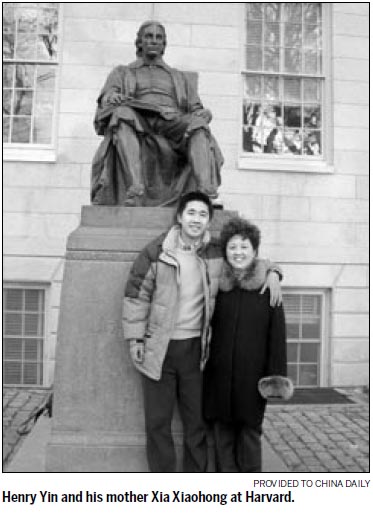
That parental mantra and other nuggets of valuable information about how Xia turned her son around from a brat to a Harvard grad can be found in Xia’s published book “From Andover to Harvard.”
In the book, she chronicles how her son successfully took advantage of opportunities to study in the US.
Henry was offered full scholarship admissions by Phillips Academy in Andover Residential secondary school in 2004 and Harvard University in 2007.
The book also introduces available opportunities for Chinese students in US high schools and how to apply.
Henry found out about Andover in January 2004 after one of his friends at Andover recommended the school.
Andover usually recruits about 10 percent international students and as a boarding school, it costs a student $36,000 per year to study there.
After attending the school’s alumni evening at the US embassy in Beijing and researching Andover, the family felt that the school, compared to schools in China, was the right choice for him.
Xia recently said that many Chinese parents are interested in knowing how she raised her son, who not only excelled in academics, but in sports and music.
Xia said she still receives dozens of e-mails and calls from different parts of China every week to seek advice on education a year and a half after the book was published.
She believes that early stage education is very important for a child’s attitude and interests in studying.
Before Henry was 7, Xia worked full-time as an electric engineer though she made time to spend at least two hours every evening with her son, using playtime to help him study.
When Henry was about 4 years old, she started to play education games with him. One of them was called “Across Bridge”. She wrote both Chinese and English words on cards and put them on the floor.
If little Henry knew the word, he could step on it and one by one, he would cross a symbolic bridge to his mom, a sort of language divide.
The book has stirred up a bit of controversy.
According to the school’s student publication “Phillipian”, some administrators at the school thought the book’s title would give Chinese readers the wrong impression that Andover was a “stepping stone” to Ivy League universities.
Andover didn’t welcome the book, which has not been translated into English, although many administrators admit that they haven’t read it yet.
“There are concerns with the title and whether it will lead some to think that Andover leads to Harvard, but that’s the title. We don’t know what’s actually in that book,” said Jane Fried, dean of admissions.
“Whether Asian or not, any family with kids at Andover has big aspirations for their child. But Ivy League schools are not the focus of PA,” said Aya Murata, an advisor to Asian and Asian American Students.
Xia explained that the book doesn’t make the statement that Andover blazes a trail for students to the Ivy League.
Andover, she said, was a heterogeneous school emphasizing comprehensive developments of their students.
“Some schools in China only care about college entrance rate that could restrain students’ talents and made them become examining machines.I am against that kind of teaching,” she said.
Xia said US high schools value the exhaustive qualities and abilities of students rather than just being a vehicle to elite universities.