China
Dark month as three captive pandas die
By (China Daily)
Updated: 2010-08-13 17:28
 |
Large Medium Small |
Chengdu - For panda lovers, last month was a dark and sad month: Three captive giant pandas died in China.
On July 3, a baby panda was killed after its mother accidentally sat on it at Beijing Zoo.
Two days later, one of the pandas at the Beijing Olympic Panda House named Shui Ling, who came to Beijing two years ago, died from illness in the early morning hours.
On July 22, a panda named Quan Quan, on a loan from Wolong in southwestern China's Sichuan province to the Jinan Zoo in eastern China's Shandong province, died of respiratory failure after it breathed in irritant gases.
The death of the giant pandas has prompted many to think: What happened to these animals?
An explanation for the death of the baby panda was its mother's carelessness. The death of Quan Quan was the poisonous gas.
But the cause of death to Shui Ling was somewhat stunning: The zoo claimed that the panda died from mesenteric volvulus, or the twisting of its intestines, during a period of strenuous exercise.
An official at the China Research & Conservation Center for the Giant Panda at the Wolong Nature Reserve said there are no links between the three deaths.
The unnamed official also said that baby pandas have been killed inadvertently by their mothers before. Pandas have also died from mesenteric volvulus. The cluster of the deaths is coincidental, the official added.
Theoretically, the pandas' deaths have nothing to do with high temperatures since each of the captive pandas are housed in air-conditioned rooms under temperatures of 25-27 C (77-81 F).
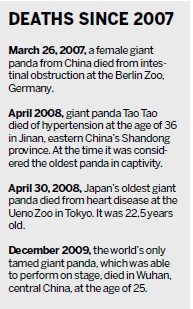
It is fair to say that pandas live a comfortable life. Keepers are asked to stimulate pandas to move and exercise. But captive pandas are not as tough as wild ones, as is the case with many captured animals. Conditions such as mesenteric volvulus can easily lead to death due to the high incidence of digestive ailments in the artificial breeding environment.
Though they are susceptible to diseases, many captive pandas bear other tremendous burdens. According to an official of Sichuan forestry department, some captive pandas are loaned to local zoos throughout the country in order to educate visitors about pandas. There are more than 150 pandas belonging to the Wolong Giant Panda Nature Reserve, with 80 or so being raised at the reserve, a dozen sent abroad as gifts and the rest being rented to local zoos.
For local zoos that want to borrow giant pandas from the reserve, they have to apply to the State Forestry Administration. Only after the administration and the local forestry department prove that the local zoos are qualified, can the transfer occur. The rental for a panda is as high as $1 million abroad and 200,000 yuan ($29,000) at home. Since most of these contracts are signed on a long-term basis, many pandas have to live a life far away from their hometowns.
According to some local zoos, most of the borrowed pandas for exhibitions are in their later stages of life because those in their prime have to reproduce. Quan Quan, who died in the Jinan Zoo, was 20 years old. Middle and old-aged pandas are more likely to have emergencies.
But the cluster of deaths in July has triggered concerns from experts.
Hu Jinchu, a professor at the Sichuan-based Xihua Normal University and a renowned giant panda expert, argues that panda leases should be accompanied with specific terms to protect them. What matters most is whether the applicants are fully capable of breeding and securing the pandas.
According to the regulations, panda lenders are entitled to do some investigation into the applicants and can withdraw pandas if necessary. Staff from the reserve said that keepers from the reserve would accompany pandas to their new home and stay there for some time. Expert teams would also visit pandas on a regular basis. Borrower zoos are also required to provide daily information about the pandas' physical conditions, appetites and use of medicine.
Excerpts from a story published in West China City Daily on Aug 1