China
Handwriting a fading art as use of computer thrives
(China Daily)
Updated: 2010-08-20 16:31
 |
Large Medium Small |
|
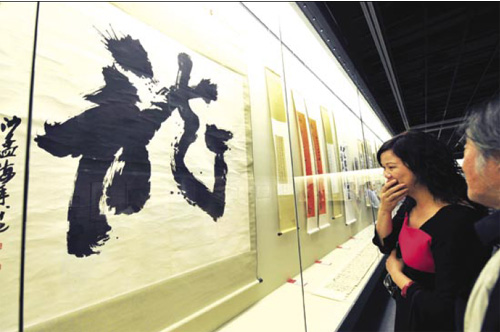 Visitors take a close look at handwriting art by a Chinese handwriter Sha Menghai at an exhbition in Zhejiang province in eastern China. Li Zhong / FOR China Daily |
BEIJING - Yao Hui had just finished writing her favorite poem on a fragrant piece of paper. She took a few pictures of it and uploaded the images onto Douban.com, a popular social networking site in China.
She expects her peers in a discussion group called "We Have Beautiful Handwriting", which she created last year, to appreciate her work. Participants regularly submit photos of their handwriting of poems, lyrics to songs and diaries. They examine each other's works and post comments. The site has become an online connection for nearly 700 handwriting lovers.
"These days, fewer and fewer people write Chinese characters well," said Yao, 24, from Shanghai. "And the worst thing is fewer and fewer people even write on paper."
The number of Chinese netizens has reached 420 million, said Xi Guohua, vice-minister of industry and information technology. China's netizen population has become the biggest in the world, according to the China Internet Network of Information Center. With computers, mobile phones and other electronic devices being widely used in China, many Chinese say they have developed a dependency on typing on these devices.
Recently, university professors and education officials expressed their concerns over the "new illiteracy" created by computers and the Internet.
Zhu Jun, professor of Guangxi College of Education, said that over 80 percent of students in his college use pinyin, the Roman-alphabet-based phonetic system for Chinese characters, to input Chinese characters. Students, he said, showed poor handwriting ability during exams in which computers were not provided.
Professor Lu Jianming, a linguist at Peking University in Beijing, said: "It is time that we pay attention to this problem and make handwriting a priority in primary education."
The majority of Chinese computer users use the pinyin input system to write Chinese characters. Pinyin was developed by the government in 1958 for the purpose of eliminating illiteracy by making Chinese characters easier to learn.
The sound of each character can be presented by a combination of Roman letters. When computer users type in the corresponding letters, the input software give them a selection of characters by the same sound for them to choose.
According to a survey done by China Youth Daily in April, 83 percent of 2,072 people surveyed said they thought it was difficult to write Chinese characters with a pen.
"When I present my ideas by writing them on a board during meetings, often times I realize that I can't remember how to write lots of the characters," said Huang Hao, a 26-year-old IT engineer working for China Mobile in Beijing. Huang said he had to draw circles or crosses in places where he didn't know how to write the characters. "But I can type them out if you give me a computer."
Like many other office workers who spend days and nights on computers, Huang admits that he has forgotten many of the Chinese characters that he learned as a child.
Chinese people learn Chinese characters by writing them repeatedly as children. The combination of strokes is remembered by heart after piles of notebooks are filled. Chinese pupils and high school students do most of their assignments on paper. But when they enter higher education, they often submit assignment in electronic forms. When they get a job, they largely depend on computers, emails and instant messages.
"Nowadays people use computers to work and play. Their lives are filled with online blogs, virtual social networking sites and instant messengers like QQ and MSN," said Mi Xiaobin, editor at Huajun Software, the leading software downloading website in China. "So they prefer a fast and convenient word-input method."
The Sogou Pinyin input system, according to Mi, is currently the most downloaded and used Chinese character input software.
Sogou is one of the biggest search engines in China. Due to its vast database of Chinese webpages, it launched a pinyin input system in 2006. It now has almost 300 million users in China, said Yang Lei, project manager of Sogou Pinyin research and development department.
"We update our phrase data base everyday. When users type in a certain combination of pinyin, our software can automatically provide the right characters according to the context. Users don't even have to choose anymore," Yang said. "We provide fast and easy Chinese character input experience."
The popular software can guess a user's intention and put together a short sentence in order to achieve the ultimate typing speed.
"Our input speed can match that of Wubi input system," Yang said, "but Wubi is too complicated to learn. No one would have the patience to learn it today."
Wubi input, in contrast to pinyin input, is another Chinese input system that requires users to remember the strokes and shapes of each character. It takes at least one month to master.
Pinyin input has been criticized because it makes Chinese people forget how to write Chinese characters but the Wubi input is too difficult.
As fewer write with pen, even fewer write with calligraphy brushes. Calligraphy used to be China's only way of writing for thousands of years. Now it has become a pure art form.
"It is the trend of history," said Shi Kai, a famous calligrapher in China. "We have to admit there is indeed less of a need for handwriting. The communication efficiency brought by typing enabled people to write more and write faster. Although computers and the Internet reduce our handwriting abilities, they extend our Chinese culture in a way."
Zhang Yunfan, a researcher at institute of linguistics under Chinese Ministry of Education, expressed a different opinion.
"We can't afford to lose the handwriting ability of Chinese characters," Zhang said. "Every character has a story, every story manifests our culture and only by writing each stroke according to the right order we remember the meaning."
China Daily