Royal care for swans
Updated: 2013-12-05 07:14
By Zhao Yinan (China Daily)
|
||||||||


Dongying in Shandong province provides a vital but vulnerable habitat for millions of migratory birds. The local economy has relied on petroleum and related industries, but the city's effort to find a path for sustainable development will be invaluable for the rest of the nation. Zhao Yinan reports.
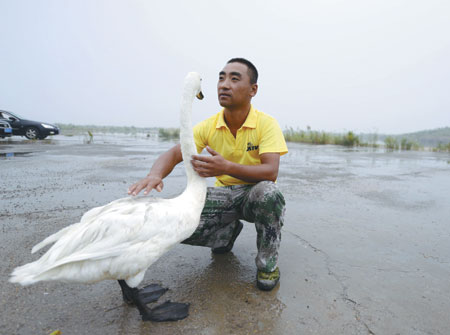
If Li Jian were Prince Siegfried in Swan Lake, the princess would be Xiao Xue (Little Snow). Li, 28, is a poultry feeder at the Yellow River Delta National Nature Reserve in Dongying, East China's Shandong province. The young man can be easily spotted on the vast wetlands, not because of his deep sun-tanned skin, but the white swan often clumsily tagging along with him. The swan is one of the birds that the young man takes care of, and it has won much of his attention. "When we found her in 2007, she had serious wing injuries and was left behind by a flock of swans on their way to the south," Li says.
Li volunteered to take care of the young swan. Three months later, Xiao Xue had survived, but her wings were permanently damaged and she had little hope of taking to the skies again.
"In her most difficult time, we spent days and nights together," Li says. "I couldn't bear to leave her alone, so I took her home and looked after her at night."
Li's care even evoked jealousy in other swans.
"When I went out for work and left her with other swans in the cage, she was often bullied by them. They seemed to be jealous of the attention I gave to Xiao Xue. Every time they bullied her, I mildly punished them."
The nature reserve at the mouth of the Yellow River, set up in 1992, is an important stop for millions of migratory birds on their global journey. The local economy, however, is heavily dependent on industries such as petroleum, once seen as threats to the environment.
In recent years, the local government and residents have striven to protect the environment, in part so the international wayfarers will enjoy safer passage.
More than 90 percent of the reserve's 153,000 hectares has been declared off limits to anyone but researchers.
This is an understandable measure as the reserve has been a transitional hub for more than 6 million migratory birds this year. In comparison, some 2 million people live in the coastal city of Dongying, to which the nature reserve belongs.
In spring and autumn, up to 367 species of birds stop by Dongying on their annual commute from Russia and Alaska to Southeast and South Asia and even Oceania. That accounts for 20 percent of the total bird varieties in China, the nature reserve said.
Among these frequent flyers are some of the world's most precious species. The oriental white stork, for instance, is on the verge of extinction with an estimated population of about 3,000 worldwide.
So when 36 baby chicks of this species hatched this summer in Dongying, researcher Shan Kai could not contain his delight, because he and his team at the reserve had helped bring these birds to life.
"That number represents half of all the new oriental white storks hatched in China this year," Shan says.
What is more amazing is that more of these rare storks have decided to stay at the reserve.
Since 2005, nearly 40 pairs of the storks, which usually leave Dongying for warmer New Zealand in October, have settled down in the reserve on their migration path from Siberia.
"I think they chose to stay for the wetlands here," Shan says. The number of oriental white storks is an important index of the health of their habitat, because they need very special living conditions.
To better record the activities of rare birds, researchers have introduced many methods. In 2010, Shan and his colleagues put electronic tags on four oriental white storks.
Except for one that malfunctioned, the satellite signals of three birds provided researchers with important information. "One bird flew to southern Anhui province and spent the winter there, while the other two stayed in Dongying," Shan says.
The findings prompted the reserve to build nests to attract more birds to settle down.
To meet the diversified requirements of bird species, the reserve has also built 13 bird islands, with different water levels and vegetation.
The reserve is home to more than 1,920 species of flora and fauna and 10,000 hectares of reed marsh, tamarisk forest, locust trees and grassland, which offer critical diversity for the migratory birds.
The reserve has also cultivated about 230 hectares of wheat along the banks of the Yellow River, as a stable source of food for birds that stay through winter.
Over the past decade, the area of wetlands quadrupled to more than 60 percent of the reserve. Another 41,000 hectares of wetlands would be restored by 2015, the local government said.
The population of birds passing by increased from fewer than 5 million in 2000 to 6 million this year. More importantly, the number of species rose from 283 to 367 over the same period.
Despite the progress, Liu Yueliang, chief researcher of the nature reserve, was still concerned that the wetlands were threatened by both natural and human destruction.
A serious problem affecting the wetlands has been the high level of saline-alkali in the soil. Throughout history, the Yellow River has often changed its course in its lower reaches.
Each time, a large area of saline-alkali soil has been left around its original course because of a lack of freshwater input and seawater transpiration, Liu says.
"The river has changed course four times since 1949, and efforts to repair the soil have never ceased."
He was more concerned about the lack of legal protection for wetlands.
One problem Liu and his colleagues face is that although they are responsible for preserving the wetlands, they do not have a matching right to punish poachers and other intruders.
"We are now working with the provincial legislature to draw up a regulation for protecting wetlands, but it is still in the initial stage.
"The wetlands in Dongying are ecologically significant for not only China, but also Northeast Asia. But their importance has not gained proper recognition."
Contact the writer at zhaoyinan@chinadaily.com.cn
|
Poultry feeder Li Jian with Xiao Xue, the swan he takes care of, at the Yellow River Delta National Nature Reserve in Dongying, Shandong province. Ju Chuanjiang / China Daily |
|
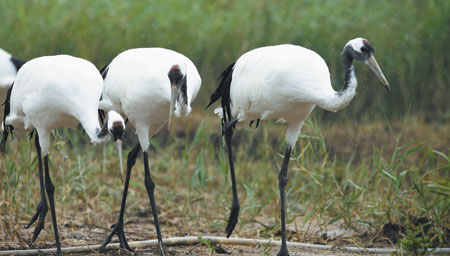
Cranes make a stopover at the reserve during their annual migration. |
(China Daily 12/05/2013 page18)
 Pictures of the year 2013: Military
 NBA game in Mexico City postponed
 Cameron shows table tennis skills in China
 Deck the White House halls
 China puts simulation models moon rover on market
 Tourism not affected, says Thai envoy
 Debate over accident shows 'crisis of trust', experts say
 Cities struggling to enforce bans on smoking in public
Most Viewed
Editor's Picks

|
|


|

|

|

|
Today's Top News
JPMorgan warns 465,000 card users on data loss
Microsoft moves to assure intl customers on spying
China tops Times rankings of universities in BRICS
Disney, China's BesTV agree on joint venture
China Mobile 'big winner' in 4G
Dialogue 'key to relations'
US-China trade hits high
Value-added tax reform expands
US Weekly

|

|





Special
|

|