Tibet commander commemorated
Updated: 2013-12-31 07:44
By Chen Nan (China Daily USA)
|
||||||||


One of Guo Yili's favorite things was walking around Lhasa, capital city of the Tibet autonomous region, where he had served as a soldier and then commander of the People's Armed Police Forces in Tibet for 38 years.
"He loved reading maps of Lhasa and walked around whenever he had free time," says Guo's driver Jiang Chenglong. "He knew every corner of the city but now he won't see it again."
Guo died on July 10 of a sudden heart attack.
|
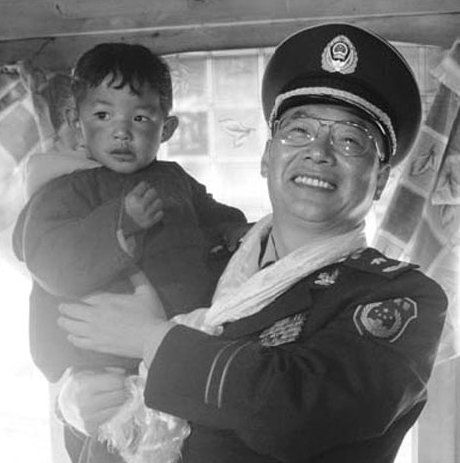
Guo Yili holds a Tibetan boy on a visit to a Tibetan family in a village. Provided to China Daily |
Four days before his death, Guo flew to the Inner Mongolia autonomous region for a meeting and after that he took a vacation in his home in Chengdu, Sichuan province. He rarely took such a break in the 38 years he devoted to the army and the Tibetan people.
Due to decades of working and living in Tibet, which has an average elevation above 4,000 meters, Guo had been suffering from gout and cardiovascular diseases caused by high-altitude hypoxemia.
He planned to go to the hospital during his vacation in Chengdu. However, he was still busy working during the holiday and took part in a telephone conference on July 9.
"After a day of working he told me that he was not comfortable. I gave him nitroglycerin pills and called the ambulance," recalls Guo's wife, Zhong Ling. "But it was too late. The doctor told me that he was exhausted and should have undergone treatment earlier."
Zhong says her husband's last words were: "I have been working in Tibet for my whole life but I am afraid I can't go back ever again."
"Then he was in a coma and never woke up again," Zhong says.
President Xi Jinping called to express his condolences and declared Guo a role model to inspire other soldiers across the country.
"He was just 56 years old and had served his entire career in Tibet," says Chendrup, vice-chief of staff of the People's Armed Police Forces in Tibet.
In life, Guo was a legend among those who knew him for his commitment to military work and his compassion for people.
Guo was most remembered for his leadership on March 14, 2008, when rioters attacked people in Lhasa, then looted and set fire to the city.
"Thanks to his immediate reaction and intimate knowledge of Lhasa, we could stop the riots very quickly," recalls Chendrup. "He knew the city and people here so well. A few days before the incident, he could predict that something bad would happen in the city. Then we were well-prepared and could soon restore stability to the city of Lhasa."
According to Guo's wife, after that incident he spent much more time working in Lhasa and rarely returned home. Guo's parents recalled that their son would come home when he had meetings in Chengdu but would stay at home no more than 30 minutes each time.
"He was always busy and comforted me that we would have more time after his retirement," Zhong says.
Because of the low temperature and high-altitude hypoxemia, it's hard to see green plants in winter and spring. Many soldiers suffered from hair loss and cracked lips caused by vitamin deficiencies. When Guo worked as the head of the General Logistics Department of the People's Armed Police Forces in Tibet in 2000, he invited experts to bring greenhouse technology to Tibet and successfully grew cherry tomatoes and cucumbers, boosting the health of soldiers.
"Because he grew up as an ordinary soldier, he loved soldiers very much," says Chendrup. "He visited every detachment in Tibet from Lhasa to Nagchu to learn about their living conditions. His car was his office."
To ensure the security of the 2008 Beijing Olympic torch being carried onto the world's highest mountain, Mount Qomolangma, Guo worked for over a month on the mountain known in the West as Mount Everest, which was a big challenge to his heath.
"He broke down from constant overwork," adds Chendrup.
Born in Ya'an, Sichuan province, Guo had strong will power since childhood, which was why his father gave him the name Yili, meaning perseverance.
According to Guo Quanzhong, Guo's 83-year-old father, his son carried stones to make money for school fees because of his family's poverty. Becoming a soldier was his childhood dream and he finally realized it at age 18.
"He planted a tree in the yard of the People's Armed Police Forces in Tibet on the first day he arrived at Lhasa in 1976. Now the tree is very tall and big," says his father. "I am proud of him."
chennan@chinadaily.com.cn






Most Viewed
Editor's Picks

|

|

|

|

|

|
Today's Top News
US analysts think Abe's shrine visit a mistake
Xi's bun shop visit wows media
Global retirement crisis looms
US train collision sparks fire
Beijing turns cold shoulder to Japan
70 journalists killed on the job
Xi to direct carrying out of reform
Abbas committed to peace talks
US Weekly

|

|





Special

|

|