City dwellers live a modern rural dream in Guizhou
Updated: 2014-08-06 07:18
By Lan Lan (China Daily USA)
|
||||||||


Chashan village approach to development belies region's backward image, reports Lan Lan in Xiuwen, Guizhou
At first glance, the narrow, long-winding dirt road that leads to Chashan village looks no different from anywhere else in rural China. But the lush green meadows, herds of livestock grazing contentedly, and rows and rows of gray cement kiwi fruit trellis on either side of the road that you chance upon after arrival in the village have a different story to tell.
It is the story of how a few resolute individuals beat the odds to put the remote rural village in mountainous Xiuwen county, in Southwest China's Guizhou province, at the forefront of sustainable rural development in China.
"Eight parts hills, one part water and one part land" is how the rugged terrain of Guizhou is often referred to in China.
Despite its rich flora and fauna, Guizhou is considered to be one of the most economically backward and underdeveloped provinces in China. But Chashan begs to differ and wants to be known for using modern, sustainable agricultural techniques to make a big difference.
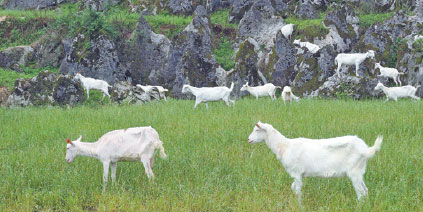
Though the village is still steeped in the old, there are visible signs of modernity. Visitors undergo sanitization procedures at a spray sterilization room before they are allowed to see the 400 dairy goats that are grazing in the lush grassland at the foot of a hill.
Though grazing reduces milk out-put by 30 percent, compared with raising goats in confinement, the villagers believe that the New Zealand-style of breeding will give it the coveted high-end green product tag. Further evidence of modernization is visible in the form of the New Zealand-designed Waikato system used to milk the goats.
The dairy farm is part of Guiyang Shengheng Ecological Agriculture Development Co Ltd, an agricultural startup established by four young professionals who gave up their promising urban careers for a tryst with the unknown in the relatively undeveloped Chashan.
The four young executives of Shengheng, all born around 1980, style themselves as real-world "Chinese rural partners".
Ning Weihua, 34, Shengheng's chairman as well as head of Chashan village, recollects the early days when he invited several agricultural experts to discuss the way forward for Chashan and the road it should take for sustainable development.
According to Ning, the experts were unanimous in the opinion that Chashan should use its natural resources to full advantage. The road map outlined by these experts hinged on increasing farming and developing leisure agricultural tourism.
"Cities are for making a living and countries are for living a life," said Ning. He said that his goal is to ensure that Chashan has a modern infrastructure without sacrificing its idyllic country life.
That was something easier said than done, said Ning, adding that his first task was to conduct an opinion poll among the village's 284 house-holds on the kind of jobs and the remuneration they expected.
"We provided job options such as cattle breeding, dairy goat raising, rural tourism, bed and breakfast, support crews and construction. The expected remuneration of farmers for these jobs ranged from 5,000 yuan ($800) to 72,000 yuan per year.
Ning said they want to help the villagers build competitiveness to sustain themselves by taking the agricultural development route for growth.
Ning, who only finished three years of elementary school, has spent lots of time and effort to attract good professional talent for Shengheng, a key factor in its successful operations.
One such person is Wang Haibin, 34, the company's technical supervisor for its goat project, who was earlier a researcher with the Guiyang agricultural department and a graduate of Northwest Agriculture and Forestry University.
Wang admitted that Chashan has been an ideal place to put his knowledge to the test. He started a goat-raising business earlier with other partners but failed because of a lack of capital.
The milk output at the goat farm is about 250 kilograms per day, Most of the dairy goats are of the Saanen breed, and Wang is working on nurturing a local breed so that more farmers can participate in goat raising and increase the output.
Unlike Wang, Luo Hongwei, a former department manager of Pudong Development Bank Co Ltd in Shanghai, would have never given a second thought or dreamed that he would resettle from the nation's financial center to a small backward village in Guizhou.
Luo's father-in-law was a supplier of Shengheng, who said good things about Ning and made the introduction.
"After almost three days' conversation through day and night, I was deeply touched by Ning's dream - a dream to change rural lives, and I decided to join," Luo said.
He is now in charge of marketing and financing issues for Shengheng.
The three team leaders found Liu Qingchun, who became deputy general manager of Shengheng, through an article Liu posted on the website about agricultural investment and agricultural industry park. Liu called himself a big fan of rural investment, and he owned an agricultural base in Chengdu, Sichuan province.
After a phone conversation, the three drove directly to Liu's place in Chengdu. Similarly, after three days and two nights of conversation that brought only six hours for sleep, they welcomed Liuas the newest member of the team.
"I saw too many agricultural investors who were actually real estate developers; we really want to develop a unique model and a circular economy for Chashan," said Liu.
Many of their friends do not understand their choice, and all of their wives are still in cities as the rural village is too backward in terms of education for their children.
The company has set up a dairy bar in Guiyang, the provincial capital, to supply milk, yogurt, pudding and cheese. The total number of the bars in Guiyang will eventually reach 20, and they are looking for dealers in other cities, according to Ning.
Other industries in Shengheng includes a pig farm with about 1,800 pigs, which has already turned a profit, and flower and kiwi fruit plantations.
According to Ning, about 150 million yuan has been invested in the redevelopment of Chashan, and indications are that the total outlay will hit 2 billion yuan by 2017.
"Funding is not an issue," said Ning. "The important thing is to know how to leverage the capital."
But he also said that financing such projects is not an easy task because they come with many risks and a long gestation period.
"We have been lucky, "he said. "Our projects have been supported by the local government, and it has provided funds for the construction of infrastructure like roads."
The local government support also extended into naming Shengheng as a provincial-level demonstration agricultural park. In addition, a local commercial bank has ensured financing of more than 200 million yuan.
Land is the most important asset for farmers. Shengheng is renting farmers' land, and Ning said his goal is to make farmers in Chashan share-holders of Shengheng and centralize the management of the village's land in the coming years. Thus farmers could get a rental income, a salary for working for the company and a bonus if the company makes a profit.
Shengheng, currently a private company, was established for the benefit of the villagers. Ning said that his goal is to ensure basic welfare for children and senior citizens of the village.
Xu Xiaoqing, director of department for rural economic development at the State Council's Development Research Center, said the practice of turning villagers into shareholders has been replicated in other places, such as Xiabo village in Foshan, Guangdong province.
"It (pooling land as shares) is a good effort to bring the villages out of poverty. But there are also risks like the performance of the enterprise," said Xu.
Lots of land was used for building factories in Xiabo and the village's development stagnated after years of hectic development.
"We won't damage the cultivated land no matter how well Chashan develops since that's not sustainable development," Ning said.
Yang Jun and Su Jiangyuan contributed to this story.
Contact the writer at lanlan@chinadaily.com.cn
|
A dairy goat farm of Guiyang Shengheng Ecological Agriculture Development Co Ltd in Xiuwen, Guizhou province. Gao Anming / China Daily |
(China Daily USA 08/06/2014 page14)

 China Southern launches Guangzhou-New York service
 NYC spurs small business
 US-Africa summit starts with development fora
 Two double-decker buses collide in New York
 Life in quake-hit areas of Southwest China
 Getting teachers to teach about China
 Drought persists in Central China's Henan province
 US artist creates lifelike baby animals
Most Viewed
Editor's Picks

|

|


|

|

|

|
Today's Top News
Rescuers race to save lives as quake toll nears 600
589 dead as strong quake jolts SW China
China to punish Chrysler, Audi for anti-trust violations
US interest in Africa grows
Chinese firm developing Ebola reagent
Barrier lakes pose threat in quake-hit Ludian
2 Canadians probed in theft of State secrets
Envoy dismisses building freeze in S. China Sea
US Weekly

|

|