Innovation in the wrong field
Updated: 2013-07-04 10:01
By Michele Geraci (China Daily)
|
||||||||


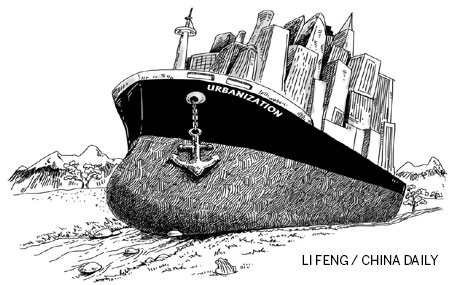
For the first time in recent history, China is trying to be innovative in an area not explored by other countries before, or, if they have, they have not done it very well. Should we rejoice? Not exactly, because the area in which China has chosen to be innovative is a one-way street. As The Hollies used to sing "it's a long, long road, from which there is no return ... that lead us to who knows where".
This one-way street is called urbanization, in which China cannot afford to commit mistakes. China is basing its future growth model on the assumption that "urbanization leads to economic growth". However, the reverse may be true, that is, "economic growth leads to urbanization".
Luckily, it seems Chinese policymakers are now taking a more cautious approach to urbanization, which is a welcome development.
Although the urbanization drive threatens to destroy what (little) is left of the immense Chinese culture, for which future generations will have to pay the price, let us leave aside the cultural aspect and instead focus on the economic side of the story.
It took more than 100 years for the ratio of the United States' urban population to the total to increase from 30 percent to the current 75 percent. Besides, when the process started, the US' total population was only 50 million. China is trying to do the same at a much faster pace with a population 25 times larger.
To describe the current status of urbanization in China, I use my back of the envelope formula, which I call "the rule of 30-50-30". It indicates three measures of urbanization, or three different definitions: 30 percent of the population have urban hukou (house registration) and 70 percent have rural hukou; 50 percent of the population lives in urban areas and 50 percent in the countryside; and 30 percent of the population gets most or all of its income from rural activities.
Urbanization has indeed created miracles in the past and has been the key input factor in China's economic growth. But going forward, will urbanization bring the same benefits to economic growth?

 Ecuador finds spy mic for Assange meeting
 US martial artists arrive at Shaolin Temple
 July 4 in Prescott: Balance of grief, patriotism
 Jubilant crowds celebrate after Mursi overthrown
 Growth slowing for services
 Venezuela eyed as Snowden seeks asylum
 Anti-terror drill staged in Xinjiang
 Memorial service held for 19 Arizona firefighters
Most Viewed
Editor's Picks

|

|

|

|

|

|
Today's Top News
US welcomes China's engagement in Africa
Data show shifts in US, China economies
Obama, Merkel agree talks on surveillance program
Filipino executed for drug trafficking
Obama orders US to review aid to Egypt
Snowden still in Moscow
China urges more efficient uses of fiscal funds
Egypt army topples president Morsi
US Weekly

|

|