Bridging the East and West
Updated: 2011-12-02 11:18
By Larry Lee and Wang Jun (China Daily)
|
|||||||||


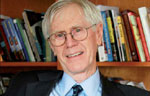
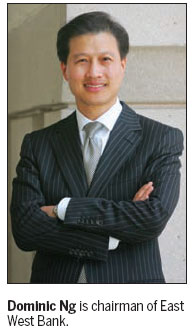
NEW YORK - As both chairman of an American bank and of a prominent Chinese American civic organization, Dominic Ng likes to say that his mission in life is to bridge the East and West.
"I like the name of East West Bank - the connection between East and West," Ng said of his bank in a recent interview with China Daily in his Pasadena, California office, where East West Bank is headquartered. The bank's name in Chinese, "Hua Mei", translates as "China and America".
The 52-year-old Ng's name in Chinese, Wu Jianmin - Ng being the Cantonese pronunciation of Wu - is coincidentally the same as that of China's renowned former ambassador to France, and like a star diplomat, Ng plays in multiple arenas in fostering Sino-US relations.
Not only does he head East West Bank, the 35th largest bank in the US in terms of total assets, Ng is also current chairman of the Committee of 100, an influential organization of Chinese-American leaders.
Born into a Catholic family in Hong Kong in 1959, Ng's parents named him after Saint Dominic. In 1977, after graduating from high school, he joined his older brother John in Texas. He enrolled in the University of Houston to study chemical engineering, a major chosen for him by his parents. However, that was not his cup of tea.
|
|
As a curious young man in a brand new country, he was fascinated by American culture, Ng recalled, so he switched his major to mass communications, where he could study American culture and values. Then in his senior year, Ng was persuaded by John to change his major again to accounting - to better find a job, Ng said.
After graduating at the top of his class, Ng was recruited by the accounting firm Deloitte and Touche, where he worked for 10 years, based in Houston and then Los Angeles. Ng recalled that there were very few ethnic Chinese working at the firm during those years, but for him it was a good place to learn about business and different industries.
In 1988, he started the Chinese business service division at Deloitte, years before others realized that China would become a major force for new business opportunities.
"I was very happy working there and never thought about leaving," Ng said. But in 1990, he was approached by PT Gajah Tunggal (GT), Indonesia's second-largest commercial group, to lead their investments in the US. Ng became president of Seyen Investment Inc in Los Angeles, GT's investment arm in the US. In 1991, he was appointed to the board of directors of the California-based East West Federal Bank and became president of the holding company. The following year, he became president and chief executive officer of East West Federal Bank.
At the time, East West Federal Bank was a savings bank with $40 million in total assets, eight branches and some 200 employees. Ng did the marketing himself, visiting potential clients one by one.
Ng turned East West from a savings bank into a commercial bank, broadening its reach to international business with a focus on China. In 1995, the bank rewrote its charter and officially dropped the word "federal" from its name. In 1998, Ng orchestrated a management buyout from the GT group. In a joint effort, Ng and then CFO Julia Gouw, who is the current president and COO of East West Bank, raised $238 million in 10 days from institutional investors on the Wall Street, laying a solid foundation for East West Bank to go public. Several months later in February 1999, the bank was listed on the NASDAQ.
Now, 20 years later, East West Bank is the financial bridge to China for many mainstream customers including the LA Lakers and the power company Southern California Edison.
Last year, East West Bank had net earnings of $165 million, a 115 percent increase over 2009, according to the bank's 2010 annual report. East West Bank now has more than 130 branches and more than 2300 employees.
The bank has developed expertise in different industries such as high-tech, green technology and entertainment, Ng said. On the management level, "customer-centered relationship banking" has gained East West Bank an edge in the competitive US financial industry, he added. "What's never changed is that we stay focused on the Chinese connection."
Earlier this year, after serving 11 years as a member, Ng was elected as chairman of the Committee of 100.
"Although it takes a lot of time from my business, it's not a waste of time," Ng said, "because the Committee of 100 has the same mission as East West Bank."
"It is my obligation to serve Chinese community in this country," Ng said. "East West Bank and the Committee 100 will help more and more people from China to invest in the US; in the meantime, we will provide our expertise to American businessmen to do business in China."
In early December, Ng will be in Hong Kong to host the annual forum of the Committee of 100. Next April, the Committee of 100 will hold its annual conference in Los Angeles.
A good relationship between the US and China "helps resolve many tough issues", Ng said. In that vein, his hope is to build a strong foundation for organized growth and for moving the Committee of 100 forward. "If we keep doing the right thing, when our mission is achieved, there will be no need for a Committee of 100," he said.
China Daily