Glowing green pigs may light way to making cheaper drugs
Updated: 2014-01-21 13:08
By Eliana Kirshenblat in New York (China Daily USA)
|
||||||||


Researchers from a Hawaii university took a new technology to China to create a group of glowing green pigs - an achievement that could someday lead to a way to create less costly and more efficient medicines.
For patients who suffer from hemophilia and need blood-clotting enzymes in their blood, "we can make those enzymes a lot cheaper in animals rather than (in) a factory that will cost millions of dollars to build," said Stefen Moisyadi of the University of Hawaii at Manoa's John A. Burns School of Medicine, who performed the initial tests with mice.
The technique, which had only been used on smaller mammals until now, quadruples the success rate at which foreign DNA is incorporated into an embryo. In this case, the foreign material contained a fluorescent protein from jellyfish DNA that made the pigs glow in the dark.
Moisyadi's Chinese collaborators at South China Agricultural University implanted 25 pig embryos with the jellyfish DNA and 10 transgenic piglets were born last August. This 40 percent success rate is a huge jump from the previous 2 percent success rate similar methods produced, the scientists said. The 10 pigs, which glow green under a black light, can be seen in a video on UH Med's vimeo account.
Wu Zhenfang and Li Zicong of the South China Agricultural University adapted Moisyadi's technique to pigs and detailed their experiments in a report to the Biology of Reproduction journal. Li is a University of Hawaii alumnus. Also helping to produce the report was Johann Urschitz, an assistant research professor in the UH medical school's Institute for Biogenesis Research.
Moisyadi explained that the pig's glow is only a genetic marker to show that the foreign jellyfish DNA was successfully incorporated into the natural makeup of the pig. The glow is literally a visual confirmation that the process works and the pigs themselves remain unaffected by their new trait and will have the same lifespan as an unaltered pig, he said.
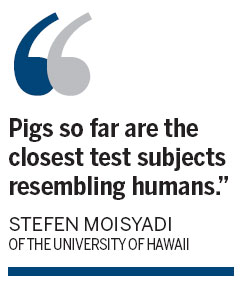
This same technique has been applied by other international teams to make mice, rabbits and sheep glow in the past but using pigs was an "important step", he said. "Pigs so far are the closest test subjects resembling humans. Results achieved with them is more likely to be applicable to people," Moisyadi said.
The ultimate goal is to introduce beneficial genes into larger animals to create less costly and more efficient medicines, the scientist said. "[For] patients who suffer from hemophilia and they need the blood-clotting enzymes in their blood, we can make those enzymes a lot cheaper in animals rather than a factory that will cost millions of dollars to build," Moisyadi said.
The next steps are to work with genes that do something other than make a green color, said Moisyadi. A useful gene might someday "be used to make medicines or apply to human gene therapy," he said.
elianakirshenblat@chinadailyusa.com
(China Daily USA 01/21/2014 page2)









Most Viewed
Editor's Picks

|

|


|

|

|

|
Today's Top News
Memorial hall reflects on Japan's aggression
Missionary wants US to get him home
Tech park visits Bay Area
US may be losing in globalization
Students develop apps for campus life
Three dead in China food poisoning
Beijing blood donations drop
US commemorates Martin Luther King Jr.
US Weekly

|

|