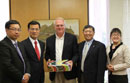
Activist looks back on cemetery victory
Updated: 2014-02-17 14:38
By Pu Zhendong (China Daily USA)
|
||||||||


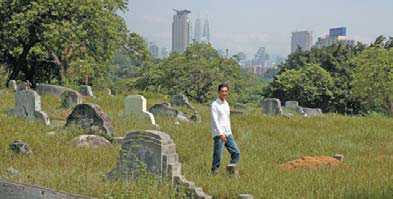
Lee Chun Kong said his biggest achievement was leading the campaign to preserve the century-old Kwong Tong cemetery, which involved more than a decade of negotiations with the Malaysian government in the late 1990s.
Since 1895, the 107-hectare cemetery has held the remains of members of six Chinese associations, all from Guangdong, such as Kapitan Yap Ah Loy and Yap Kwan Seng, who are regarded as the founders of modern Kuala Lumpur.
"The graves were designed to match the personality of the deceased. Arcs and waves on the tomb represent gentleness and amicability, while sharp angles mean valor and feistiness," said Chow Teng Choy, who was in charge of the beautification of the cemetery.
"Their ancestral home addresses are engraved in great detail by their children. This is seen as a spiritual connection with their motherland," he said.
At the end of the 19th century, the cemetery stood on a hill in a southeastern suburb, but as the city developed, it was absorbed into central Kuala Lumpur.
The Malaysian government had planned to take back the land since the mid-1990s, when it was estimated to be worth $710 million.
In 1998, then prime minister Mahathir Bin Mohamad announced that it was inappropriate to have cemeteries in the city center and called for their relocation.
The Chinese communities reacted angrily, viewing the plan as a move to wipe out their contribution to Kuala Lumpur's history, and united in protest. Lee, together with five other leaders of the local Chinese community, sat down with the municipal government to negotiate.
"They asked us to state a price, but it was not an issue of money, it was about the heritage and esteem of our ethnicity," he said. "The Chinese contribution to Malaysia's history should be recognized and respected."
After two years of tough talks, the government compromised in the face of public criticism to preserve the cemetery and develop it into a heritage park.
"We are glad that the cemetery is now a must-see for tourists and historical researchers," Lee said. "As a social activist, I have not had a professional career like most people, but I never stopped fighting for equal rights for our Chinese groups.
"Recording history and passing down our cultural heritage in Malaysia is a responsibility that cannot be relinquished," he said.
|
The century-old Kwong Tong cemetery is the resting place for the deceased members of six Chinese associations. Jiang Dong / China Daily |
(China Daily USA 02/17/2014 page6)

 World's largest freshwater lake frozen
 American photographer wins World Press Photo 2013
 Zhou Yang retains women's 1500m title
 Renzi set to become Italy's youngest PM
 Kissing contest celebrates Valentine's Day in Beijing
 Xinjiang quake damage could have been worse
 US East Coast buried in snow
 China's Li wins women's 500m gold
Most Viewed
Editor's Picks

|

|

|

|

|

|
Today's Top News
Dallas shooting kills one, injures six
Venezuela expels 3 US diplomats
High-rise security tightened after stunt
Shelters reveal flaws in child welfare
Precipitation expected to clear up smog-filled skies
Police reveal details of Xinjiang terrorist attack
Canadian immigration changes 'unfair'
Finding real wealth in health industry
US Weekly

|

|