Targeting 'elegant' bribes in crackdown
Updated: 2014-09-08 07:27
By China Daily(China Daily)
|
||||||||


The objects do not have fixed prices and the deals are often sealed privately.
A painting at a gallery will not sport a price tag, bargaining is common at antique stores and at auctions, and bidders have only "high" or "low" estimates for reference.
With these characteristics, works of art have long been viewed as a "grey area" opportunity for corruption - making it extremely difficult to identify precisely how much an art bribe is worth.
Judicial prosecutors have recently been asked to brush up their knowledge of artworks and antiquities, so that they are better able to spot evidences of such yahui, or elegant bribery, in the behavior and activities of suspected corrupt officials.
The far-reaching anti-corruption drive already seems to have hit yahui.
Some auction houses have reported a drop in consignments from clients made up of government officials, retired and current.
These boast rich collections of Chinese paintings and antiquities but dare not sell them at public auction for fear of being investigated, Chinese media reported.
Beijing-based Art Market Monitor of Artron, an affiliation of Shenzhen printing company Artron, recently issued a report on the Chinese art auction market in the first half of the year.
It predicted that unlike what had occurred in the past decade, the Chinese art market will experience minimal eruptions and rocketing prices in the coming five years, a response to the economic slowdown.
The cooling down will be felt strongly in Chinese painting and not just because of economic factors, according to the report.
The Chinese painting market has been increasingly criticized as a conduit for deals between money and power, and the central government has vowed to target yahui in its corruption crackdown.
Art bribery dates back to hundreds of years and extremely corrupt officials such as Yan Song of the Ming Dynasty (1368-1644) and He Shen of the Qing Dynasty (1644-1911) were among its most notorious examples.
After the art market revived in the 1990s, works of art sold for up to several hundred yuan and appeared more as gifts centering on their aesthetic value.
But as the market boomed and prices hit tens of millions of yuan, speculators looking for short-term gain flooded in the market. Works of art became a shortcut for cashing in, making it very convenient for yahui dealings.
Some art market observers have questioned the extent that the anti-corruption drive can curb art bribery and whether a better way can be found to determine the true value of the bribes.
Yahui-related pricing has disrupted the art market for years. There have been several cases of paintings in which investigators alleged involved bribes worth millions, only to find out the objects were deliberately overpriced.
In other cases, officials sold a painting valued at several thousand yuan at auction only to have the bribers winning the bid by paying millions of yuan.
These abnormalities cannot be eradicated if the market continues to function without a comprehensive pricing mechanism, analysts said.
Some dealers and auctioneers have been fully involved in the "industry chain" of yahui. They help launder bribes and others consign a forged painting to dealers or auctioneers who then sell it to the bribers at the price of a genuine one.
The practice of yahui reflects how bad the art market can be, when an independent authentication body has long been absent and cheating prevails without strict supervision, analysts said.
|
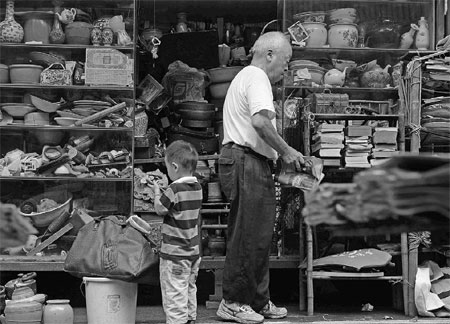
A shopkeeper at an antique market in Shanghai on Aug 21. The country's antique market has been affected by the authorities' anti-graft campaign. Lai Xinlin / Xinhua |
|
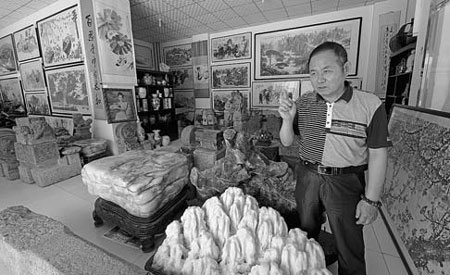
Han Zhigang, a shop owner in Dali county, Shaanxi province, says he raked in about 500,000 yuan ($81,500) last year by selling artwork. Lu Guoliang / for China Daily |
|
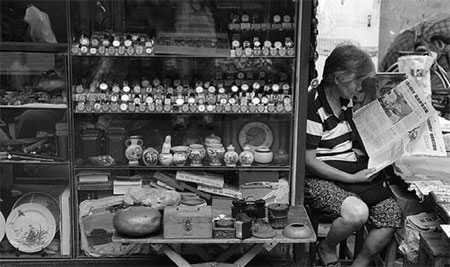
A vendor peddles wares including watches and porcelain at an antique market in Shanghai's Dongtai Road on Aug 21. Lai Xinlin / Xinhua |
(China Daily USA 09/08/2014 page6)
 Chinese embassy in Washington holds Teachers' Day reception
 Boao Forum for Asia Seattle conference kicks off
 New York Fashion Week: Day 2
 First prison themed restaurant opens in Tianjin
 Zhang Zhijun welcomed at Chinese Consulate in San Francisco
 'Returning to China in 1980s' exhibition
 Federer, Djokovic both lose in US Open semifinals
 Nishikori upsets Djokovic to reach US Open final
Most Viewed
Editor's Picks

|

|

|

|
|
|
Today's Top News
Tsinghua, Berkeley prepare joint institute
Obama to give speech Wednesday on IS
Kathy Griffin, Howard Stern at Joan Rivers funeral
Hainan Air offers Chinese-language Boston map
Obama delays acting on immigration
Alibaba to raise $20b in IPO record
A child of Guatemala seeks a seat in Congress
Boao Forum meets in US
US Weekly
|

|