Fostering China-US cooperation
Updated: 2016-07-08 11:44
By Chen Weihua in Honolulu, Hawaii(China Daily USA)
|
||||||||


For Charles Morrison, president of the East-West Center (EWC), cooperation between the United States and China is essential in tackling global problems.
EWC is an education and research organization that was established by the US Congress in 1960 to strengthen relations and understanding among the peoples and nations of Asia, the Pacific and the US.
In Morrison's views, the US cannot do it alone anymore in a lot of areas, and China is not envisioned to do it alone.
"But when we work together, there is a lot more we can accomplish," he told China Daily in his office on July 1.
Like many people in the two countries and the world, Morrison cited the US agreement on climate change as "a good example of how the US and China work together, then we can provide a much stronger impetus for the whole world".
Several landmark agreements reached by China and the US on climate change since June 2013, when President Xi Jinping and US President Barack Obama met in the Sunnylands retreat in California, have been widely regarded as instrumental to the historic Paris Agreement signed last December by 195 countries.
|
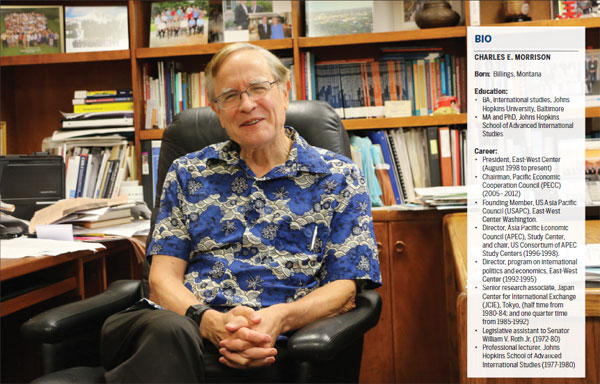
Charles Morrison, the longest-serving East-West Center president, will soon retire. He is a firm believer in China-US engagement and cooperation. chen weihua / China Daily |
Morrison, an expert on economic integration in the Asia-Pacific region, believes that China and the US are approaching the same issues, such as the One Belt One Road (OBOR) and Trans-Pacific Partnership (TPP), in different ways.
The Americans concentrate on the legal framework, such as in making WTO and TPP very legalistic agreements. But he said China focuses on connectivity, on building things.
"Both are good," he said.
While the initial US opposition to the China-led Asia Infrastructure Investment Bank (AIIB) has further reinforced the thinking among many Chinese that the Americans intend to curtail China's rise, Morrison said the US was right to push for the standards, but added that the US perhaps made a mistake "to appear to oppose the whole idea (of AIIB)".
Despite Washington's opposition, virtually all of its major allies in Europe and Asia except Japan have joined the AIIB, which focuses on badly needed infrastructure-financing in the region.
The soft-spoken Morrison said that many Americans aren't too worried about One Belt One Road.
"One Belt One Road in a sense may help stabilize some of the Central Asian states we are very worried about," he said.
Many thought-leaders, such as Robert Zoellick, the former World Bank president and former US deputy secretary of state, hold similar views that China's One Belt One Road initiative also serves US interests, and therefore the US should cooperate more closely with China in the program.
Morrison believes that as long as One Belt One Road operates on good principles, such as on environmental protection, it could be positive for the region.
"I think the way Americans and Chinese deal with each other should be very frank and blunt, but (they should) try to figure out how to use our resources as best we can to cooperate in (areas where) we have common interests, and over time, expand those common interests," he said.
As a supporter of TPP, Morrison has been disappointed with the way US domestic politics have played out, with Republican presidential candidate Donald Trump blasting the deal and Democratic contender Hillary Clinton also saying it was one she would not have negotiated.
Morrison is pessimistic about the prospect that the TPP, a free trade agreement among 12 Pacific Rim nations, will be approved by the US Congress in a lame-duck session later this year, something that the Obama administration is making a desperate last-ditch effort to pass. "That won't happen," he said.
Morrison, who has devoted much of his life to regional economic integration, called for patience, and said regional integration is a long-term process.
He believes that China will continue to work with the Association of Southeast Asian Nations (ASEAN) nations on a RCEP (Regional Comprehensive Economic Partnership), but that eventually there will be some kind of agreement.
Many experts believe that TPP and RCEP will finally evolve and merge into something like the Free Trade Area of the Asia-Pacific (FTAAP).
Morrison attributed the stance that Americans believe China is challenging US hegemony and dominance, as the Chinese believe the US is trying to contain China, mostly to domestic politics in the two nations.
He believes the bilateral relationship is held hostage by the two countries' general anxiety about global issues. To the US, China is the face of globalization, compared with Japan decades ago. To China, the US is the most powerful country in the world.
"We are all relative to the rest of the world; we are all going to be less powerful. ... That means we need more cooperation," he said.
Morrison is equally pessimistic that a Bilateral Investment Treaty (BIT) will be approved by the US Congress anytime soon - if it's ever even negotiated completely - but he said it's important for the two countries to continue to negotiate and work hard "because that's the way we learn about each other's practices".
He said he was glad that leaders of the two countries have addressed cybersecurity and made progress on it, despite the fact that it remains an issue.
Morrison was heartened by the cooperation at the subnational level. When US state and Chinese provincial officials met in Hawaii two weeks ago, they did not discuss a single negative issue such as the South China Sea, but rather how to improve business relations.
"Everybody wants foreign investment to their region," he said. "So at the local level, we see a kind of different relationship than the one between Washington and Beijing. That is another dimension of the US-China relationship, one we try to continue to cultivate."
At the EWC, research focuses primarily on the entire region rather than on a specific country, but Morrison admitted that China's rise has made it an essential partner for virtually every project.
"Most of the activities here are about the region, but I would say China is 80 percent of the region sometime, for good or for bad," he said, chuckling.
Besides the US, Japan and the Philippines used to have more participants than any other country, but China is quickly catching up.
"I think after the US, China is probably the country with the most representation in terms of participants now," he said. That includes scholars, officials, journalists and students.
Morrison called Wu Jianmin, the former Chinese senior diplomat who died on June 18 in a traffic accident, as "my very good friend". He tweeted the news that day with deep sorrow for the death of Wu, who was a member of the EWC international advisory panel.
Wu had always been regarded as the opposite of the more hardline and nationalistic voices in China. Morrison expressed concerns over a voice like that going away.
China's growing role in EWC is reflected in Morrison's travel agenda. He is headed to China for the Eco Forum Global Conference 2016 in Guiyang, Southwest China's Guizhou province, from July 8-10.
He also will go to Yangzhou of East China's Jiangsu province in late September for the Pacific Economic Cooperation Council meeting and then make another trip to China in November. He has already attended the Boao Forum on Hainan Island and a meeting on education in Hangzhou, in East China's Zhejiang province.
"So this year I may go to China five times," he said.
Under Morrison, the EWC has opened an office in Washington and has a room in Beijing that is used for activities in China but is still not staffed.
Morrison indicated that it will now be the work of his successor to staff the Beijing office. Having served as EWC's president since 1998, he believes it's time to move on and for a new person to take over and lead the institution.
The EWC launched a global search early this year to prepare for Morrison's retirement, which is expected in August.
chenweihua@chinadailyusa.com
(China Daily USA 07/08/2016 page11)
- Eid al-Fitr celebrated worldwide
- Swedish PM looking at tightening laws after festival sex attacks
- British PM race cut to 3 hopefuls as 2 contenders exit contest
- Chinese herbalists offer free US treatment
- Obama praises Hillary's judgement hours after FBI's censure
- Rio mayor tells Olympic visitors: 'Don't expect New York or London'
 Griezmann scores twice to lift France into Euro final
 Life goes on in flooded Wuhan
 Paper cutouts offer a new view of world landmarks
 Animals occupy Shanghai
 Beijing Muslims mark end of Ramadan
 Remember emerging heroes in China's floods
 Ronaldo powers Portugal into Euro 2016 final
 Culture Insider: Six things you may not know about Minor Heat
Most Viewed
Editor's Picks
|

|

|
|
|

|
Today's Top News
Ministry slams US-Korean THAAD deployment
Two police officers shot at protest in Dallas
Abe's blame game reveals his policies failing to get results
Ending wildlife trafficking must be policy priority in Asia
Effects of supply-side reform take time to be seen
Chinese State Councilor Yang Jiechi to meet Kerry
Chinese stocks surge on back of MSCI rumors
Liang avoids jail in shooting death
US Weekly

|

|
