Cupping and coining: I did it long before Michael Phelps did in Rio
Updated: 2016-08-25 17:11
By Sopheng Cheang In Phnompenh Associated Press(China Daily USA)
|
||||||||


Ancient Asian medical treatment is having an Olympic moment
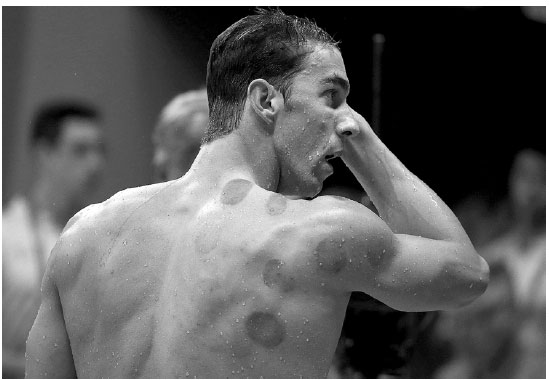
I sported those purple round welts on my body long before Michael Phelps was born. OK, so Phelps made the world aware of cupping by showing his marked muscular shoulders before diving into the pool at the Rio games.
But cupping, and a similar treatment known as coining, has been practiced in East Asia for centuries. I grew up with them. My mother made sure of that.
Phelps, the 31-year-old US swimming star, was seen with purple circles dotting his shoulder and back before his first race at the Olympics. The circles were caused by the ancient Chinese treatment, in which he is a great believer.
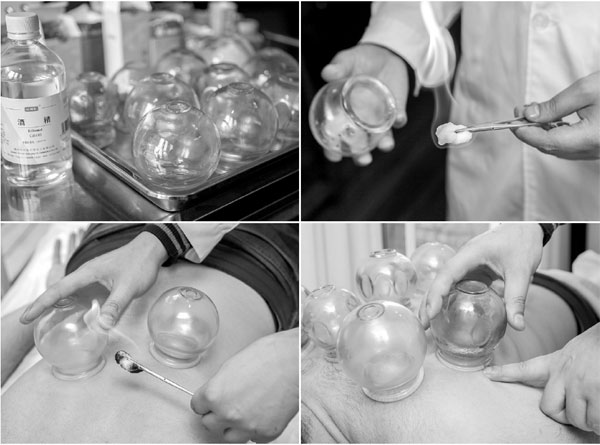
It involves pressing glass or plastic cups to the area of discomfort and either applying heat or suction to create a vacuum. The suction causes the large hickey-like marks.
Another similar treatment is coining. The principle is the same: press a large metal disc with an attached handle on the area of discomfort. While cupping is virtually unknown in the rest of the world - and dismissed by doctors educated in Western medicine as hocus pocus - it is commonplace in China, Cambodia, Vietnam and Myanmar as a cure for ailments as varied as fever, tuberculosis, rheumatism and muscular pain.
I remember, some 40 years ago (I am 46), when I fell sick, my mother always did coining on me. She would rub coconut oil on my skin and then push the coin all over, leaving rows of welts. It scared me. I would cry and sometimes run away. But my mother would say: "Be patient! It will take only a few minutes to complete and it will hurt just a little bit, like an ant bite."
So I would let her, and it usually helped.
In my generation, most people did coining when they had fever including my relatives, siblings and neighbor. Cupping became popular later.
Now when I have a fever, flu, headache or other problems I go to a neighborhood "cupping spa" and get both done. Not that I don't trust medicines. But I also believe in cupping and coining. Got it done just last month for my fever, which wasn't coming down with medicines and injections. One session of cupping and the fever was gone.
The procedure was done in a well-illuminated room with one small bed and a wall fan. I took off my shirt and lay down on my stomach so the practitioner could work on my back, first by rubbing oil and then using the coin. After 15 minutes or so, she told me to turn over and so she could work on my chest. The same procedure was followed with cups as I dozed off.
But there's a rule to coining and cupping - no alcohol or bath for three hours before and five hours after the treatment.
It is popular in the countryside because it is cheap and most Cambodians are poor, and not every village has hospitals or clinics. Ironic, since health spas in the US charge a few hundred dollars for the service. Here we pay the equivalent of $3 for an hourlong session.
Even Prime Minister Hun Sen has touted the benefits of coining and cupping. He has told journalists that his wife Bun Rany does it on him when he is sick.
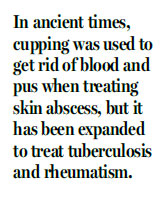
In ancient times, cupping was used to get rid of blood and pus when treating skin abscess, but it has been expanded to treat tuberculosis and rheumatism. Because cupping was widely used in Chinese folklore culture, the technique was inherited by modern Chinese practitioners. It is established as an official therapeutic practice in hospitals all over China.
The US National Institutes of Health says on its website that cupping "is considered generally safe for healthy people when performed by a trained health professional." While saying the placebo effect may account for some claimed health benefits, it also cites recent research that found it may be an effective short-term treatment for chronic neck and lower-back pain.
I ran into Sok Pheakdkey, a 39-year-old driver at a local construction company, at a cupping clinic where he had undergone treatment for fever.
"Now I feel I am fully recovered. Do you see the sweat coming from my head and back? That means the fever is gone," he says. He says the medicines he bought from a pharmacy brought his fever down, but only for a while.
"I don't mean to say that I don't trust medicines. But in my experience the best way to treat these illnesses is coining and cupping. My body seems to be addicted to this type of treatment even though it hurts," he says.
The Cambodian Health Ministry does not advocate cupping, and warns that it could be a health risk.
Health Ministry spokesman Ly Sovann told me that the practice is not known to cure any illnesses, and in fact can be dangerous for people with high blood pressure or heart problems. Still, the practice is not banned in the country because it is almost a way of life for Cambodians, he says.
"My advice is that Cambodia people should start changing their habit. They should consult physicians or doctors first if their illness is something related to high blood pressure and heart attack. Then after they talk with the doctor, of course they can do coining or cupping if they prefer," he says.
Associated Press reporter Sopheng Cheang grew up in Cambodia and has lifelong experience with coining and cupping.
|
The Chinese treatment, also known as baguan, utilizes heated glass cups to create a suction on the patient’s skin, causing a circular mark that looks like bruising on the skin. Photos By Lamyik Fei / Getty Images |
|
US swimmer Michael Phelps has appeared at the Rio Olympics with purple circles dotting his back and shoulder - the telltale mottling left by the ancient Chinese treatment of cupping. Michael Dalder / For China Daily |
(China Daily USA 08/25/2016 page9)
- Talks with Manila at early date expected
- Respect, protect nature during development: Xi
- School to compensate parents of students studying in US
- Gobi has been found! Marathon-running stray dog reunites with owner
- Six Chinese youths make MIT's innovators of the year list
- Whale shark found dead in
East China
- Prince William and Kate visit charity orgarnization in Luton
- China welcomes Japan to play constructive role in G20 summit
- Expert: G20 ushers in collective leadership
- Turkey to provide support for anti-IS operation in Jarablus
- China, Japan, S. Korea should work to make differences controllable
- Several killed after strong quake strikes Italy, topples buildings
 Top 5 fitness bands in customer satisfaction
 Orangutan goes shopping in Southwest China
 Prince William and Kate visit charity orgarnization
 London Zoo's animals have annual weigh in
 Ukraine celebrates Independence Day
 Top 5 smartwatches in customer satisfaction
 Woman creates silk Chinese cabbage
 Panda family celebrate birthday in Malaysia
Most Viewed
Editor's Picks
|
|

|

|

|
|
Today's Top News
Trump outlines anti-terror plan, proposing extreme vetting for immigrants
Phelps puts spotlight on cupping
US launches airstrikes against IS targets in Libya's Sirte
Ministry slams US-Korean THAAD deployment
Two police officers shot at protest in Dallas
Abe's blame game reveals his policies failing to get results
Ending wildlife trafficking must be policy priority in Asia
Effects of supply-side reform take time to be seen
US Weekly
|

|
