Fore! Golf is driving its way into China
Updated: 2016-05-13 11:10
By Chris Davis(China Daily USA)
|
||||||||


Golf has been a hot and cold game in China, officially banned by the government but now officially okay to play. The question is, what golf's next shot may be in China, Chris Davis reports from New York.
In golf they call it a tough lie. The ball rolls between a rock and a hard place, or nestles itself in the crotch of some gnarly tree roots, or sneaks under some low-hanging shrubbery.
The sport of golf is finding itself in a similar pickle in China these days.
On the one hand, there's golf image as, what Mao called, "a sport for millionaires" banning it and the talk of it being banned as part of President Xi Jinping's crackdown on graft and corruption.
On the other hand, there's the fact that after 112 years, golf has been reinstated as an Olympic sport and China, on its self-proclaimed quest for Olympic gold, revived and revamped its national golf team program.
"They've been pouring an unprecedented amount of money into their national team program, while at the same time cracking down on various other aspects of the game, so in China there's always these kind of alternative realities. Nothing's ever black or white. It's very much a gray area," said Dan Washburn, author of The Forbidden Game: Golf and the Chinese Dream.
After being banned in 2004 and experiencing a boom in spite of it, golf course construction has come to a standstill - with somewhere above 600 courses throughout the Chinese mainland. Last year China announced it would close 66 of them, dig them up and put the land to better use.
Yet at the same time, fans see more and more Chinese names on leader boards at international golf tournaments. And as for the big international PGA Tour China Series tournaments - like this week's Henan Open in Zhengzhou and next month's Nanjing Open - are still going on, business as usual.
So it's fair to wonder what golf's next shot may be in China.
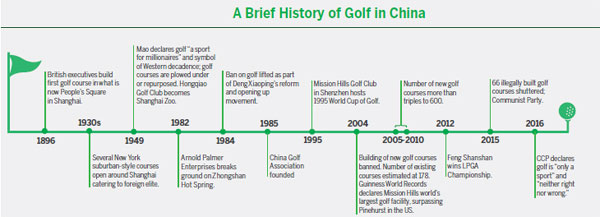
Golf has actually been in China for a while, on and off. In 1896 British executives opened a 9-hole course in Shanghai on the site of what is now People's Square. By the 1930s there were a handful of courses built in the style of classic courses in the New York City suburbs. Starting in 1949 they were all plowed under and repurposed.
Golf's cradle
The real cradle of modern golf in China is Guangdong province, Guangzhou is pretty much the birthplace of modern golf in China. It was there in 1982 that Arnold Palmer broke ground on the Zhongshan Hot Spring, the official first golf course.
The sport was reintroduced to the country in the 1980s, made possible by then leader Deng Xiaoping's opening up policy, which led China through far-reaching reforms that opened the country to foreign investment and the global market and made it more accepting of Western values and activities.
Today, as Washburn explained, no one really knows for sure how many golf courses there are in China.
In 2004, the central government moved to guarantee land for farm use by restricting new golf courses.
When the moratorium started, state media then said there were about 178 courses, maybe a dozen of those were "legal" in that they had the word "golf" in their name.
According to Professor Han Liebao of Beijing Forestry University, the number continued to rise, reaching 521 by 2013, many of them "black courses", disguised as resorts or equestrian parks.
"They banned golf course construction but they also at the same time just turned their backs and let the thing that they were supposedly trying to stop grow unregulated," Washburn said, adding that at one point the government turned to satellite imagery to try and get a handle on the number.
The official number of courses, according to the China Golf Association, is 644 courses. But Washburn said it could be as high as 1,000.
The China Golf Association is like the PGA and USGA wrapped up in one. The government body overseeing everything golf related, national team push Olympic dream. No golf tournament happens in China without the CGA being involved.
Last month, headlines like the Guardian's: "Golf is no longer a crime, decrees China's Communist party", and time.com's "China's Communist Party Cadres Can Play Golf Again" help reinforce the misconception that golf was ever outlawed.
"That was largely misreported," Washburn said.
Playing golf itself was never a crime in China, he explained, even for a Chinese government official, it wasn't technically illegal. Last year, the word golf made its way for the first time into the official regulations for Chinese Communist Party (CCP) members, and with it misconceptions.
"What it specifically said was that it was against the rules for a CCP member to own a membership at a golf club or to receive golf outings for free," Washburn said.
So for a Chinese official to play golf has never been officially illegal, just strongly discouraged. It's an image problem. Golf is extremely expensive in China, so no government official on a public salary should be able to afford it. So when the average person sees a government official playing golf, naturally they'd suspect something fishy was going on.
On April 12, the Discipline Inspection and Supervision News - the official newsletter of the Party's anti-corruption effort - said, golf is "only a sport" and is "neither right nor wrong" in explaining the regulations outlawing gift memberships.
Unlike the US and Western countries, China does not have public courses, where you can find very expensive rounds and very cheap rounds. In China there are only very expensive rounds, all private clubs, the average round being upwards of $200.
"Well out of reach of the overwhelming majority of the Chinese population," Washburn said. For the average Chinese person, a round of golf would be a huge chunk of their annual salary. It's not even something the average Chinese person would even consider as a hobby they might take up."
According to the CGA, there are 358,000 registered golf players in China. And even though it's prohibitively expensive, there are more and more wealthy people every day playing the game. Business people cutting deals, a lot of the newly wealthy using golf like luxury cars or Armani handbags, to broadcast their new status.
Washburn said that when he first went to China in 2004, most golf players were from off the mainland - Japan, Korea, Taiwan, Hong Kong - and there's been a shift over the last decade.
He said the CGA's 358,000 number sounds somewhat realistic, but so does a million. A lot depends on your definition of "a golfer".
The Forward Group, a golf management group, defines "core golfers" as anyone who plays at least eight times a year and says there were 390,000 of them in China in 2015, down 5 percent from 2014.
"Golf is always going to be saddled with some baggage in China, always going to have somewhat of an image problem, at least for the foreseeable future, just because it is such an elitist pursuit there, just because it is out of reach for just about everybody in the country, and because it is tied to corruption in the minds of many," Washburn said.
Even if a Chinese golfer were to win an Olympic medal, it wouldn't change all of the major obstacles that the sport faces there overnight, making it accessible. "No way can it change the fact that developing golf courses requires a large amount of land and a large amount of water resources, two things that are in very short supply in China," he said.
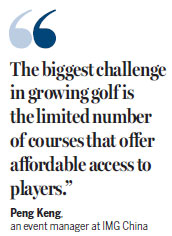
Peng Keng, an event manager at IMG China, the agency that manages junior golf games organized by HSBC, said, "The biggest challenge in growing golf is the limited number of courses that offer affordable access to players."
Inevitable growth
The growth of Chinese golf is inevitable, Washburn said, even though it isn't growing the way some predicted. When golf became an Olympic sport, there were many wild and overly optimistic predictions that the floodgates would open, the government would give it the green light and there would be thousands of public courses opening in China.
That didn't happen, and quite the opposite happened, with closures and a halt to construction.
But China did start the national team program. Some believe the way to create the best pool of potential Olympic talent is to get as many people golfing as possible, the grassroots approach.
China took the opposite approach. "It's more of an elitist national team system," Washburn said. "So if you're going to catch the eye of the national team, you already have to have been performing well in junior tournaments; and if you're performing well in junior tournaments, you're probably from a wealthy family that could have afforded coaching and travel to the tournaments."
Washburn thinks more and more Chinese golfers are going to be making inroads into professional tours.
"Golf fans throughout the world had better get used to seeing more and more Chinese names on leader boards at tournaments," Washburn said, "and golf announcers had better brush up on their Chinese pronunciations."
Contact the writer at chrisdavis@chinadailyusa.com.
|
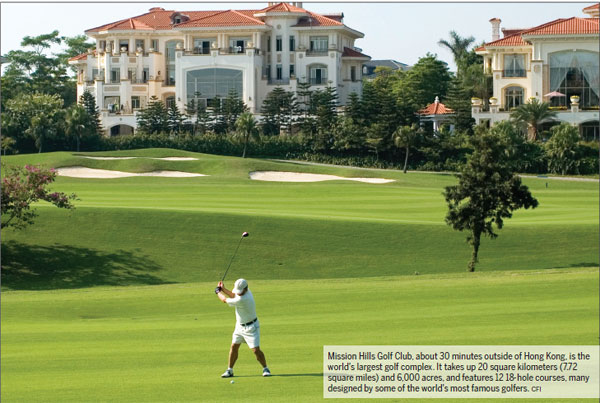
Mission Hills Golf Club, about 30 minutes outside of Hong Kong, is the world's largest golf complex. It takes up 20 square kilometers (7.72 square miles) and 6,000 acres, and features 12 18-hole courses, many designed by some of the world's most famous golfers. CFI |
(China Daily USA 05/13/2016 page20)
- First joint EU-China civil exercise begins in Shanghai
- Uncertainty over EU referendum vote impacts UK economy: Think-tank
- Canadian miner sells world's most expensive rough diamond for record $63 million
- German, Cuban FMs hold talks on bilateral cooperation
- Putin prevails in Sochi all-star ice hockey game
- US guided-missile destroyer visits Tonga

 Karst wonderland in Southwest China
 Love on the rubble: wedding stories after deadly quake eight years ago
 High-tech gadgets shine at CES Asia in Shanghai
 Cannes Film Festival opens amid terror threat
 Supporters of Rousseff clash with police as her removal looms
 Lego opens world's largest store at Shanghai Disney
 Exhibition of table setting art held in Beijing
 Shanghai Disney Resort starts internal test run
Most Viewed
Editor's Picks
|
|

|
|
|
|
Today's Top News
Liang avoids jail in shooting death
China's finance minister addresses ratings downgrade
Duke alumni visit Chinese Embassy
Marriott unlikely to top Anbang offer for Starwood: Observers
Chinese biopharma debuts on Nasdaq
What ends Jeb Bush's White House hopes
Investigation for Nicolas's campaign
Will US-ASEAN meeting be good for region?
US Weekly

|

|
