Rural bamboo business thriving
Updated: 2013-05-05 08:30
By Erik Nilsson (China Daily)
|
||||||||


The rural bamboo business is thriving because farmers are taking the initiative, rather than taking orders, Erik Nilsson reports in Lin'an county, Zhejiang province.
 |
|
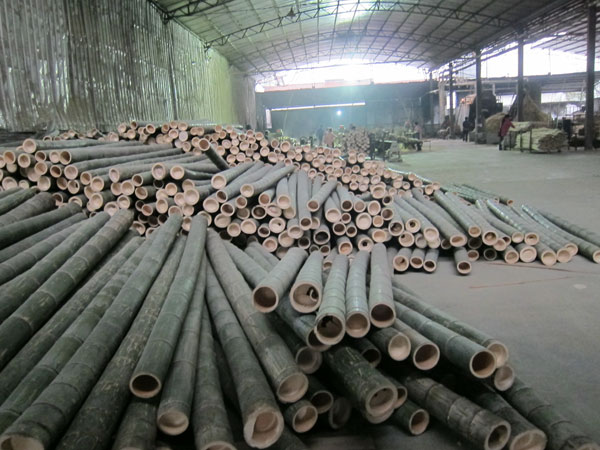
Bamboo processing is a major industry in Zhejiang province's Anji county, which produces about 20 percent of the country's bamboo. Photos by Erik Nilsson / China Daily |
The prosperity of the bamboo industry in Zhejiang province's Lin'an county has come from community-driven development, in which farmers reach consensus with agricultural scientists, the local government says.
"The farmers' prosperity has been self-determined rather than from policies derived by government decree," Chinese Forest Academy of Bamboo Professionals committee member Wang Anguo explains.
"Farmers must be involved if their situation is to improve. We can't just give them orders."
The county's bamboo production is 3 billion yuan ($487 million) a year, accounting for 55 percent of the local GDP. About 253 million yuan comes from exports.
Lin'an's population of 250,000 dwell on 3,100 square kilometers, 65,833 hectares of which are covered with bamboo. About 32,600 hectares of those are for edible shoots.
It hosts about 100 processing factories. About 70 percent of the staff are farmers, including administration, Wang says.
The county even publishes the Lin'an Bamboo Newsletter.
Various levels of government also provide bamboo producers 1,500-3,000 yuan in annual subsidies.
The county is host to 67 types of moso (giant) bamboo, although moso bamboo represents only about 30 percent of its total bamboo coverage. There are 20 species in the county.
The most common is huangtian zhu (yellow-sweet bamboo), which is celebrated not only for being delicious but also for its ability to draw toxic substances from soil and prevent erosion.
"Farmers across the country used hazardous pesticides from the 1960s until the '90s," Wang says.
"So, we've been planting huangtian zhu around China to clean the earth."
This is especially important in Lin'an, which is a major producer of edible shoots.
 |
|
Workers in Zhejiang province's Anji county process bamboo strips, which is the first step in producing virtually all bamboo goods. |
Bamboo also absorbs CO2 at an incredible rate, Wang explains, waving his hand toward a slew of glass domes containing moso bamboo plants.
Lin'an trains up to 5,000 people from poor communities in China, especially ethnic areas. It also trains about 500 from developing countries.
The county is a major producer of ornamental bamboo and hosts the 70-hectare Hangzhou Lin'an Taihuyuan Ornamental Bamboo Planting Garden.
"Bamboo makes Lin'an beautiful in every way," Wang says.
Contact the writer at erik_nilsson@chinadaily.com.cn.
- Envoys dig in at Earth Day bamboo garden
- Chefs challenged at food festival in Beijing
- Grass and bamboo weaving enriches lives for Naxi villagers
- Chinese scientists decipher moso bamboo genome
- New year blessings tied on "bamboo forest" in China's Changsha
- Town embraces green philosophy
- Anthology of bamboo-themed poems published

 Michelle lays roses at site along Berlin Wall
 Historic space lecture in Tiangong-1 commences
 'Sopranos' Star James Gandolfini dead at 51
 UN: Number of refugees hits 18-year high
 Slide: Jet exercises from aircraft carrier
 Talks establish fishery hotline
 Foreign buyers eye Chinese drones
 UN chief hails China's peacekeepers
Most Viewed
Editor's Picks

|

|


|

|

|
|
Today's Top News
Shenzhou X astronaut gives lecture today
US told to reassess duties on Chinese paper
Chinese seek greater share of satellite market
Russia rejects Obama's nuke cut proposal
US immigration bill sees Senate breakthrough
Brazilian cities revoke fare hikes
Moody's warns on China's local govt debt
Air quality in major cities drops in May
US Weekly

|

|