Fish swimming in beer
Updated: 2013-05-25 07:21
By Pauline D. Loh (China Daily)
|
||||||||


|
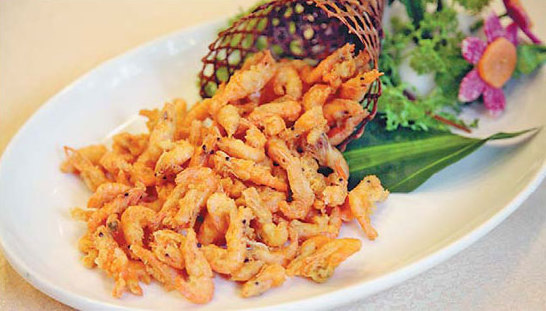
Deep-fried prawns are a fresh catch from the Lijiang River. Photos by Fan Zhen / China Daily |
|
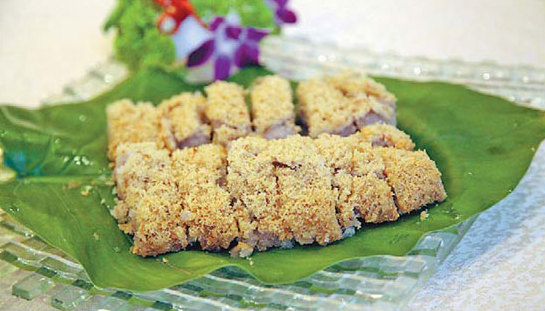
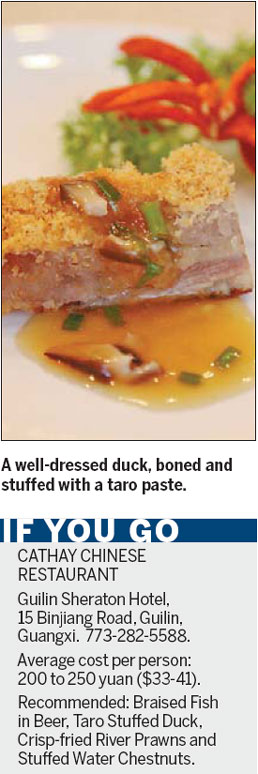
Taro-stuffed duck is an inspired creation on the menu of Cathay Chinese Restaurant. |
|
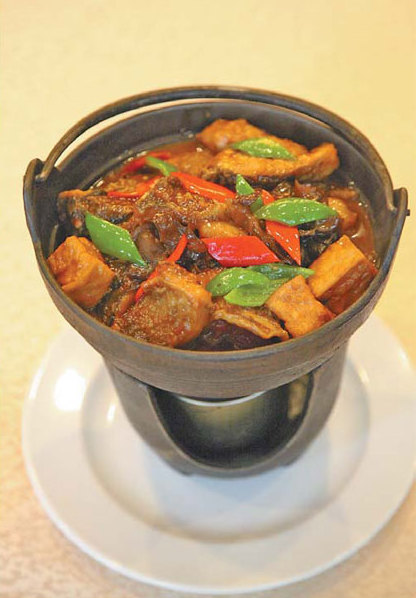
Braised fish in beer is served in a small cast-iron cauldron on a matching warmer. |
Everybody in China knows Guilin is famous for its osmanthus, water chestnuts, betel-nut taro and snail noodles, but Pauline D. Loh finds out there is a lot more to tempt the galloping gourmet.
The scenery is peerless. The air is fresh and moist, and it's like living in a temperate spa. Being near a cool, clear, clean river definitely has its advantages.
For example, you get fresh fish at your doorstep, and also river prawns that make up for their lack of size with almost sugary sweetness. Then there are baby crabs no larger than walnuts that are deep-fried and crunched up along with a couple of tankards of the local beer.
And speaking of beer, good beer needs good water, and Guilin is well known for that. That is why one of the signature dishes in Guangxi Zhuang autonomous region is the river fish braised in beer.
The rich, deep malty tones of the beverage actually go extremely well with the river fish, if you don't mind a few bones and carefully avoid the lethal red chili peppers that are diminutive but fiery enough to have you reaching for a lot more beer.
At the Cathay Restaurant on the ground floor of the Sheraton Guilin, chef Huang Yong has tempered the heat with the addition of red and green bell peppers - cleverly avoiding combustion in the mouth, but still keeping the taste of capsicums strong.
His version of fish in beer comes in an elegant small cast-iron cauldron, balanced on a matching warmer. The fish, cut into large chunks and deep-fried before they are braised in the beer sauce, is simply delicious.
The batter is soft and tender, having soaked up the sauce, but it still retains a slight crunch from the deep-frying.
The fish inside is snowy white, tender and delicate, which makes for a very interesting contrast with the bold flavors outside.
It is a bit like marrying beauty and the beast, and this is probably why it is such a popular order among locals and visitors, served from Guilin to Yangshuo and every small town in-between.
It is obvious that Huang, Guilin born and bred, is proud of his culinary heritage.
He serves up a stuffed water chestnut, crisp to the bite until the sweetness of the aquatic corm meets the sweetness of the minced prawn filling. He wisely leaves the strong flavoring aside, and lets the ingredients speak. All that is needed is the crystal glaze that makes the dish shine.
Another ingredient he proudly displays almost naked is the steamed betel-nut taro that is served with nothing more than just a little saucer of sugar.
The mauve hues of the root are laced with darker purple, just like the grains of a cut betel-nut, hence its name. The taro grows abundantly along the water's edge and Guilin's Lipu region is famous for its yams, another name for this root vegetable.
Both water chestnut and taro are local produce, exported all over China and abroad when they are in season.
Huang trained under both Cantonese and Sichuan chefs, but he has added his own influence to Cathay's menu. For example, he serves a very well-dressed duck, boned and stuffed with a taro paste.
He roasts the whole duck, just like the Cantonese barbecue, but he later removes all the bones, carefully preserves the skin and then applies a thick layer of taro paste underneath.
The stuffed duck is dusted with a gluten flour and deep-fried. The result is fluffy taro and duck cake that is redolent with the fragrance of yam, yet tasting of duck.
The chef is modest about his success, but I have it on good authority that this is a must-eat item.
It is also a good example of how talented chefs can apply the methods they learn to the excellent ingredients available right at home.
While I am pretty sure the chef does not fish for his prawns in the Lijiang River running just outside his hotel, those we next see on our table are prettily pink and beautifully presented.
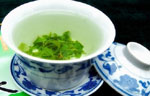
They are crisp, flavorful and addictive, beer food at its best. The platter goes just as well with our osmanthus tea, and the luohanguo infusion we are served with as soon as we settle at table.
Luohan is the Chinese name for the arhats, the semi-saints of Buddhism. There are many stories on why the brown and bald fruit, actually a gourd, is so named, but we will not go into that here.
Instead, let me tell you that the luohan fruit is going to be the next big thing as a natural sweetener, right there with the currently popular herbal sugar substitute, stevia.
Its sweetness is scented with a fruity fragrance and the locals drop pieces of luohanguo into almost everything they drink from hot water to tea to the local herbal tonics traditionally used to dispel the summer heat.
The Sheraton in Guilin is one of the first, and now its oldest, international five-star hotels, and that it has stuck to its benchmarks is apparent from the offerings at its signature Chinese restaurant.
And while we have homebred chefs like Huang guarding Guilin cuisine, we can be sure that here at least, the legacy is safe.

 Michelle lays roses at site along Berlin Wall
 Historic space lecture in Tiangong-1 commences
 'Sopranos' Star James Gandolfini dead at 51
 UN: Number of refugees hits 18-year high
 Slide: Jet exercises from aircraft carrier
 Talks establish fishery hotline
 Foreign buyers eye Chinese drones
 UN chief hails China's peacekeepers
Most Viewed
Editor's Picks

|

|


|

|

|

|
Today's Top News
Shenzhou X astronaut gives lecture today
US told to reassess duties on Chinese paper
Chinese seek greater share of satellite market
Russia rejects Obama's nuke cut proposal
US immigration bill sees Senate breakthrough
Brazilian cities revoke fare hikes
Moody's warns on China's local govt debt
Air quality in major cities drops in May
US Weekly

|

|