Fashionable dynasties
Updated: 2013-06-06 08:12
By Zhao Ruixue (China Daily)
|
||||||||


 |
|
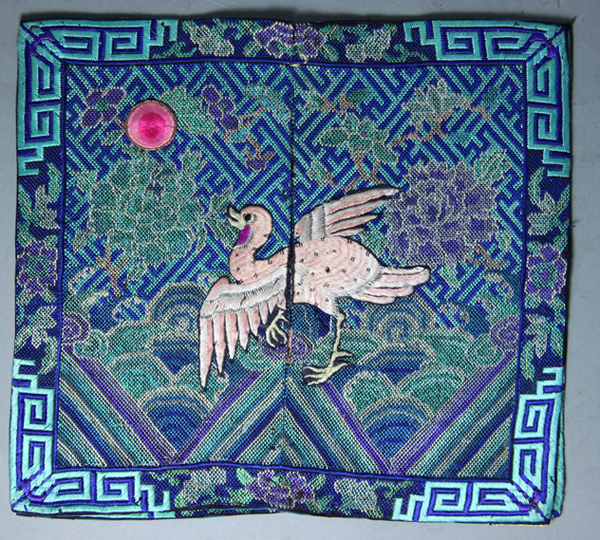
A square patch with a partridge for eighth-rank officials. Provided to China Daily |
Clothing has always been the first thing to change following with the birth of a new Chinese dynasty, says Fang Hongjun, who has studied Qing Dynasty (1644-1911) clothing for 24 years at Beijing's Palace Museum.
The Qing Dynasty's takeover from the Ming Dynasty (1368-1644) initially replaced the Ming-era's loose and flowing robes with saddle-shaped collars and U-shaped sleeves with semicircular cuffs. The Qing rulers were ethnic Manchu, whose soldiers spent their lives riding horses and hunting, Fang explains at an ongoing Ming and Qing clothing exhibition held at the Shandong Provincial Museum. So this clothing style suited the ruling culture's lifestyle, Fang says.
"The saddle-shaped collar protected their faces and is the prototype of the stand-up collar of the cheongsam (qipao)," Fang says.
"The Qing robes' high cuts developed into the cheongsam's signature style in the 1920s."
But some Ming elements survived into the new era and re-emerged more prominently as the Qing Dynasty went on.
"As the Qing Dynasty became established, women no longer needed protective clothing," Fang says.
"So, they started wearing loose and comfortable dresses during casual occasions. This was also a result of cultural integration."
One element that was passed from the Ming to the Qing was patches on robes. While the patches are said to have originated under Tang Dynasty (AD 618-907) Empress Wuzetian, it was during the Ming and Qing that it was formalized to indicate rank.
Ming Emperor Zhu Yuanzhang (1328-98) decreed in 1391 that officials' garments should be loose gowns with round collars, and square patches were sewn on both the fronts and backs. Civil servants' patches were designed with twin flying birds, while military officers' featured a single animal.
"Qing rulers added new patches," Fang says.
Qing emperors, for instance, developed round patches, that only they could wear, while officials' patches were square.
"We can decode the rigid ranking systems of the two dynasties by the designs of the patches - for instance, by looking at what animals are shown and how many adorn the patches," Fang says.
"Clothing bears cultural information."
This remains true today, Fang believes.
"Our descendants will glean information about our lives from the shirts we wear," Fang says.
|
|
|
| Dressed like nobility |

 Michelle lays roses at site along Berlin Wall
 Historic space lecture in Tiangong-1 commences
 'Sopranos' Star James Gandolfini dead at 51
 UN: Number of refugees hits 18-year high
 Slide: Jet exercises from aircraft carrier
 Talks establish fishery hotline
 Foreign buyers eye Chinese drones
 UN chief hails China's peacekeepers
Most Viewed
Editor's Picks

|

|


|

|

|

|
Today's Top News
Shenzhou X astronaut gives lecture today
US told to reassess duties on Chinese paper
Chinese seek greater share of satellite market
Russia rejects Obama's nuke cut proposal
US immigration bill sees Senate breakthrough
Brazilian cities revoke fare hikes
Moody's warns on China's local govt debt
Air quality in major cities drops in May
US Weekly

|

|