Future points to carbon trading
Updated: 2013-06-14 02:17
By Lan Lan (China Daily)
|
||||||||


Challenges ahead
Setting standards and building the capacity of China's carbon market takes time, but the biggest hurdle might be China's sluggish energy pricing system reform.
Whether electricity rates are determined by the market will be a core concern of building a carbon market, said Dargin.
"Without a market-determined price, the imposition of a carbon price on power producers would have little impact as power producers are not allowed to pass on costs to end-users and resist absorbing these costs themselves," he said.
Carbon is a product that is closely linked to energy, but China's energy prices are still mainly controlled by the government. But this year the government has showed signs of accelerating its energy price reforms.
The National Development and Reform Commission in March launched a more market-oriented fuel pricing system to better reflect costs. Economists said relatively low inflation levels have provided favorable conditions for energy pricing reform.
The healthy development of the carbon market will eventually rely on reform of the energy pricing system, said Tang.
"It's difficult to (do things that) affect vested interests among energy groups, so starting the carbon market could be a force to help accelerate reform in the energy sector, but that also brings major challenges for China's carbon market," said Tang.
Also, integration among different markets will be a challenge, he said.
Local pilot projects may have some limitations such as small trading pools for suppliers and buyers, so the central government should allow them to extend trading with other regions, said experts.
Also, potential fraud must be monitored by regulators to ensure that the market has adequate oversight and transparency. As carbon exchanges open in various cities, information security must be monitored and made robust, said Dargin.
For instance, regulators shut down the EU's ETS after hackers stole more than 3 million carbon credits from government and private company accounts.
Furthermore, penalties for non-compliance must be clear. What are the penalties if emitters exceed their emissions caps and do not pay the levied fines? This needs to be clearly stated, said Dargin.

 Michelle lays roses at site along Berlin Wall
 Historic space lecture in Tiangong-1 commences
 'Sopranos' Star James Gandolfini dead at 51
 UN: Number of refugees hits 18-year high
 Slide: Jet exercises from aircraft carrier
 Talks establish fishery hotline
 Foreign buyers eye Chinese drones
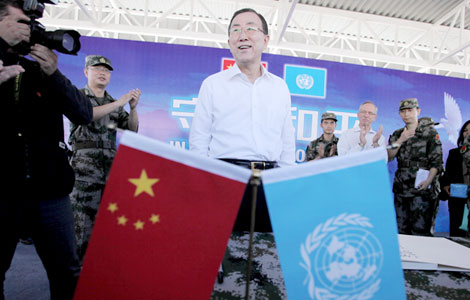 UN chief hails China's peacekeepers
Most Viewed
Editor's Picks
|

|


|

|

|
|
Today's Top News
Shenzhou X astronaut gives lecture today
US told to reassess duties on Chinese paper
Chinese seek greater share of satellite market
Russia rejects Obama's nuke cut proposal
US immigration bill sees Senate breakthrough
Brazilian cities revoke fare hikes
Moody's warns on China's local govt debt
Air quality in major cities drops in May
US Weekly

|

|