Italian painter's brush with New China came five decades ago
Updated: 2013-06-14 07:41
By Lin Qi (China Daily)
|
||||||||


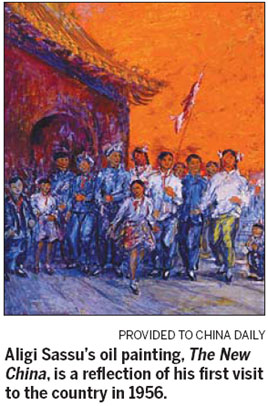
Soon after his return from a thought-provoking trip to China in 1956, Italian artist Aligi Sassu (1912-2000) began several large-scale oil paintings, which included The New China that he finished three years later.
In the work, Sassu depicted a group of young pioneers, one holding up a red flag, who moved forward cheerfully against the backdrop of a red-bricked ancient architecture and bright orange sky.
The painting sums up Sassu's impressions of his first visit to China, or as he wrote to his mother three days after his arrival in Beijing, " this is an ancient and a new world that's walking forward very fast, working with a positive attitude and a truly new and touching spirit".
For more than half a century, The New China had been kept in Sassu's residence in Milan. Now it travels back to the land where it was conceived.
It is among about 140 artworks on display at The Heart of Innocence, at the Central Academy of Fine Arts' art museum.
The exhibition is the largest-ever retrospective of Sassu outside Italy, chronicling his artistic exploration that spans seven decades.
A representative modern artist in Italy, Sassu participated with great passion in social and cultural evolutions of the 20th century. His art bears witness to the development of impressionism, primitivism, romanticism, futurism and cubism.
His works reflect turbulent, anxious and intriguing social realities, pondering such questions as liberty and equality.
The exhibition features Sassu's iconic "red man" works, in which he painted naked young men who bathe in the red rays like those of a setting sun.
"The red implies the warm blood, the ardor of righteousness that flows in the men's bodies. They are descendants of heroes in ancient Greece. They bravely confront with the fears inside and seek for spiritual freedom," says the artist's son Vicente Sassu Urbina.
CAFA Art Museum Director Wang Huangsheng says, "Sassu's artistic language combines romantic feelings with realistic attitudes. He constructed an enchanting atmosphere of traditional Italian art with powerful colors and daring strokes, and meanwhile expressed the dignity of life."
The exhibition also displays dozens of diaries and sketches Sassu made during his 1956 visit. He then headed a delegation of Italian artists, who were among the first Western intellectuals setting foot in China after 1949.
Sassu detailed their traveling in cities including Beijing, Shenyang, Shanghai, Guangzhou and Hong Kong in his autography A Cry of Color.

Sassu wrote that his first hours in China were as fantastic as how the Orient was portrayed in The Thousand and One Nights, for China had numerous colors that were beyond people's imagination. For instance, he compared the sandy wind in Beijing to "an orange and yellow layer of yarn".
One of Sassu's most fruitful days in China was visiting Qi Baishi at his Beijing home.
Sassu said meeting the master of Chinese painting and seeing his art and the emotion in his works were crucial, maybe even more important than meeting Picasso.
"Through those works of flowers and birds, and fish, he shows the sensitiveness as an artist in depicting nature," Sassu said.
 Michelle lays roses at site along Berlin Wall
 Historic space lecture in Tiangong-1 commences
 'Sopranos' Star James Gandolfini dead at 51
 UN: Number of refugees hits 18-year high
 Slide: Jet exercises from aircraft carrier
 Talks establish fishery hotline
 Foreign buyers eye Chinese drones
 UN chief hails China's peacekeepers
Most Viewed
Editor's Picks
|
|

|
|

|
|
Today's Top News
Shenzhou X astronaut gives lecture today
US told to reassess duties on Chinese paper
Chinese seek greater share of satellite market
Russia rejects Obama's nuke cut proposal
US immigration bill sees Senate breakthrough
Brazilian cities revoke fare hikes
Moody's warns on China's local govt debt
Air quality in major cities drops in May
US Weekly
|

|