A growing thirst for water safety
Updated: 2013-06-28 07:51
By Wu Wencong, Jiang Xueqing and Tang Yue (China Daily)
|
||||||||


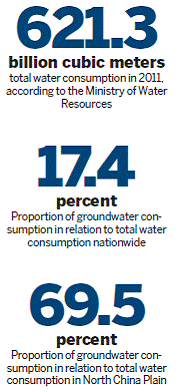
North China Plain
The problem of polluted groundwater on the North China Plain is exacerbated by the high level of consumption - around 70 percent of the area's total water consumption. The level is much higher than the national average of 17.4 percent, according to a research paper written by Wu Aimin, director of the Geological Survey and Technology Department at the China Institute of Geological Environmental Monitoring, in 2010.
On April 26, the Ministries of Environmental Protection, Water Resources, Land and Resources, and Housing and Urban-Rural Development announced a special investigation proposal targeting groundwater pollution on the North China Plain, two months after heated public discussions prompted by claims of illegal dumping of wastewater in Weifang city.
The proposal highlighted the current condition of groundwater on the plain, pinpointed the main causes and future quality targets.
The key pollutants were identified as heavy metals and organic matter, confirming that some small- and medium-sized enterprises had discharged untreated wastewater into the ground via wells and pits, according to a separate investigation conducted by the Institute of Hydrogeology and Environmental Geology at the Chinese Academy of Geological Sciences in 2006. Zhang Zhaoji, who was in charge of the investigation, refused China Daily's request for an interview.
Chen Ming, from the Water Resources Ministry, explained the reasons behind the intensive investigations in the region.
"It's the most heavily polluted region in China in terms of groundwater. Also, because of China's rapid development, which has constantly affected the environment, investigation into the quality of groundwater may be upgraded and the frequency may be increased. By 2012, there were 41,000 groundwater monitoring stations in China.
He emphasized that the latest round of investigations not only retests water at areas previously visited, but is adding new sites to the list.
However, Gao Cunrong from the China Institute of Geological Environmental Monitoring, said that even with new monitoring stations being built or in the planning stage, there aren't enough of them.
"In a 2004 plan for national geoenvironmental monitoring, we suggested that the country should have at least 55,000 stations. But, the number should be increased to 70,000 to 80,000, because of the country's tremendous economic growth in recent years," said Gao.
The national groundwater monitoring project is planning to build around 15,000 new stations, bringing the total to 56,000 when the project is completed, far below Gao's suggestion.
He urged the central government to build two networks, one regional and the other city-oriented. For example, on the North China Plain measures should be taken to prevent the expansion of land subsidence. Meanwhile, in the cities the government should bore test holes to monitor groundwater in areas where pollution is likely to occur, such as landfills and industrial parks.

 NASA telescope to probe solar mystery
 Visit aids 'trust-building process'
 King of Pop returns
 Crowds cheer Court decision on gay marriage
 Hiring index signals further job weakness
 Dance becomes popular stress relief
 Philippine, US start Naval exercise in S China Sea
 Supreme Court gay rights ruling celebrated across US
Most Viewed
Editor's Picks

|

|


|

|

|

|
Today's Top News
Senate OKs immigration reform; hurdles remain
Snowden could request asylum in Russia: official
US collects Internet data on citizens
Boston bombing suspect accused in 4 deaths
816 elected in provincial leadership reshuffle
US adds to DPRK sanctions list
Chinese pros put trust in blogs
More Americans see Snowden as patriot: Poll
US Weekly

|

|