It's been a panda-ful year
Updated: 2013-10-04 09:10
By Amy He (China Daily)
|
||||||||


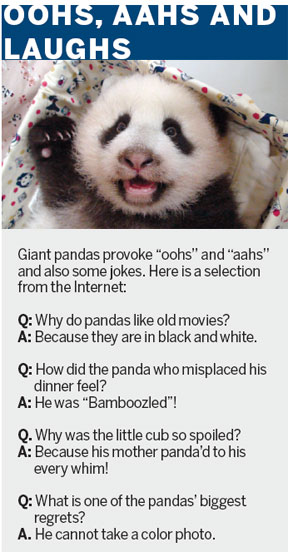
Pandas in zoos everywhere are greeted with a chorus of "oohs" and "aahs" over their cuteness, but some conservationists say that the bears attract far more attention and funding than other endangered animals, reports Amy He in New York.
Nobody hates pandas.
How can they, when the bumbling cuteness of the slow-plodding, bamboo-eating bear is what helped propel it to become a global conservation icon? And this year has seen plenty of panda births, from China to the US capital.
Like the endangered bald eagle and the humpback whale, the panda is considered one of the "charismatic" species, well known and instantly recognized animals that conservationists use to attract the public's attention - and hopefully financial support - to conservation causes.
|
Fourteen giant panda cubs, all born this year, make their debut at the Chengdu Research Base of Giant Panda Breeding on Monday. The base said its 128 pandas form the world's largest captive panda population. Huang Zhiling / China Daily |

Despite all the fans the panda has - which was demonstrated by the outcry when the Washington zoo turned off its panda cam this week due to the government shutdown - the panda still hasn't won over everybody. Some conservationists are concerned about how the bear attracts more attention and funding than other endangered animals - disproportionate to their reproductive successes.
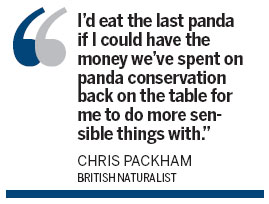
"I'd eat the last panda if I could have the money we've spent on panda conservation back on the table for me to do more sensible things with," said British naturalist Chris Packham in 2008. He went on to say that the panda is "possibly one of the grossest wastes of conservation money in the last half century. The panda is, unfortunately, virtually unsavable. It lives in the most overpopulated country in the world, it feeds on plants when it ought to be eating partially meat, it transfers all sorts of nasty diseases among itself, it tastes nice and it's got a coat that looks good on someone's back."
And more recently, Jacob Lentz and Steve Nash - who humorously grade animals based on their usefulness to the Earth and ability to survive in their book The Animal Review: The Genius, Mediocrity, and Breathtaking Stupidity That Is Nature published in 2010 - gave the panda an "F":
"Much ado is made about the plight of the panda. Pandas are endangered due to their habitat destruction, the Chinese tradition of poaching, and a hilarious low birth rate.
"This has prompted aggressive captivity-breeding programs. These never work, because getting pandas to mate is like launching a satellite into orbit.
"Every so often captive pandas will mate (always by accident), and the local news then runs endless loops of a gross panda cub in an incubator as it plots a life of not mating. While everyone worries about the panda's future, any objective observer is led to the conclusion that perhaps its time has passed. Maybe Nature is trying to give them the hint that they need to go the way of the dodo, and maybe we should spend our time on a species that at least wants to survive.
Valuable space
"In the meantime, pandas occupy valuable zoo space and consume prodigious amounts of bamboo that could otherwise be used to produce offbeat furniture. Way to be, Gao Gao."
The authors and researchers of Giant Pandas: Born Survivors, Zhang Zhihe and Sarah Bexell, also worry that people are attracted to the panda in an almost crazed way. Apart from the panda, they wrote, other species don't get the frenzy of attention that people have given the bear; people rarely announce the births, deaths and locations of other captive species in the same obsessive degree they do for pandas.
"While scientists and conservationists appreciate the attention to work being done to promote awareness of captive panda issues, it is somewhat disturbing that the focus is on one species," they write in their book published this year.
To panda detractors and worried conservationists, expending energy on animals that are meant to die out is a waste because they say the efforts take resources away from animals that may have a better chance of survival.
But to others devoted to the panda conservation cause, using the charismatic black and white bear is the perfect kind of pragmatism.
"Conservation is a very practical framework. Our goals are to preserve wildlife and if we want to be successful as conservationists, we have to take a very practical approach," said Megan Owen, a conservation program specialist at the San Diego Zoo. "The form that pragmatism takes will vary from situation to situation."
"Pandas are a conservation ambassador and anyone who's involved in panda conservation understands the cascading impact that panda conservation has, because not only are you working to save giant pandas, but people pay attention to panda conservation," she said. "People who are not necessarily interested [in conservation] might be more interested because it's about giant pandas. It provides an incredible opportunity for us to share with the general public the complexities of conservation."
Asked if she thought pandas attracted a disproportionate amount of funding compared to other animals, Owen said that what helps pandas ultimately helps other species: "Much of what we do with giant pandas - the techniques, the strategies, the connections - we can apply beyond giant pandas, we can make the same connections to support other wildlife and other wild habitats."
There might be a "perceived inequity," Owen said, "but ultimately our job is to make sure that [in the] long-term it serves the greater purpose of conservation."
Serving a greater purpose is especially apt for an animal like the panda since it is considered to be one of the classic umbrella species: protecting the panda protects other species that exist within the umbrella species' natural ecological systems, said Owen. Owen described the panda as a "large-ranging animal," one that inhabits large habitats - in this case, high-altitude forests in China after being driven out of the lowlands by human activity. Preserving that animal within those large habitats, means that "numerous other species will have a greater chance at preservation because of the habitats for the larger animals", she said. Some of the animals living in the same habitat as the giant panda include Sichuan golden snub-nosed monkeys, red pandas and golden pheasants, as well as 12,000 plant species.
Many cubs
Meanwhile, the panda lineage forges ahead, with 2013 so far being a good one for panda births.
Mom Haizi gave birth to twin cubs in Sichuan in June, the first pair to be born this year. A pair of pandas presented to Taiwan in 2008 gave birth to a female cub in early July. Nicknamed Yuan Zai, the cub is the first born to parents Yuan Yuan and Tuan Tuan, who were given to Taiwan by the mainland as goodwill gifts.
Yang Yang and Long Hui became parents to a male baby panda at Zoo Vienna, which was born by natural conception and only the third ever in Europe. About 10 days later, Mei Xiang, a 15-year-old panda at the Smithsonian National Zoo in Washington, gave birth to a female cub.
A cub born in Madrid at the end of August - also male - was conceived through artificial insemination, just like the twins born to Lun Lun at Zoo Atlanta in Georgia, the first panda twins to survive in the US.
Breeding pandas has always been a difficult task for scientists since the fertility period for a female panda is only a couple of days annually, which makes the successful births from this year ever the more reassuring.
"One of the big problems [we faced] when we initiated our conservation program was a very low success rate for captive breeding, both in terms of successful breeding and in the successful rearing of cubs," said Owen of the San Diego Zoo in California, which last saw a panda birth in 2012.
Understanding how pandas communicate is a key to understanding how they breed, and that involves monitoring pandas' well-being, Owen said. Like any other species, animals in captivity do best when they are behaving as they would in a natural environment. To assess whether that behavior is normal, Owen said that it is important to observe how the animals engage with their environment.
"Enrichment," Owen said, is a specific type of strategy in which species are provided with positive challenges that keep the animals stimulated, whether cognitively or physically.
"There needs to be a degree of novelty in the approach as well, so that the animal doesn't get the same enrichment item every day to the point where it's no longer an interesting or novel thing for them to interact with," she said.
Panda specialists do a lot to keep pandas happy and stimulated in captivity, and extensively catalogue fluctuations that might occur in a panda's stress or well-being levels. But as it turns out, pandas don't have many problems breeding in the wild without human aid. Authors Zhang and Bexell call them "stoic survivors" and wrote in their book that they are "extremely adept breeders".
Breeding problems
What is giving pandas trouble is breeding in captivity, which has led to extensive efforts in artificial insemination. At the San Diego Zoo, artificial insemination was initially used when a pair of pandas that went to the zoo in 1996 proved to be sexually incompatible, Owen said.
"The male was completely uninterested in breeding with our female, so we used artificial insemination prior to the arrival in 2003 of our current male, Gao Gao, and we had a successful artificial insemination," Owen said.
Artificial insemination techniques are constantly being fine-tuned, and the key to success, Owen said, is understanding the timing.
The reproductive physiology department at the San Diego Zoo has worked on developing techniques to preserve the semen that's collected from the male pandas. Other zoos in the US - the National Zoo, Zoo Atlanta, the Memphis Zoo in Tennessee - have been actively involved, which has led to other successes this year, said Owen.
Many consider the bears to be China's national treasure, and their frequent use in international diplomatic relations helped coin the phrase "panda diplomacy". The animals were used as gifts in diplomatic exchanges, although gifting pandas has turned into a practice of placing the bears on loan for a period of up to 10 years.
It costs up to $1,000,000 a year to get a panda on loan, and any cubs born to the pandas are property of the Chinese government. The pandas are usually required to go back to China at around age 3, San Diego Zoo's Owen said, but that can vary.
Good business
The costs are hefty, but plenty of zoos overseas are willing to pay the money because pandas are good business.
Jeff Wallace, a professor of economics at the University of Memphis, told BBC Radio earlier in September that pandas at the Memphis Zoo generated upwards of $20 million a year for the zoo and the local economy.
"When you think about it, people come to the zoo or come to Memphis specifically to see the pandas at the zoo," he said. "It's a giant magnet in terms of tourism, and when these people come to Memphis to see the pandas, they're also spending money in the nightclubs, they're visiting restaurants, and leaving lots of money behind."
Research gathered by the Association of Zoos and Aquariums (AZA) showed that AZA-accredited zoos and aquariums - which includes the Memphis Zoo - generated $158 million in economic activity for Tennessee in 2011. According to Wallace's estimates, that means that for Tennessee, the black and white bears generated one-eighth of that total, through their sheer attractiveness of being cute.
The Edinburgh Zoo in Scotland saw its annual income jump 53 percent to almost 15 million ($24 million) after the arrival of pandas Tian Tian and Yang Guang in December 2011.
In a 2012 financial statement released by the owners of the zoo, CEO Chris West said that in a year, the zoo went from an operating deficit to a surplus of 1.5 million ($2.4 million). This was "obviously a huge leap for us, we must acknowledge giant pandas as being part of the reason".
The lines to see pandas can be long, but given their rarity in zoos, the anticipation can be great and this lends itself to great marketing opportunities through merchandise and branding.
The Edinburgh Zoo trademarked the pandas' anglicized names (Sweetie and Sunshine) before the bears even arrived at the zoo, making sure that if the pandas were to give birth, it won't inspire other businesses to make money off the pandas' branding for the Edinburgh Zoo, according to The Guardian newspaper. Ned Potter wrote for ABCNews.com: "Zoos know they can draw visitors, attract corporate donations, and even build a national identity just by showcasing one unique species. And pandas are perfect for that - they're cute, cuddly, and instantly recognizable."
The bears' endearment to people is explained by authors Zhang and Bexell in Giant Pandas.
They note the zoology concept of "neoteny", which is particularly applicable to pandas and people's perceptions of them. Neoteny is the "retention of ostensibly immature characteristics in adulthood. These characters include a bulging forehead, round cheeks, big eyes, short stubby limbs and the appearance of a chubby body".
These physical characteristics alone are cute to people, but there are also the panda's neotenic behaviors as well, which include playfulness, "clumsiness (in the case of pandas, assume clumsiness) and a perceived peaceful, happy-go-lucky personality".
With these traits, it's not surprising that thousands crowd into zoos just to get a glimpse, despite pandas spending most of their time eating, sleeping and lulling around. Different zoos' panda cams regularly broadcast their panda's activities across the web.
Recently, viewers got a glimpse of Mei Xiang giving birth on Aug 23 at the National Zoo in Washington, drawing so many visits that the servers hosting the camera online crashed. The zoo has experienced 1.2 million clicks to the panda cam since the birth. The camera draws so much traffic that users get kicked off after hitting a 15-minute viewing limit.
"I don't think there's a person on the planet who can look at a giant panda and not say that they are incredibly beautiful and cute animals," Owen said. "We need to make those connections for the people we have the opportunity to communicate with, and one of the first ways to open people's eyes to what they can do to impact in a positive way the conservation status of wildlife is to open their hearts.
"And pandas are really good at that."
Contact the writer at amyhe@chinadailyusa.com
(China Daily USA 10/04/2013 page19)

 Driver shot dead in car chase at US Capitol
 NY SUV driver's wife: We were in 'grave danger'
 Death toll in sunk boat off Italy could top 200
 A southern staple
 Tropical Storm Karen aims for US Gulf Coast
 City rush, island time
 Death toll in Italy migrant boat wreck rises to 94
 Lang Lang: First Chinese winner of Classic Brits Award
Most Viewed
Editor's Picks

|
|


|

|

|

|
Today's Top News
Gunfire forces brief lockdown at US Capitol
Death toll in sunk boat off Italy could top 200
NY driver's wife says in danger
Call for new 'maritime silk road'
Shutdown in third day
Plane crash kills 15 in Nigeria
Obama, congressional leaders still deadlocked
Italy boat wreck kills dozens
US Weekly

|

|