China's PMI at five-month high
Updated: 2014-05-25 11:37
By Zheng Yangpeng (China Daily USA)
|
||||||||


Index pulled up by output and new orders while employment still lags behind
The preliminary Purchasing Managers Index for Chinese manufacturing in May beat expectations with a five-month high, suggesting the world's second-largest economy is stabilizing.
The PMI, released by HSBC Holdings Plc and Markit Economics, was 49.7, compared with a 48.3 median estimate from analysts. April's final reading was 48.1. Still, a reading below 50 reflects contraction. A final May reading is expected on June 3.
"Tentative signs of stabilization are emerging, partly as a result of the recent mini-stimulus measures and lower borrowing costs," HSBC economist Qu Hongbin said.
Output and orders rebounded. The new order sub-index rose to 50.2 from 47.4 in April, the highest reading so far this year. The new export order sub-index rose to 52.7, compared with 48.9 in April, the highest since November 2010. The manufacturing output index rose to a four-month high of 50.3 in May, up from 47.9 in April.
Deinflationary pressure eased. Output prices rose for the first time since November.
"Momentum for recovery has strengthened," Guan Qingyou, assistant dean of Minsheng Securities Research, said. He repeated his forecast that economic growth for the second quarter may stay flat with the first quarter's 7.4 percent.
Some data worried economists. The employment sub-index shrank more quickly, according to HSBC and Markit. Qu said the jobs measure "implies that this month's uptick in sentiment has not yet filtered through to the labor market".
"Downside risks to growth remain, particularly as the property market continues to cool", Qu said. "More policy easing is needed to put a floor under growth in the coming months," Qu added.
"A few industries that are sensitive to the mini-stimulus may have started to benefit from the pro-growth policies," Xu Gao, chief economist for Everbright Securities Co, was cited by Bloomberg News as saying. "It's still too early to conclude that a quick rebound is taking place in the Chinese economy," as funds available for projects on the ground remain tight and property weakness persists.
Jiang Chao, an analyst with Haitong Securities, said it is still too early to conclude the economy has touched bottom and is on track for a steady recovery.
He cited the inconsistency between the PMI preliminary reading and May's electricity output. So far this month, power output grew 4 percent, slower than the 4.4 percent gain for the last 10 days of April.
GOVT FOCUSES ON QUALITY NOT QUANTITY
China adopted measures to steer local officials' focus away from economic growth, measured by GDP. That's been seen as a major reason behind the country's inability to alleviate its long-standing overcapacity problem, an economist from government think tank said on Thursday.
The importance of GDP has been significantly lowered in the system that evaluates local officials' performance. Focus shifted toward quality, not quantity of growth, Huang Qunhui, director of the Institute of Industrial Economics of the Chinese Academy of Social Sciences told a news conference.
Overcapacity is problematic for China's economic officials. Despite the central government's repeated calls and administrative moves to quell it, the problem has not shown signs of easing.
A major reason, according to analysts, is local governments' persistent protectionist attitude, and half-hearted response toward Beijing's call. The industries with the most excess capacity in China are not only crucial for local GDP growth, but also critical to their fiscal revenue and employment.
zhengyangpeng@chinadaily.com.cn
|
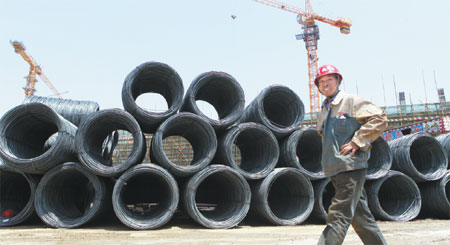
A worker walks past steel products in Rizhao, Shandong province. China's preliminary Purchasing Managers Index was 49.7 in May, according to HSBC Holdings Plc and Markit Economics. Provided to China Daily |

 37,000 US flags planted in Boston Common for Memorial Day
 The multibillion-dollar house that Jack built
 Highlights of New York Forum Africa
 Obama picks Director of OMB, new Secretary of HUD
 In photos: aftermath of Santa Barbara campus shooting
 JD.com makes US debut with $1.78b IPO
 Lucy Li, at age 11, makes US golf history
 World leaders wear gowns to collect certificates
Most Viewed
Editor's Picks
|

|


|

|

|

|
Today's Top News
Obama pledges to uphold 'sacred trust' with US veterans
7 dead in drive-by shooting in California
US cyber-scoundrelism to backfire
Republicans try to define Clinton
Checks to help ensure cybersecurity
Opinion: The pot calls the kettle black
Walters gives archives to Sarah Lawrence College
Russia, China veto draft UN resolution on Syria
US Weekly

|

|