China internationalize only when wise
Updated: 2015-02-20 08:51
By Cecily Liu(China Daily Europe)
|
||||||||


"China has gained a lot from its currency's internationalization, but such progress is also made with significant costs," Yu says.
He says China should not completely open its capital account controls, as currency stability is an essential part of having a stable economy.
One major issue for China currently is its high M2 to GDP ratio, meaning much of the country's money is concentrated in the hands of a few, and opening up capital account controls too quickly could lead to capital flight, Yu says.
"Although there are no actual figures, there is a lot of anecdotal evidence that many corrupt officials are putting their money offshore, in jurisdictions like the Virgin Islands or Cayman Islands. This could generate a very large capital outflow if adequate controls are not put in place."
Although China's central bank has previously set a target to make the renminbi partly convertible by this year and fully convertible by 2020, Yu believes the mindset of having such a target is not right.
Instead, the correct method is to segment different market players' needs, encouraging foreign direct investment flows into and out of China when there is a real economic need for such flows, but restrict speculative flows.
In the long term, Yu says the renminbi needs to be fully convertible for it to be a global reserve currency, because a reserve currency is one that can be freely traded by those who hold it, so it requires high liquidity.
And in the short term, it is still important for the Chinese central bank to use exchange rate controls to stabilize economic growth in reaction to monetary policies practiced by other international major economies, and the quantitative easing about to be implemented in Europe could be an example of this.
According to European Central Bank announcements last month, at least 1.1 trillion euros will be injected into the ailing eurozone economy, and the program is expected to start next month.
"The QE in Europe could have very negative consequences for the Chinese economy, and it is our priority to guard our economic growth against such big shocks.
"We are already in a currency war. So either we have international coordination to have no intervention by governments in our financial markets, or alternatively we will need to intervene to reduce adverse effects on our economy that other countries' monetary policies are causing," Yu says.

 Across America over the week (from Feb 13 to 19)
 Chinese in the South remembered
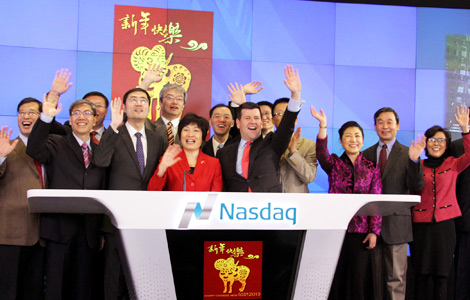 Ringing in Chinese New Year on the Nasdaq
 Spring Festival greetings from the ambassadors
 Las Vegas lights up for Lunar New Year
 Spring Festival fireworks in New York City
 Going abroad for Lunar New Year
 New York Fashion Week
Most Viewed
Editor's Picks

|

|


|
|
|

|
Today's Top News
Chinese students, faculty to study at Missouri university
Andover to deepen China ties
Chinese in the South remembered
California port chief upbeat on agreement to end dock strike
NBA China CEO sees the sport proliferate
China tilts to Kabul with US pullout
No letup seen for business travel
Chinese visitors set to celebrate New Year worldwide
US Weekly

|

|